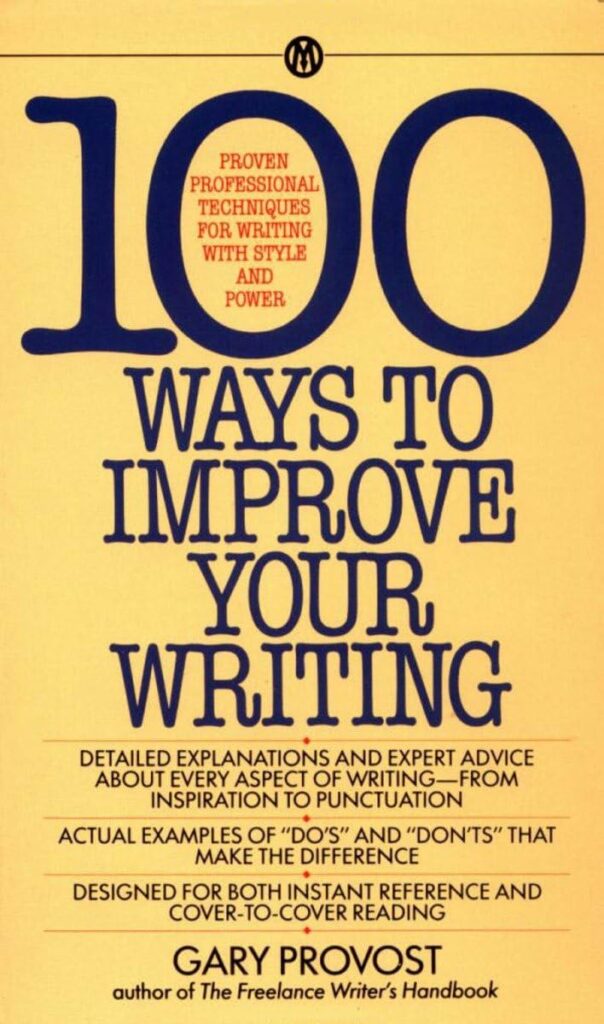
100 Ways to Improve Your Writing by Gary Provost
Summary
Gary Provost’s book is exactly what it promises: 100 practical, specific tips that sharpen clarity, precision, and readability. It’s less about inspiration and more about craft — a manual of small, cumulative improvements that make prose strong.
Key Insights
Accuracy: Always check facts. Never assume, especially with details at the edges (“the fringes”).
Routine: Set aside a place and time to write; treat writing as practice.
Clarity: Each paragraph should answer a question, and begin with a clear topic sentence. Short paragraphs give R visual rest.
Style: Vary sentence length and structure; read aloud to catch flaws.
Verbs: Use active, precise verbs. A clock stood/towered is better than was in. Avoid lazy verbs propped up by adverbs.
Nouns: Prefer specific nouns over vague descriptors. Mansion is stronger than large house.
Specificity: Details bring writing alive (a black box with silver hinges and a gold strap).
Emphasis: Place the emphatic word last in a sentence.
Positive phrasing: “The plan failed” is clearer than “The plan didn’t succeed.”
Focus on people: People are what readers care about most.
Grammar: Be precise with singulars (everyone is), pronouns (Jane and I / Jane and me), and avoid clunky parentheses.
Strengths
Incredibly practical — easy to dip into and apply immediately.
Shows how small changes (verb choice, noun precision) produce big improvements.
Encourages simplicity, clarity, and specificity, without jargon.
Weaknesses
The “list” format can feel mechanical if read cover-to-cover. Best used as a reference or workbook.
Some examples feel dated in tone, though the principles remain timeless.
Reflections
For me, the strongest lesson is his insistence on specificity. Abstract nouns and vague adjectives are empty calories; specific nouns and precise verbs are nourishment. A priest walking into a room instantly tells us more than “a man.”
Conclusion
Provost’s 100 Ways is less about lofty theory and more about sharpening the nuts and bolts of writing. It’s a practical handbook for clarity, precision, and reader engagement. If I apply even a handful of his tips, my writing becomes leaner, clearer, and far more vivid.
Book Details
Title: 100 Ways to Improve Your Writing: Proven Professional Techniques for Writing with Style and Power
Author: Gary Provost
Publication Year: 1985
Genre: Creative writing
Reference:
← Previous: Effective Writing by Turk and Kirkman
Next → Hooked by Les Edgerton