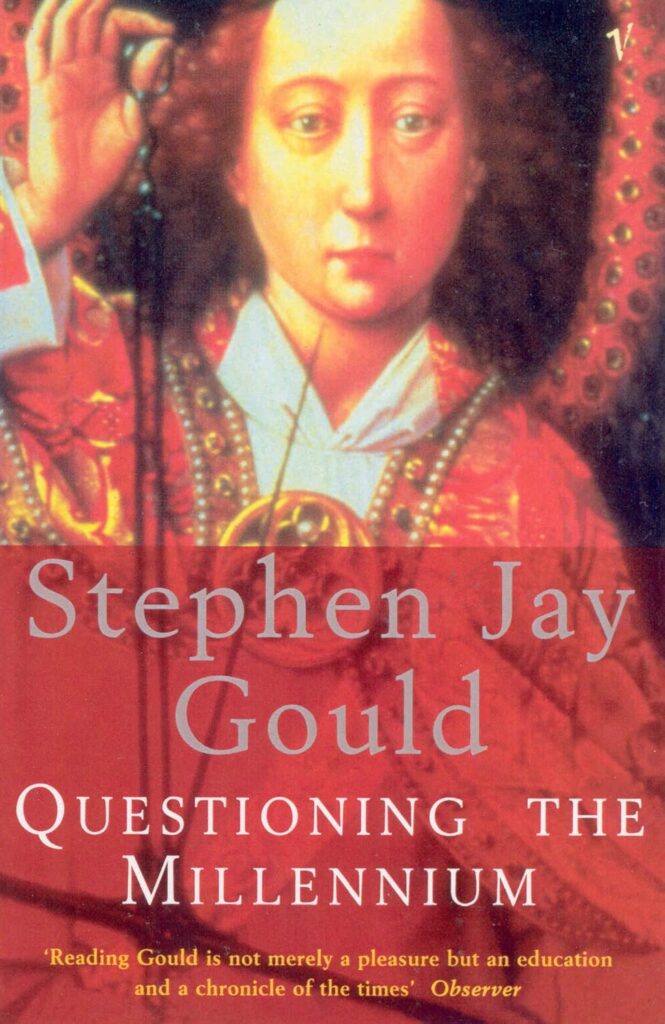
Questioning The Millennium by Stephen Jay Gould
Summary
In Questioning the Millennium, evolutionary biologist and essayist Stephen Jay Gould turns his curiosity toward a deceptively simple topic: the meaning and structure of the millennium. Published in the run-up to the year 2000, this book is a meditation on our obsession with counting, and especially counting time.
Gould investigates how Western civilisation came to use the BC/AD calendar system, tracing it back to the sixth-century monk Dionysius Exiguus (or “Dennis the Short”), who misdated the birth of Christ by four years and began counting from year 1, not zero. Gould also explores the Gregorian calendar reform, the Metonic cycle (used in calculating Easter), and the intellectual quirks of people drawn to arbitrary numerical landmarks.
This is part cultural history and part philosophical musing on the human need for structure, symbolism, and a sense of narrative in time.
Key Insights
We are obsessed with classification – Gould sees our attraction to round numbers and clean categories (like millennia) as a deep-seated human trait.
Dionysius Exiguus misdated the calendar – Christ was likely born four years before “Year 1,” making our current calendar off by several years.
There was no Year Zero – The concept of zero came from Arabic mathematics and wasn’t used by Dionysius.
BC/AD replaced AUC – Before Dionysius, years were often counted from the founding of Rome (ab urbe condita, 753 BCE).
Herod’s death is dated to 750 AUC, meaning Christ’s birth must have occurred earlier than Year 1.
James Ussher’s chronology – In 1650, Ussher dated the world’s creation to 4004 BCE. Gould critiques this as a classic idée fixe, a rigid obsession masquerading as reason.
The Jewish proverb “If not now, when?” – Gould uses this as a recurring motif to suggest that all temporal systems are artificial, so why not act in the present?
The Metonic cycle – A 19-year period after which lunar phases repeat on the same calendar day; used to calculate the date of Easter.
Calendar reform came late – The Gregorian calendar (devised by Jesuit astronomer Clavius) wasn’t adopted in England until 1752.
George Washington’s birthday – Depending on which calendar is used, it’s either 11 Feb 1731 (Julian) or 22 Feb 1732 (Gregorian).
Mayan vigesimal maths – Ancient Mayan timekeeping was based on base-20 numerals, showing how arbitrary our base-10 system really is.
Strengths
Written with Gould’s characteristic blend of wit, erudition, and digression.
Clarifies the surprisingly complex history of the calendar.
Makes the abstract (time, counting, chronology) feel deeply human.
Offers a gentle critique of millenarian hype while still respecting our symbolic needs.
Weaknesses
Occasionally meanders—more a series of connected essays than a tight narrative.
Assumes some background in religious and calendar history; casual readers may need to pause and re-read.
Some material now feels a little dated post-Y2K, though the arguments remain relevant.
Reflections
Questioning the Millennium is a charming book about a curiously irrational subject: the significance we attach to the number of the year. Gould shows that our modern calendar is a patchwork of historical accident, theological decisions, and mathematical convenience, and yet we imbue it with meaning as though it were natural law.
I particularly liked Gould’s clarity on the absence of a Year Zero, and how that detail, which most people overlook, distorts our century-mark celebrations. His exploration of the Metonic cycle, Mayan base-20 numerals, and Herod’s death adds scientific and historical heft to what could otherwise be dismissed as trivia.
At times, the book reads like a museum wander, fascinating, but digressive. Still, it’s a delight to follow Gould’s mind as he connects theology, astronomy, history, and human psychology. The millennium is now long behind us, but this remains an elegant reminder of how much of our daily structure is built on arbitrary but shared belief.
Conclusion
Questioning the Millennium is an entertaining and thoughtful stroll through the intellectual archaeology of our calendar. With the author’s typical warmth and rigour, it turns the countdown to the year 2000 into a broader meditation on how and why humans construct time. A book for curious minds, especially those who enjoy digging beneath the surface of the everyday.
Book Details
Title: Questioning The Millennium
Author: Stephen Jay Gould
Publication Year: 2010
Genre: Political Science