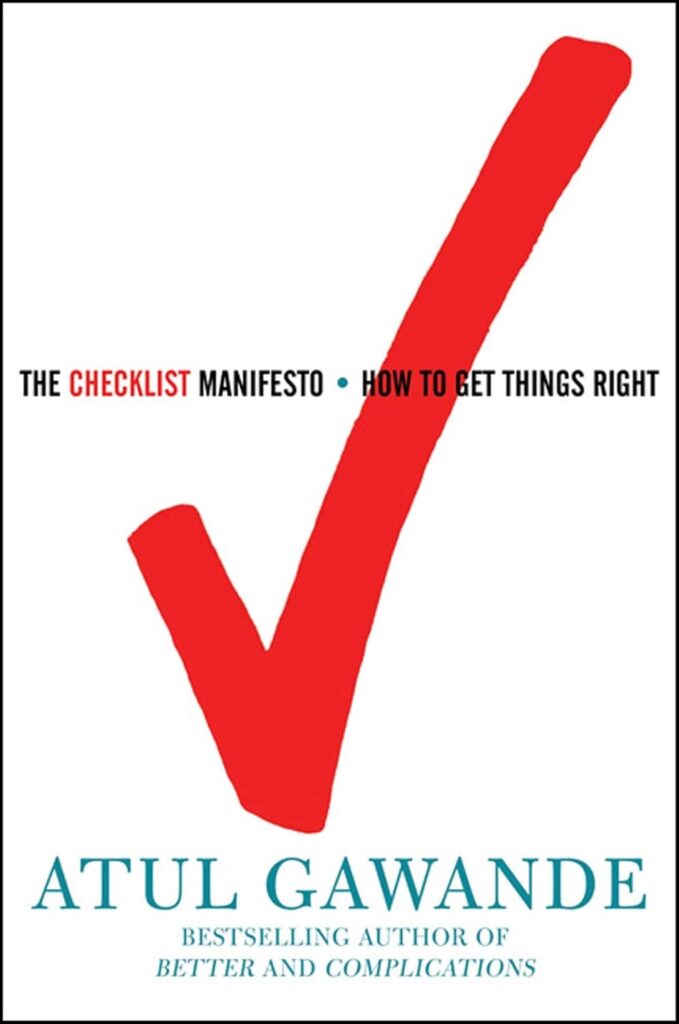
The Checklist Manifesto: How to Get Things Right by Atul Gawande
Summary
In The Checklist Manifesto, surgeon and writer Atul Gawande explores how simple checklists can improve outcomes in fields where complexity and stakes are high, such as medicine, aviation, construction, and disaster response. Drawing on a wide range of real-world examples, Gawande argues that while human expertise is essential, it is not sufficient. People forget, get distracted, or miss steps under pressure. Checklists serve not to replace intelligence, but to support it, especially in fast-moving, high-risk situations.
Key Insights
Checklists guard against distraction and memory lapses.
Even skilled professionals can forget routine steps when under stress. Checklists prevent avoidable errors by codifying essential steps.
Simple hospital checklists have saved thousands of lives.
In one example, a surgical safety checklist piloted by the WHO led to significant reductions in deaths and complications worldwide.
“Forcing functions” encourage correct behaviour.
A well-designed checklist doesn’t merely suggest — it requires key steps to be completed before proceeding.
No one can master modern complexity alone.
Today’s problems (in medicine, engineering, etc.) require teams of specialists. Checklists help coordinate these teams by setting shared protocols.
Construction uses checklists to manage complexity.
Large-scale building projects maintain “project centres” where any worker can raise issues — not through hierarchy, but through process.
Empowerment through shared goals: the Walmart Katrina response.
Instead of micromanaging, Walmart encouraged employees to “do the right thing.” By setting goals instead of issuing commands, they enabled flexible, local decision-making.
Dr. John Snow and the Broad Street cholera outbreak.
Gawande links Snow’s pioneering, checklist-like reasoning to modern public health. Snow identified the water pump as the disease source, though vindication came posthumously.
Encouraging team communication saves lives.
Before surgery, every team member introduces themselves by name and role. This “priming” makes it more likely they’ll speak up later if something goes wrong.
Checklists must be well-designed.
Bad checklists are too long, vague, or poorly timed. Good ones are short, precise, and used at critical pause points.
Pilots rely on checklists.
Aviation is a model of checklist use: pilots don’t rely on memory for critical steps, no matter how experienced they are.
A Scientific Aside: Snow, Farr, and the Vindication of Truth
One of the most compelling historical examples Gawande includes is the story of Dr. John Snow, who traced the cause of cholera to contaminated water during the 1854 Broad Street outbreak in London. Snow’s theory was at odds with the dominant “miasma” model, which held that disease was spread by bad air. Despite presenting strong evidence — including persuading authorities to remove the handle of the contaminated water pump — Snow’s theory was dismissed by the medical establishment.
Among his critics was William Farr, a respected government statistician and firm believer in the miasma theory. Yet, unlike many defenders of orthodoxy, Farr changed his mind. During a later cholera outbreak in 1866, he revisited the data and concluded that Snow had been right all along. He not only reversed his position but did so publicly — an act of scientific integrity that remains rare and admirable.
This episode directly contradicts the often-quoted remark by physicist Max Planck:
“Science advances one funeral at a time.”
While this glib line captures a sad truth about scientific resistance, it is not a law. Farr’s public reversal demonstrates that evidence can change minds, even established ones. Science does not have to wait for funerals; sometimes, it advances through courage, humility, and reason.
Planck’s quip may have been offhand, but words matter. As a cultural aphorism, it risks reinforcing fatalism, the notion that progress depends on generational turnover rather than honest thinking. Farr and those like him prove otherwise.
Strengths
Accessible and engaging writing. Gawande’s prose is clear, persuasive, and full of vivid real-life examples.
Cross-disciplinary perspective. The book draws from medicine, aviation, construction, and business — making it relevant to many fields.
Practical implications. The ideas are immediately actionable. Whether you’re a surgeon or a software engineer, the value of checklists is clear.
Weaknesses
Anecdotal bias. While the stories are compelling, the book leans heavily on narrative rather than presenting broad statistical data.
Limited discussion of failure cases. There’s less exploration of situations where checklists fail or are rejected by organisations.
Reflections
What makes The Checklist Manifesto powerful is its humility. Gawande is not advocating for rigid bureaucracy, but for intelligent simplicity. In an age where complexity is often met with more technology or more training, his reminder is profound: sometimes, a simple list is the most effective innovation of all.
Conclusion
Atul Gawande’s argument is difficult to deny: complex activities can be made safer and easier using checklists. This applies to taking off a jetliner or performing heart replacment surgery. More importantly is the concept of cross-fertilasation, of how the hard-won safety lessons and principles learnt in aviation can be applied in medicine. The same applies to other areas, for example fire safety.
Book Details
Title: The Checklist Manifesto: How to Get Things Right
Author: Atul Gawande
Publication Year: 2009
Genre: Management Skills, Leadership