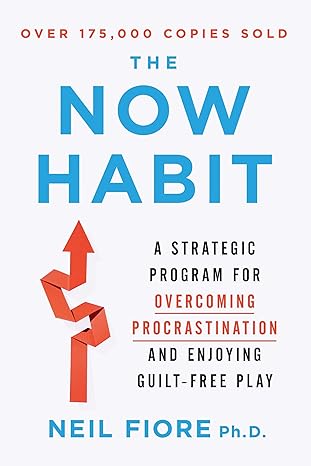
The Now Habit: A Strategic Program for Overcoming Procrastination and Enjoying Guilt-Free Play by Neil Fiore
Summary
The Now Habit by Neil Fiore is a thoughtful, insightful look at why we procrastinate and what we can do to overcome it. Unlike simplistic advice that treats procrastination as laziness or poor time management, Fiore sees it as a symptom of anxiety, fear, and internalised pressure. His central insight is that procrastination often arises not from the task itself, but from how we talk to ourselves about the task: harsh inner critics, perfectionist expectations, and a sense of powerlessness all fuel avoidance. Laziness is not the problem. The problem is negative self-talk.
Rather than fighting procrastination with guilt and self-threats, Fiore recommends a gentler and more strategic approach: emphasising choice, minimising anxiety, and linking work to immediate, tangible rewards.
Key Insights
Procrastination is a coping mechanism.
It offers temporary relief from anxiety, often triggered by fear of failure, overwhelm, or a toxic internal dialogue.
“I am not what I do.”
One of the book’s most liberating ideas is the separation of self-worth from performance. Failing at a task does not mean failing as a person.
Victim thinking reinforces procrastination.
Saying “I have to…” or “I should…” puts us in the role of a child being coerced. Replace this with: “I choose to…”, “I want to…”, “I decide to…”
Fear of failure thrives on vagueness.
Counter it by asking clear, structured questions:
- What’s the worst that could happen?
- If it did, what would I do?
- How would I mitigate?
- What are my alternatives?
Break down tasks into small, manageable parts.
Don’t ask “Can I finish?” but “When can I start?” Starting — even for five minutes — builds momentum.
The inner critic is not motivational.
Harsh self-talk triggers resistance. What we need is commitment, not compliance — and that means working from choice, not fear.
Establish a work–reward cycle.
Work for 25 minutes, then reward yourself with something immediate: a short walk, a song, a few pages of a novel. One full day a week should be completely work-free.
Create “unscheduled” time.
Schedule rewards first, then fit work around them. This reverses the usual guilt-based approach and helps reframe work as something chosen, not imposed.
State goals as choices.
“I choose to write a novel” is far more empowering than “I must write.”
Identify distractions.
Write them down and designate them as “skunk-alpha” — mental clutter that needs containment, not indulgence.
Give employees choice and control.
Fiore notes that motivation improves when people feel autonomy. Compliance leads to resistance; choice leads to ownership.
Eat the frog.
Tackle the most challenging task first each day to reduce dread and reclaim energy.
Strengths
Psychologically astute.
Fiore takes procrastination seriously as a symptom of deeper emotional and cognitive patterns, not just bad habits.
Empowering tone.
The shift from “I have to” to “I choose to” is deceptively powerful. It reframes the whole emotional experience of work.
Practical and actionable.
Techniques like the 25-minute work block, post-task rewards, and the “unschedule” are easy to adopt and surprisingly effective.
Weaknesses
Leans on affirmations.
Fiore occasionally recommends positive self-statements (e.g. “I choose to succeed”) that may feel forced or hollow to sceptical readers.
Repetition.
The core ideas could be delivered more concisely. Some points are revisited several times, which dilutes their impact.
Requires self-awareness.
Some of the strategies rely on a high degree of self-reflection and honesty, which may be challenging for readers under real stress.
Reflections
This book cuts deeper than most productivity literature. Fiore’s key insight, that procrastination is not the problem, but a symptom, helped me rethink the emotional causes of avoidance. What begins as a manual on how to stop procrastinating becomes, by the end, a treatise on self-compassion.
The message echoes others I’ve encountered recently: success doesn’t come from self-bullying or shortcuts. It comes from ontrolling inner dialogue, and taking steady, well-chosen action. In that respect, The Now Habit is not just about productivity. It’s about becoming a healthier, more grounded person.
The problem is, how? We shouldn’t think negative thoughts about ourselves. No one disagrees. But how do you stop it? How do you take control of a thought? But his concept of “self-bullying” is one I hadn’t encountered before, and I am better for knowing it.
Conclusion
The Now Habit is a compassionate, psychologically rich guide to overcoming procrastination. It challenges the lie that pressure and guilt are the best motivators, replacing them with something more sustainable: choice, confidence, and structure.
Perhaps its most important contribution is the unspoken but powerful concept of self-bullying — the idea that many of us try to motivate ourselves by threat, criticism, or internal coercion. Fiore shows that this inner aggression only increases anxiety and avoidance. In contrast, his approach is rooted in self-respect, autonomy, and trust in one’s capacity to act.
For anyone stuck in cycles of avoidance, this book may be of some benefit.
Book Details
Title: The Now Habit: A Strategic Program for Overcoming Procrastination and Enjoying Guilt-Free Play
Author: Neil Fiore
Publication Year: 2007
Genre: Management Skills, Creativity