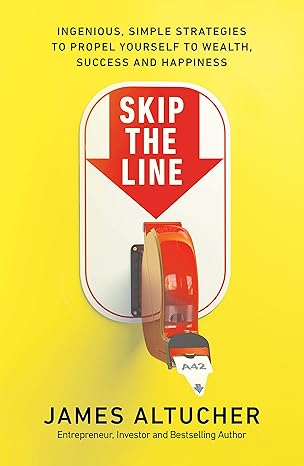
Skip the Line: Ingenious, Simple Strategies to Propel Yourself to Wealth, Success and Happiness by James Altucher
Summary
In Skip the Line, James Altucher argues that success doesn’t require permission or following traditional paths. The book is a manifesto and a method. It champions experimentation over perfection, daily improvement over lifetime mastery, and self-agency over gatekeeping. Good stuff. Altucher encourages readers to leap over outdated systems, for example, the “10,000 hours” myth, and take bold steps, skipping the line entirely.
Key Insights
Mindset
- “You can’t do that” means it’s exactly what you should explore.
That’s their limitation, not yours. - Fear of uncertainty is more stressful than bad news.
Uncertainty triggers stress and isolation, releasing neurochemicals like tachykinin. We’re hard-wired to hate ambiguity. - Control reduces stress—even if it’s just the illusion of control.
- Agency is everything.
Don’t wait for permission. You can skip the line.
The Power of Experiments
- Replace the 10,000 hours rule with 10,000 experiments.
Don’t just think—do. Every attempt is a test. - A good experiment should be:
- Easy to set up
- Cheap
- Quick
- Likely to teach you something—whether or not it succeeds
- Every experiment has two outcomes:
- I succeed
- I learn
- Stay emotionally detached: Don’t take failure personally.
1% Daily Growth
- The 1% Rule: Improve just a little, every day.
- What is 1% of being a better writer?
- End each day with the question: What was my 1%?
- Daily micro-habits:
- 500 words/day = 50,000 words in 100 days
- One joke/day (like Seinfeld)
- 10 ideas/day (Altucher’s core habit)
- Micro-skills matter. Writing, for example, breaks into:
- Research
- Organisation
- Self-discipline
- Clarity
- Brevity
- Editing
- Citations
- Layout
- Fact-checking
- Cover design
- Each skill can be tested with a mini-experiment.
Idea Generation
- “Idea Sex”: Mash together random ideas for new insights.
- 10 ideas to…:
- Solve a problem
- Improve something
- Discover a business idea
- Design web pages
- Test writing topics
- Idea tools:
- Subtraction: What’s stopping this? Remove it.
- Multiplication: Apply a working idea to new domains.
- Division: Shrink a big idea into a more focused version.
Collaboration & Teaching
- Teach what you want to learn.
Pretend to explain it to a full classroom. - Mentors matter: Learn from those ahead of you.
- Collaboration and community are force multipliers.
Go further, faster, with others.
Strategy & Execution
- Execution starts with the customer, not the product.
- Who is it for?
- What problem does it solve?
- Why would they pay?
- Test the market fast:
- Run a Facebook ad to a blank page and count clicks.
- Build 10 landing pages and see which gets the most hits.
- Aim for a low “conspiracy number”:
“How many things need to go right for this to succeed?” - The only real failure is not to try.
Life Principles
- Focus on progress, not perfection.
- Notice fear—it signals opportunity.
- Diversify income.
- Don’t rely on the news or others for self-esteem.
- Don’t feel sorry for yourself.
- Always ask: What’s my daily experiment?
Strengths
Hugely motivational without being shallow
Combines life advice with a startup mindset
Encourages playfulness, curiosity, and experimentation
Weaknesses
Some advice may feel too casual for readers seeking structure
Success stories are anecdotal rather than systematic
High-energy tone may not appeal to more analytical readers
Reflections
This book complements productivity classics like The War of Art or Atomic Habits but adds an entrepreneurial twist. It’s a call to stop over-planning and start testing. If you’ve been sitting on a business idea, blog, book, or career change—this book says: Run the experiment today.
Come to think of it, James, I suspect you’ll never read this review. But if you do, you once promised that if anyone signed up for your Udemy course on writing and went on to publish a book, you would buy their book and review it. I took you at your word. I joined the course, paid my money, and a year later, I published my book (see next book) and sent you a copy. Did I hear from you? Not a squeak. I assumed you might be asleep, busy, or out visiting, so I tried again a few weeks later. Still nothing. I’m not about to blubber, but I was disappointed.
Conclusion
Skip the Line is part toolkit, part pep talk, and entirely actionable. Altucher’s mantra is clear: think less, do more, test everything.
If you commit to 1% daily improvement and a daily experiment, the line isn’t just skippable; it disappears entirely.
Book Details
Title: Skip the Line: Ingenious, Simple Strategies to Propel Yourself to Wealth, Success and Happiness
Author: James Altucher
Publication Year: 2021
Genre: Entrepeneurship