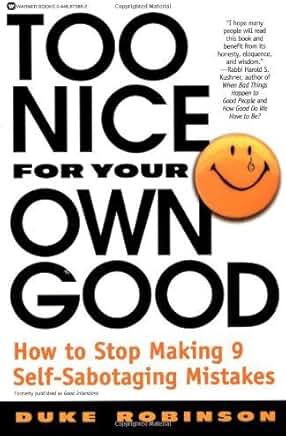
Too Nice For Your Own Good by
Duke Robinson
Summary
Duke Robinson’s Too Nice for Your Own Good explores why so many people self-sabotage by being overly nice. Robinson identifies nine core mistakes that people make in the name of kindness, and explains how to live more truthfully and assertively, without becoming selfish or cruel.
Key Insights
- Many of us are raised to be “nice,” polite, and pleasing — but this can lead us to take on too much, aim for perfection, and live for others’ approval.
- Perfectionism is harmful and wasteful. We should strive for excellence, not flawlessness.
- There’s a difference between serving others and pleasing them. Love means acceptance, not conditional approval.
- Assertiveness is respectful, honest communication. It involves being specific, direct, and positive — not manipulative, negative, or moralistic.
- Anger should be acknowledged, not hidden or misdirected. Use a five-question reflection to process it: Why am I angry? How bad is it? How should I express it? What do I want? Is it justified?
- Use the “two-day rule” to create distance before responding. Confrontation should be descriptive, not accusatory.
- It’s better to be alone than in a disrespectful relationship.
- Forgiveness benefits the forgiver. Grudges harm us more than the offender.
- We cannot always reason with irrational attacks. Understand the deeper reasons people lash out — insecurity, frustration, mental illness, or power plays.
- Truth should be spoken with love, humility, and care. Lying to protect feelings is ultimately unkind.
- Giving advice is usually a mistake. It diminishes the other person and robs them of growth. Offer support, information, and alternatives instead.
- Childhood rejection or shame can linger into adulthood. But worthiness is not earned — it’s inherent.
Strengths
- Compassionate and encouraging tone.
- Highly practical — offers clear frameworks and phrases for real situations.
- Balances firmness with kindness.
- Emphasizes dignity, truth, and mutual respect.
Weaknesses
- Could be repetitive for readers familiar with assertiveness literature.
- Some examples may feel dated or overly American to a global audience.
Reflections
Robinson’s message is that self-worth is not conditional and that real kindness includes honesty and boundaries. His insistence on telling the truth “with love” is powerful. The book is wise counsel, reminding us that dignity and compassion go hand in hand.
Conclusion
A humane and empowering guide for anyone who feels exhausted by being too nice. Duke Robinson offers not just permission, but a roadmap, to live more authentically.
Book Details
Title: Too Nice for Your Own Good: How to Stop Making 9 Self-Sabotaging Mistakes
Author: Duke Robinson
Publication Year: 2000
Genre: The Self, Ego and Personality
Reference: Calandra Vol. 4 p. 1