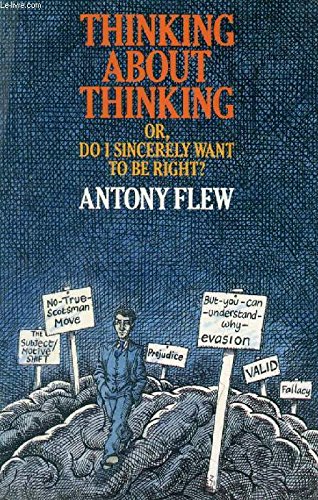
Thinking About Thinking by Antony Flew
Summary
In Thinking About Thinking, Antony Flew, philosopher, logician, and noted atheist, offers a lucid guide to the art of reasoning well. The book explores logic as a formal discipline and intellectual honesty, including fallacy-spotting and the habits of clear thought. Drawing on examples from philosophy and history, Flew examines how we can critically evaluate our thoughts, how we perceive them, and why we hold them.
At its heart, the book is a call for intellectual integrity, echoing Socrates’ imperative to “follow the argument wherever it leads.” Flew insists that clarity is a moral obligation in argumentation: we owe it to ourselves and others to be coherent and open to correction.
Key Insights
The Nature of Propositions and Arguments:
Flew distinguishes between propositions (statements that can be true or false) and arguments (logical relations between propositions). He reminds us never to confuse truth with validity.
The Classical Fallacies:
The book is rich with classic fallacies: the fallacy of the undistributed middle (e.g., all students carry backpacks; my father does too, therefore he’s a student), affirming the consequent, denying the antecedent, and more.
Popper and Falsifiability:
Flew draws heavily on Karl Popper, particularly his insistence that scientific theories must be falsifiable. “All swans are white” cannot be proven by white swans, but can be disproven by one black swan.
Pascal’s Wager and the Nature of ‘Reason’:
Flew critiques arguments like Pascal’s Wager, noting the ambiguity of the word “reason,” which might mean cause, motive, or justification. He warns us not to conflate a motive for belief with justification for that belief.
Sincerity and Clarity:
One of the book’s deepest themes is the moral duty of clarity. Unsound arguments don’t just fail—they discredit the cause they are meant to serve. Obscure language is often a sign of intellectual bad faith.
Fallacies in Language:
Flew highlights the danger of equivocation—using a word in multiple senses without clarifying. He also explains the “No True Scotsman” fallacy: the dishonest redefinition of terms to defend a shaky argument.
Philosophical Humility:
From Darwin (who recorded every objection to his theory) to St Augustine (“I cannot define time, but I know what it is”), Flew advocates for a stance of epistemic humility and self-scrutiny.
Clarifying Terms and Origins
Flew traces the historical and etymological roots of words to dispel conceptual confusion:
- Duns Scotus – A 14th-century philosopher whose followers were later mocked as “Duns men,” giving rise to the word dunce.
- Hijack – Originally meant the theft of stolen goods from other thieves.
- Piracy – Refers to the seizure of lawfully held goods.
- Aircraft terrorists – Flew argues they are guilty of piracy, not hijacking, because they seize legally owned planes, not stolen ones.
These clarifications serve Flew’s broader aim: to insist that our concepts be as precise and honest as our arguments.
Strengths
Crisp, Clear Prose:
Flew writes with clarity and wit, avoiding the obfuscation so common in philosophical writing.
Breadth of Examples:
The book covers a wide range of logical fallacies and philosophical pitfalls, illustrated with memorable examples and aphorisms.
Moral Emphasis:
Flew elevates good thinking to a matter of sincerity and moral responsibility, not just intellectual rigor.
Weaknesses
Dated References:
A few of the examples and references (e.g. hijacking vs piracy) feel historically specific and may require context for modern readers.
Sparse Structure:
The book is more a collection of reflections than a structured course in logic. Some readers may find it lacking in systematic development.
Reflections
Reading Thinking About Thinking feels like being gently but persistently guided by a wise mentor who refuses to let you off the hook intellectually. Flew’s insistence on clarity in thought resonates deeply. His reminders, such as Bacon’s emphasis on the negative force of counterexamples, or Darwin’s habit of recording inconvenient objections, should be internalised by anyone who aims to reason well and live truthfully.
Conclusion
Thinking About Thinking is a short but weighty book. It is an essential primer for those seeking to think more clearly and argue more honestly. It deserves a place on the shelf of every writer, teacher, student, or citizen who still believes that truth matters and that it can be found, if we sincerely want to be right.
Book Details
Title: Thinking About Thinking or How Do I Sincerely Want to be Right?
Author: Antony Flew
Publication Year: 1989
Genre: Philosophy
Reference: Calandra Vol. 4 p. 90
← Previous: Black Box Thinking by Matthew Syed