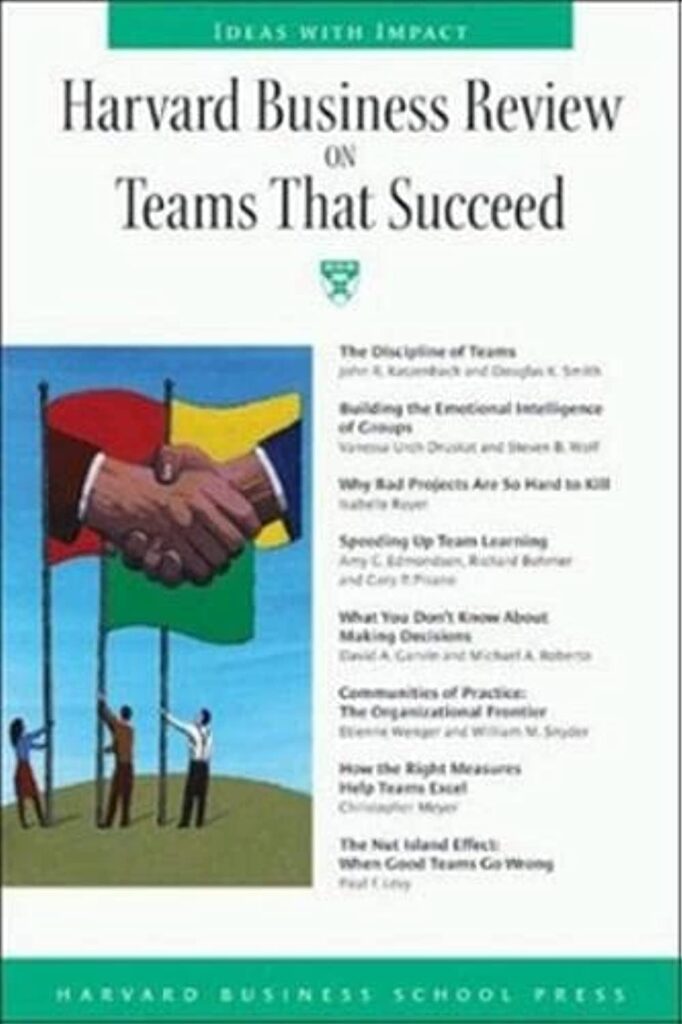
Teams That Succeed by Harvard Business Review
Summary
This Harvard Business Review collection examines what truly makes a team succeed. It emphasises that a “team” is not just a label and success depends on shared purpose, clear performance goals, complementary skills, mutual accountability, and effective leadership. The book provides practical guidance on forming, managing, and evaluating teams, with an emphasis on trust and evidence-based decision-making.
Key Insights
A team is defined by shared purpose, performance goals, complementary skills, and mutual accountability — not by simply calling it a team.
Optimal team size is around 12 members.
Complementary skills are more important than identical expertise; teams can build missing skills as they work.
Team-building essentials: establish urgency, set clear performance standards, select members for skill, make first impressions count, define acceptable behaviours, give feedback, spend time together, and provide recognition.
Leaders set the tone; their behaviour becomes the norm for the team.
Mutual accountability requires members to trust their fate to others, which can be uncomfortable.
Psychological safety is crucial: never demean team members, protect them from attack, and actively solicit input from quieter members.
Decision-making is a process, not an event; distinguish between advocacy (arguing for a position) and inquiry (collectively seeking the best answer).
Use an “exit champion” — a respected person authorised to cancel a project when evidence shows it should stop.
Test beliefs against facts as projects progress; facts are better than dreams.
Post-mission analysis should avoid blame and fault, focusing on learning instead.
Reward structures should support team performance, not just individual achievement.
Strengths
Clear, actionable advice drawn from practical experience.
Stresses both the human and structural aspects of teamwork.
Balances inspiration (belief, vision) with hard evidence and data-driven decision-making.
Addresses difficult realities, such as when to end a project.
Weaknesses
Some points are repeated in different wording, which can dilute impact.
Optimal team size (12) is presented without much discussion of exceptions.
The role of organisational culture could have been explored in more depth.
Reflections
This book reminds me that assembling a great team is as much about diversity of skills and perspectives as it is about shared goals. The “exit champion” idea is especially valuable because too many projects limp on due to a lack of permission to stop them. I also appreciate the emphasis on psychological safety, which aligns with modern research on high-performing teams.
Conclusion
Teams That Succeed provides a rich set of principles for building effective teams, blending leadership wisdom with operational discipline. It’s particularly useful for managers, project leaders, and anyone responsible for group performance. The lessons on trust, mutual accountability, and evidence-based decision-making make it a worthy addition to any leader’s library.
Book Details
Title: Teams That Succeed
Author: Harvard Business Review
Publication Year: 2005
Genre: Professional Development
Reference: Skylark Vol. 4, p. 49
← Previous: Eat The Frog By Brian Tracy
Next → Willpower by Roy Baumeister