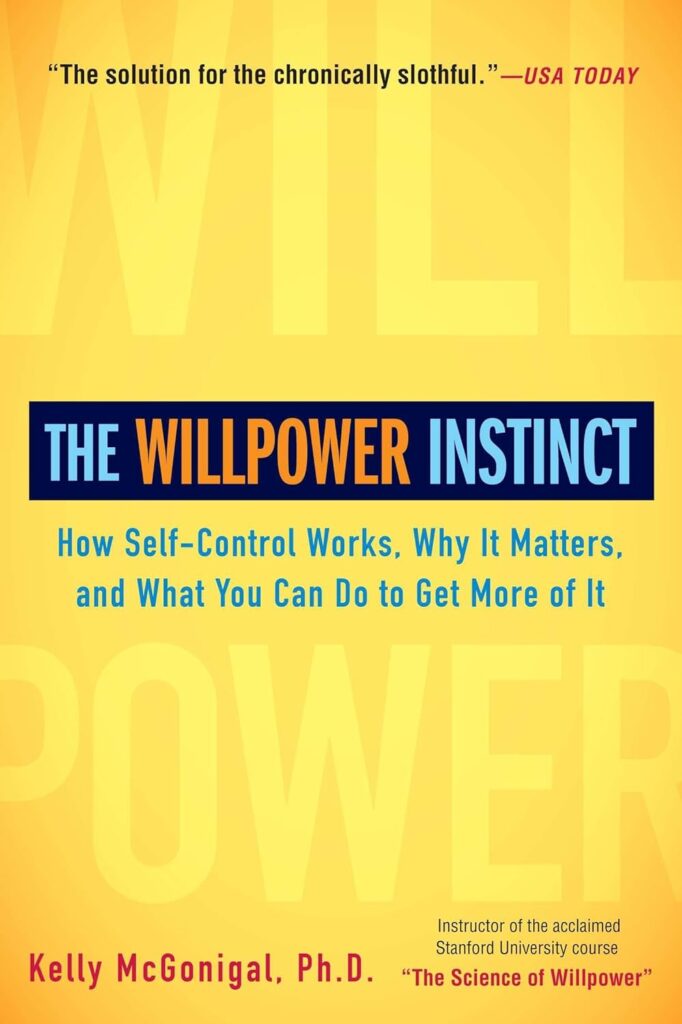
Willpower Instinct by Kelly McGonigal
Summary
McGonigal explores the science of self-control, showing how willpower works, why it fails, and how it can be strengthened. She draws on psychology, neuroscience, and behavioural economics to provide practical tools for resisting temptation, staying focused, and acting in line with long-term goals. The book’s recurring message is that willpower is a trainable skill, best developed by self-awareness and intentional habits.
Key Insights
Willpower can be trained, like a muscle.
Dopamine drives action, not just pleasure; its promise of reward is exploited in marketing, but can also be harnessed to make boring tasks appealing.
Use the 10-minute rule: wait 10 minutes before giving in to temptation or commit to doing an unwelcome task for 10 minutes.
We falsely expect our future selves to make better decisions; instead, what we do today we are likely to do tomorrow.
Stress increases susceptibility to temptation; use healthy outlets like exercise, music, or creativity to counteract it.
Self-compassion improves self-control and breaks the “what the hell” cycle, while self-criticism undermines it.
Delay discounting: we undervalue long-term goals compared to immediate gratification; visualising and connecting with our future selves increases wise decision-making.
Rule-breaking is contagious; model yourself on those with excellent self-control and use social proof to reinforce positive behaviours.
Don’t suppress urges—acknowledge and label them; temptation will pass.
Never use good behaviour as an excuse for bad.
Strengths
Combines scientific research with actionable techniques.
Practical exercises (e.g., 10-minute rule, future-self visualisation) are simple and memorable.
Emphasis on self-compassion is refreshing compared to more punitive self-help approaches.
Weaknesses
Some examples are familiar from other self-help literature.
The chapter structure occasionally repeats similar points with different case studies.
Reflections
McGonigal’s framework for understanding and training willpower has applications far beyond resisting obvious vices. Her strategies are just as relevant for productivity, professional conduct, and long-term personal growth.
Willpower became a publishing fad for a while, with a slew of books on the subject. Still, our understanding of its importance did grow. And for my money, McGonigal’s contribution is one of the best.
The “ten-minute rule” works particularly well. When you feel tempted to eat or drink something you shouldn’t, tell yourself: I’ll have it in ten minutes. Often, that short delay is enough to see the urge fade away.
Conclusion
Willpower is not fixed. It can be strengthened. Take captive every thought. Act according to your values.
Book Details
Title: The Willpower Instinct: How Self-Control Works, Why It Matters, And What You Can Do To Get More Of It
Author: Kelly McGonigal
Publication Year: 2013
Genre: Assertiveness
Reference: Calandra Vol. 2, p. 18
← Previous: What The Dog Saw by Malcolm Gladwell