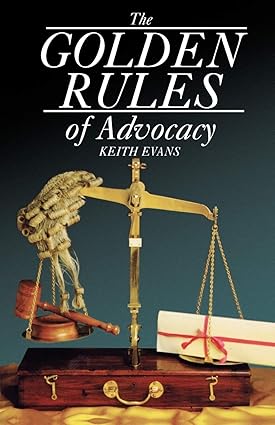
The Golden Rules of Advocacy by Keith Evans
Summary
Keith Evans distils the craft of courtroom persuasion into a set of practical rules. His focus is not on the pursuit of abstract truth during a trial, but on the art of convincing the fact-finder — usually a judge or jury, through preparation, presentation, and persuasion. Drawing on the traditions of common law advocacy, Evans covers everything from body language to questioning technique, always stressing sincerity, clarity, and respect.
Key Insights
Purpose of trial: In common law, discovery is over before trial — the goal is persuasion, not fact-finding.
Persuasion is visual: Seeing outweighs hearing; roughly 60% of persuasion is body language, 30% tone of voice.
Professional appearance: Dress smartly, avoid undue friendliness with opponents (but remain courteous), and never joke except with the jury.
Absolute sincerity: Avoid unintentional cues, maintain eye contact, and present with complete honesty — manipulation undermines credibility.
Courtroom materials: Number all pages, highlight only relevant sections, get bundles approved.
Language and tone:
- Avoid legalese; use plain language.
- Say “I trust” instead of “I believe” and “I hope” instead of “I feel.”
- Avoid pompous phrases like “I put it to you that…” — instead, use “Isn’t this what happened?”
Efficiency: Keep arguments brief, direct, and respectful of everyone’s time. Warn if a section may be dull.
Storytelling: Frame the case as a clear narrative without unnecessary detail.
Relationship with the judge and jury:
- Avoid confrontation; invite and suggest rather than demand.
- Prepare them for weaknesses in your case — better they hear it from you.
- Aim to become “one” with the jury.
Questioning witnesses:
- Design questions to elicit the desired answer.
- Keep them short (10–14 words).
- Avoid multi-part or yes/no demands.
- Always ask how the witness knows something.
- To undermine credibility, seek “I don’t know” answers.
- Never ask questions where you don’t already know the answer.
Strengths
Packed with practical, immediately usable advice.
Balances tactical tips with timeless advocacy principles.
Emphasises sincerity and respect, which strengthen credibility.
Weaknesses
Written primarily for courtroom settings; some advice may be less relevant in other advocacy contexts.
Body language percentages may be oversimplified — the relative importance can vary.
Reflections
Evans’ rules show that effective advocacy is as much about how you conduct yourself as about the facts you present. His advice to acknowledge weaknesses before the opposition raises them is particularly valuable for building trust with the fact-finder. The book bridges the gap between theory and practice, grounding lofty ideals in tangible courtroom behaviour.
Reading this book reminded me of a story in Commander “Sharkey” Ward’s account of the Sea Harriers in the Falklands. One of Ward’s men had been charged with shoplifting about ten months before the conflict. Ward asked if he was guilty, and the man explained that his wife had been admitted to hospital with cancer, he had his two young children with him, and had forgotten to pay.
Ward reflected that the man had served with him for years without a hint of dishonesty and told him he needed a good solicitor. When the man said he couldn’t afford one, Ward replied that it was the squadron’s concern, not his. He arranged for a solicitor, who in turn briefed a QC, and the man was duly acquitted. What struck Ward most was the QC’s professionalism. Even as a military man accustomed to the highest standards, he realised he still had much to learn by watching a top advocate at work. His men noticed too. Ten months later, when the Falklands war came, they repaid Ward in full, working twenty hours a day to keep the Sea Harriers in the air.
Conclusion
Evans reminds us that while the goal in advocacy is to win the case, lasting success comes from mastering the process. Preparation, sincerity, and respect for the court are not incidental — they are the process. Focus on these consistently, and outcomes will follow.
Book Details
Title: The Golden Rules of Advocacy
Author: Keith Evans
Publication Year: 2002
Genre: Skylark Vol. 3, p. 52
Reference: Law
← Previous: Producing Ideas by James Young