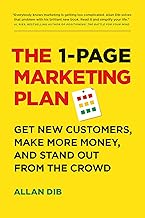
The 1-Page Marketing Plan by Allan Dib
Summary
Dib stresses that professionals plan ahead rather than improvise, and success demands a deliberate marketing strategy. The book expands on the Pareto principle (80:20) with the 64:4 rule, urging readers to focus time and money on the activities that deliver the greatest returns. Marketing is the process of making people know, like, trust, and buy from you; without it, no business survives.
He insists that a clear niche is essential to avoid competing solely on price and to tailor messages that address specific customer problems. Creating customer avatars, understanding their pains and desires, and crafting targeted, single-purpose messages form the backbone of his approach. Ads should invite interest, not attempt an immediate sale, and always be customer-focused and problem-solving.
Businesses must define their USP, avoid vague claims like “quality and service,” and understand the emotional results customers are truly buying, such as peace of mind, status, or belonging. He advocates for measuring ROI, using ethical tactics such as free downloads to capture leads, nurturing those leads with value, and never relying solely on “word of mouth.” The ultimate goal is to become an outstanding marketer who happens to own a business.
Key Insights
Without marketing, your business will fail because no one knows you exist.
Narrow your target market to a specific niche to become a specialist.
Customers buy emotional results (peace of mind, status), not the product itself.
Always have a single, clear goal for each marketing activity or ad.
“Hope” is not a strategy — measure ROI and take deliberate action.
Ethical bribes and free resources can help generate and nurture leads.
Marketing should be customer-focused and solve real problems.
Turn setbacks into opportunities by rethinking approach and targeting.
You must be a great marketer who owns a business, not the other way around.
Strengths
Extremely practical and action-oriented.
Encourages measurable, specific marketing rather than vague promotion.
Provides concrete tools such as customer avatars and elevator pitches.
Strong emphasis on customer psychology and emotional drivers.
Weaknesses
Some advice may feel basic to experienced marketers.
Heavy reliance on the niche concept may limit applicability for certain broad-market businesses.
Reflections
I find Dib’s relentless focus on deliberate, planned marketing resonates with my own experience, especially the idea that without a niche, you end up competing only on price. His concept of “hopeium” as a dangerous mindset rang uncomfortably true, as I have sometimes relied on hope instead of structured action. The book is a reminder that marketing isn’t just an add-on to a business; it is the business.
My first business failed miserably, and looking back, hopeium was my downfall. Well, maybe that overstates it, but still, hopeium is to be avoided.
Conclusion
The 1-Page Marketing Plan distils marketing into an actionable, focused process. Dib makes it clear that success is not about luck but about defining a market, understanding it, and delivering value in a compelling way. It’s a manual for turning marketing from an afterthought into the engine that drives a business.
Book Details
Title: The 1-Page Marketing Plan: Get New Customers, Make More Money, And Stand out From The Crowd
Author: Allan Dib
Publication Year: 2018
Genre: Management Skills
Reference: APA-01 p. 1
← Previous: Rip It Up by Richard Wiseman