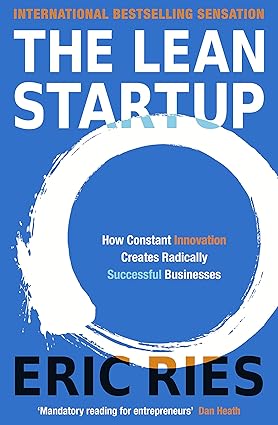
The Lean Start-up by Eric Reis
Summary
Eric Ries’s The Lean Startup challenges the traditional approach to business building by emphasising rapid experimentation, customer feedback, and learning over elaborate planning and blind perseverance. His central argument is that a start-up is not a smaller version of a large company, but it is an organisation in search of a sustainable business model. Success comes from discovering, as quickly as possible, what customers will actually pay for, and adjusting accordingly. Ries rejects the idea that hard work alone guarantees success, stressing that building the wrong thing perfectly is still failure.
Key Insights
Start with the customer — The key questions are “Who is my customer?” and “What problem am I solving for them?”
Build the right thing, not just anything — The question is not “Can we build it?” but “Should we build it?”
Value is defined by the customer — Quality is not what I think it is, but what the customer perceives as valuable.
Minimum Viable Product (MVP) — Create the simplest version that allows you to learn quickly from real users.
Validated learning — Test assumptions systematically rather than relying on intuition or vanity metrics.
The myth of perseverance — Tenacity is valuable, but only if directed toward solving the right problems.
Failure as feedback — If I cannot fail, I cannot learn; failure should lead to actionable insight.
Avoid building on assumptions — Detailed plans are worthless if they rest on untested guesses.
The Five Whys — Dig into root causes rather than assigning blame.
Avoid “achieving failure” — Successfully executing a flawed plan is still failure.
Imitate essentials, not appearances — Copying Steve Jobs’s black turtleneck won’t make me Steve Jobs.
Strengths
Offers a clear, actionable framework for turning ideas into tested, market-ready products.
Challenges romanticised notions of entrepreneurship by focusing on evidence and iteration.
Practical tools like MVPs, validated learning, and The Five Whys can be applied immediately.
Weaknesses
The Lean Startup model is sometimes over-applied to contexts where customer feedback is harder to obtain or irrelevant (e.g., highly regulated or long-cycle industries).
The book repeats certain points and anecdotes, which can feel drawn out.
Reflections
This book hit uncomfortably close to home: I recognised in myself the tendency to make detailed plans based on untested assumptions and to persevere with products no one had asked for. The emphasis on validated learning and customer-defined value is a timely reminder that my own excitement about an idea doesn’t make it a viable business. Ries’s concept of the MVP, launching quickly to learn, rather than to impress, is one I wish I had applied in past projects.
Conclusion
The Lean Startup is essential reading for anyone launching a new product or business. Its principles, to test, learn and adapt, provide a disciplined alternative to building in the dark. The lesson is simple but hard to live by: success is not about working harder, but about learning faster.
Book Details
Title: The Lean Startup: How Constant Innovation Creates Radically Successful Businesses
Author: Eric Reis
Publication Year: 2011
Genre: Leadership
Reference: Skylark Vol. 5 p. 74
← Previous: Royal Navy Officers’ Handbook