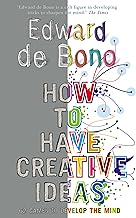
How To Have Creative Ideas by Edward de Bono
Summary
Edward de Bono demonstrates that creativity is not a talent but a learnable skill that improves with deliberate practice. This book outlines 62 practical exercises, many involving the use of random words to break habitual thought patterns and stimulate new ideas. Exercises range from object analysis to problem-solving games, all designed to push thinking beyond the obvious.
Key Insights
Creativity is a skill that requires active practice — observing creativity is not enough.
“Random input” method: start with a focus, generate a random word, then look for concepts and values linked to both.
Combining unrelated elements can trigger ideas (e.g., tree-recognition app, tackling obesity with “beermat” as stimulus).
Variations include:
- Double effect: two problems plus one random word.
- Odd man out: pick four random words and identify which is different, and why.
- Grouping: six random words into two groups, explaining the connection.
- Pairing: match words from two lists to spark new links.
- What connects: find a link between five random words.
- Improvement: use a second random word to enhance the first.
- Value ranking: order words by a chosen measure (price, danger, happiness).
- Bridge: link first and fifth words using the middle three as connectors.
- Storyline: craft a story from a word list.
- Constraints thinking: explore what can’t be done (e.g., catch a wasp with a lasso).
- Scene creation: two random words to set a scene (e.g., for a murder).
- Needs analysis: generate random words and ask how they could meet your needs.
Analysing nouns:
- Concept: what it represents (e.g., neon light = illumination, clarity).
- Value: benefits it brings (e.g., safety, direction).
- Function: its basic use (e.g., provides light).
Simplification: always look for ways to make something simpler.
Devalue: explore how to reduce an object’s value (e.g., blunt a needle).
Automation: apply automation ideas to random items.
“Watching others work” analogy: going to the gym and watching won’t make you fit — practice is essential.
Triangle: create a triangle from three of five words.
Attractiveness: find appealing qualities in random items.
Poetry: make a sentence starting and ending with random words, using rhyme to connect.
Task application: use five random words to explore ways they could help complete a task.
Strengths
Highly practical with clear, repeatable exercises.
Encourages breaking mental ruts by forcing unusual connections.
Exercises scale well for individual or group creativity work.
Weaknesses
Heavy reliance on random word generation may feel forced for some.
Limited guidance on evaluating or implementing ideas after generation.
Reflections
I have come across people who are quite dismissive of de Bono. It is not a view that I share. As far as I know, he was beating the drum that thinking is a learnable skill decades before many of the more popular writers were born. He was an early advocate of using random word associations to generate ideas; I don’t know if he invented it, but certainly he was writing about 40 years ago.
One thing that has always stuck in my mind about de Bono’s work is that he coined the term “Po”. It means “provocation”, that is, a provocation to think. It allows you to make an outlandish claim without needing to justify it. Once you have your provocation, you then see where that takes you.
I have developed my version. It is based on a book by “Sharky” Ward about his time commanding a Sea Harrier squadron. They wanted to find out whether the Harries could land on the carrier at night. Whilst the carrier was cruising a few miles from shore at night, Ward was ordered to take off, and once airborne, he opened sealed orders: he was to simulate an emergency landing at night on the carrier. He speaks into his radio: “For exercise, mayday, mayday, mayday…” I use the expression “For exercise, I have been sacked from my job, what do I do?” Or, more cheerily: “For exercise, I have inherited a shop on Harborne High Street. Now what do I do?”
Conclusion
The exercises remind me that creativity flourishes under structured randomness. It’s often the imposed absurdity that triggers lateral insights. The “devalue” exercise could also be helpful in business strategy (spotting vulnerabilities in a product or service). I like the bridge and needs-analysis methods for tackling tricky problems. As a compatriot of de Bono (we are both Maltese), I have always had a soft spot for him. Malta doesn’t have many famous sons, so we take pride in their achievements.
Book Details
Title: How to Have Creative Ideas: 62 exercises to develop the mind
Author: Edward de Bono
Publication Year: 2007
Genre: Creativity
Reference: