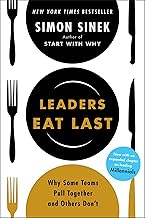
Leaders Eat Last by Simon Sinek
Summary
Simon Sinek explores how great leaders create environments where employees are inspired to give their best. Sinek argues that leaders who prioritise their people over short-term gains win the loyalty and trust of their staff, which results in better productivity and commercial success. The key to long-term success lies in treating one’s staff well. By eliminating fear and by empowering staff, leaders can achieve sustained success rather than short-term wins.
These are thoughts that have been expressed many times before. The ancients knew it. Alfred the Great wrote about it. A thousand business gurus have echoed it. What is astonishing is that these messages keep having to be repeated.
Key Insights
Trust is earned by trusting first.
Leadership’s primary goal is to remove fear from the workplace.
Cohesion is the true strength of any organisation.
Recruit for character rather than qualifications.
Employment is a long-term responsibility, akin to adopting a child.
Lack of control harms health and motivation — give employees autonomy.
Recognition (e.g., simply saying thank you) strengthens loyalty.
Dopamine fuels goal completion; goals must be tangible.
Oxytocin, released through kindness and trust, improves health and longevity.
Cortisol from stress weakens the immune system and increases selfishness.
In crises, shared sacrifice boosts morale (e.g., shared unpaid leave instead of redundancies).
People want to be led, not managed.
Abstracting others (removing human connection) makes it easier to harm them.
Do what’s right, not just what’s legal.
Organisational design matters — smaller units foster trust (e.g., Gore’s 150-person cap).
Salaries and bonuses don’t buy loyalty — respect does.
Empower people to act with intent rather than blindly seek permission.
Train people to think, not merely to comply.
Responsibility means doing what is right; obedience means doing what you’re told.
Short-term directive leadership underperforms long-term empowering leadership.
What benefits employees benefits customers and shareholders alike.
Strengths
Blends neuroscience, business theory, and real-world case studies effectively.
Provides memorable anecdotes (e.g., Captain Marquet’s “I intend to…” system).
Strong moral stance on leadership ethics.
Emphasises practical, actionable cultural changes rather than vague inspiration.
Weaknesses
Occasionally leans on idealism without fully addressing entrenched corporate constraints.
Some case studies are over-romanticised, potentially overlooking hidden complexities.
Repetition of key points may feel redundant to careful readers.
Reflections
The emphasis on biology, linking dopamine, oxytocin, and cortisol to leadership behaviour, makes the arguments concrete and memorable. The “I intend to…” approach is particularly appealing for fostering initiative in teams. The book’s moral clarity stands out in a field that often treats leadership as merely a toolkit for efficiency. While some examples may be tidied up for narrative effect, the principles provide a persuasive case for people-first leadership.
Conclusion
Leaders Eat Last makes a compelling case that genuine leadership is about service and trust, not authority or control. By prioritising people over profit and creating environments where fear is replaced by trust, leaders can unlock long-term commitment and performance. The book is full of practical examples showing that the best leaders are those who always put their people first.
Book Details
Title: Leaders Eat Last: The leadership book that every good manager needs, from the multi-million copy bestselling author of Start With Why
Author: Simon Sinek
Publication Year: 2017
Genre: Leadership
Reference: Skylark Vol. 5 p. 32