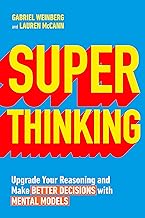
Super Thinking by Gabriel Weinberg
Summary
Gabriel Weinberg’s Super Thinking is a compendium of mental models in which Weinberg examines patterns of reasoning that help one think more clearly and avoid common pitfalls. The book’s goal is to help the reader make better decisions. The authors argue that strong thinking isn’t about raw intelligence, but about learning and pattern recognition. Importantly, Weinberg identifies several heuristics that guide decision-making.
Gabriel Weinberg’s Super Thinking is a compendium of mental models in which Weinberg examines patterns of reasoning that help one think more clearly and avoid common pitfalls. The book’s goal is to help the reader make better decisions. The authors argue that strong thinking isn’t about raw intelligence, but about learning and pattern recognition. Importantly, Weinberg identifies several heuristics that guide decision-making.
Weinberg and McCann also highlight the traps our brains fall into, for example, the conjunction fallacy and cognitive dissonance. The authors present strategies for countering them. A recurring theme is clarity: identifying assumptions, alternatives, and responsibility. The other useful thing is to understand if a decision is reversible before acting.
Key Insights
Inversion thinking: Solve problems by asking how to cause the opposite outcome.
Minimal Viable Product: Launch early; if you’re not embarrassed by version 1, you waited too long.
Razor tools: Ockham’s razor, Hanlon’s razor — prefer simple explanations, avoid assuming malice.
Framing and anchoring: Small changes in wording or comparison points can dramatically change decisions.
Most Respectful Interpretation: Assume good intent when interpreting others’ actions.
Semmelweiss reflex: Rejecting ideas prematurely because they are incomplete or challenge the status quo.
Grey thinking: Delay judgment until you fully understand opposing arguments.
Goodhart’s law: When a measure becomes a target, it stops being a good measure.
Reversibility: Treat decisions as one-way or two-way doors to decide how fast to act.
Bias awareness: Recognise survivorship bias, base rate fallacy, observer expectancy, placebo/nocebo effects.
Social psychology tools: Reciprocity, commitment, social proof, authority, FOMO.
Organisational clarity: Always have a directly responsible individual (DRI) for every task.
Deliberate practice: Train on the edge of your abilities; don’t just repeat what you do well.
Strengths
Extremely comprehensive—covers a wide range of mental models and cognitive biases, from inversion thinking to survivorship bias, with plenty of practical examples.
Includes memorable historical anecdotes, such as Semmelweiss and the “Cobra effect,” which make the lessons stick.
Emphasises both recognising biases and applying structured thinking tools (e.g., BATNA, scenario planning, deliberate practice).
Strong practical focus, encouraging readers to think on paper, assess reversibility of decisions, and avoid presentism.
Franklin’s maxim, “An investment in knowledge pays the best interest,” neatly encapsulates the book’s core value.
Weaknesses
The sheer volume of models can be overwhelming — hard to retain without frequent review.
Some concepts are described too briefly to fully master without external reading.
Organisation is broad rather than deep; it’s a sampler, not a deep dive.
Reflections
Super Thinking is a wide-ranging and practical guide to improving reasoning through mental models. It’s full of examples that make the ideas memorable and applicable in everyday life. It helps avoid unforced errors and design better decision-making processes. The breadth of coverage means that while not every model will be new to many readers, the book serves as an excellent reference and refresher. In the spirit of Franklin’s maxim, “An investment in knowledge pays the best interest,” this is a book worth reading and revisiting.
Conclusion
A valuable reference for those wanting to sharpen their thinking and decision-making. While not every model is immediately relevant, the wide range makes it likely that there will be something of interest. The real benefit comes from active use, applying the models in real decisions until they become second nature.
Book Details
Title: Super Thinking: Upgrade Your Reasoning and Make Better Decisions with Mental Models
Author: Gabriel Weinberg
Publication Year: 2019
Genre: Thinking
Reference: Calandra Lark 9, p. 38
← Previous: Tiny Habits By Bj Fogg
Next → Free Speech By Andrew Doyle