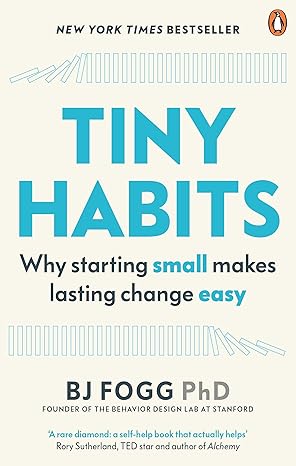
Tiny Habits by BJ Fogg
Summary
In Tiny Habits, BJ Fogg introduces a method of behaviour change that relies on starting small, anchoring new habits to existing routines, and celebrating successes. Fogg emphasises that motivation is unreliable and failure is not a personal flaw. To achieve sustainable change, we need to make the desired behaviours simple and rewarding, and the undesirable ones difficult and painful. To do this, Fogg introduces his “Anchor → Behaviour → Celebration” framework underpins the whole method.
The book stresses the power of prompts and the importance of making actions easier. Good and bad habits into their smallest components. Another useful insight is Fogg’s “pearl habits”, turning irritations into triggers for positive actions, and suggests designing one’s environment to make desirable behaviours automatic.
Key Insights
Three steps to behaviour change: stop self-blaming, break down goals into tiny steps, embrace mistakes as learning opportunities.
Simplicity drives change — if a habit feels easy, it’s more likely to stick.
Anchor → Behaviour → Celebration is the core habit-building framework.
Motivation fluctuates — ability and prompts are more reliable drivers of behaviour.
Pearl habits turn irritations into positive actions.
Good prompts are precise; vague “trailing edge” triggers fail.
Environment design is critical: remove prompts for bad habits, make good habits easier.
Celebrate success immediately — repetition alone doesn’t create habits; positive feelings do.
Identity matters — think of yourself as the type of person who maintains the desired habit.
Breaking bad habits: remove prompts, make the behaviour harder, replace with better habits.
Most Memorable Examples
- Pearl habits — turning irritations (like someone leaving the door open) into cues for gratitude.
- Ban the Guardian/Daily Mail — removing prompts for unproductive habits.
- Anchor moments — “When I put the kettle on, I will do 20 press-ups.”
- Mini start — reading one verse of the Bible, praying for one person, or learning one German word.
- Celebrate immediately — reinforcing success with a smile or a moment of pride.
Strengths
Practical, step-by-step approach that is easy to apply.
Strong emphasis on starting small, lowering barriers, and building success momentum.
Fresh concepts like pearl habits give the reader memorable tools.
Balances habit formation and habit-breaking strategies.
Stresses self-kindness — change is easier when you feel good about yourself.
Weaknesses
Some examples (e.g., humorous habit prompts) may feel gimmicky to certain readers.
Heavy repetition of the “start small” message — useful for reinforcement, but might feel overextended.
Limited discussion of how to scale “tiny” habits into major transformations without losing momentum.
Reflections
This is a highly practical book, with its emphasis firmly on doing rather than just planning. Fogg’s framework resonates because it’s rooted in self-discipline, detail, and a focus on achievable actions. I especially liked his “pearl habits” concept, transforming irritations into positive cues, and his insistence that we change best by feeling good, not bad, about ourselves. His ideas on environmental design and prompt removal are powerful tools for both building good habits and dismantling bad ones.
Some of it this worked well for me. After waking up and going downstairs for my first cup of tea, I always do 40 press-ups on the landing. That’s a great win for me; he day is barely ten minutes old and I have already achieved a useful goal of my daily press-ups. What didn’t work so well was the celebrating. The idea of cheering myself soon became cheesy, but i do congratulate myself internally. The other useful concept, which has been made elsewhere, is the IF x THEN y formulation. If I found that my partner has left the door unlocked (again!) I will think of all her loving things she has done for me over the years.
Conclusion
A highly actionable, well-structured guide to making lasting change by starting small. The “tiny” approach makes habit-building achievable for anyone, while the focus on positive emotion makes it sustainable. Worth reading, and potentially life-changing.
Book Details
Title: Tiny Habits: Why Starting Small Makes Lasting Change Easy
Author: BJ Fogg
Publication Year: 2020
Genre: Psychology
Reference: Calandra Lark 9, p. 25
← Previous: Ultra Learning By Scott Young