Ultra-learning by Scott Young
Summary
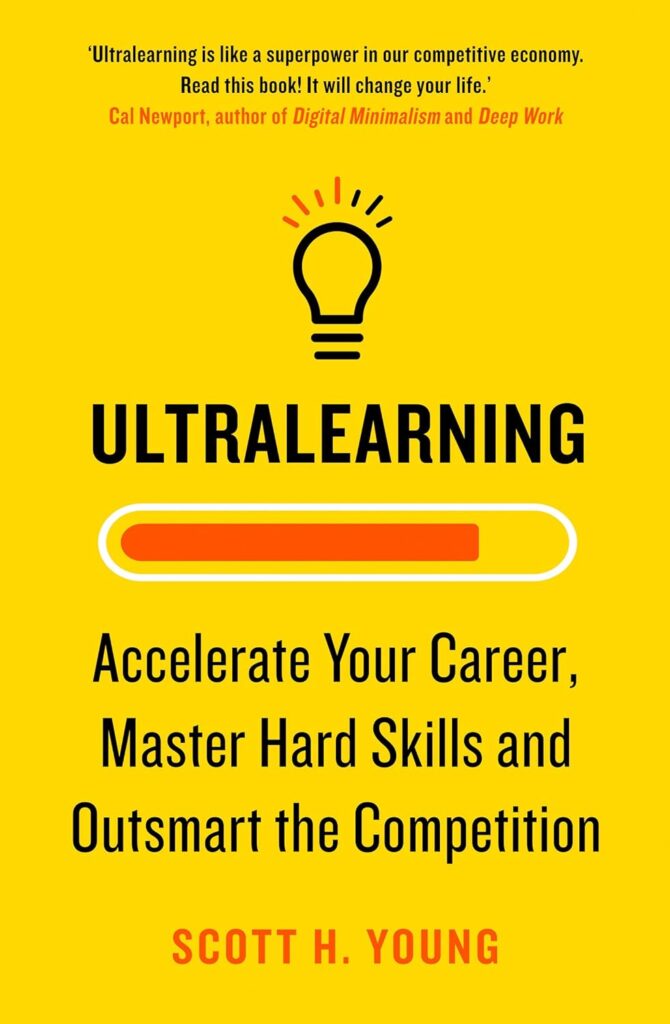
In Ultralearning, Scott Young presents a nine-principle framework for acquiring complex skills quickly and effectively. These principles, meta-learning, focus, directness, drill, retrieval, feedback, retention, intuition/play/experiment, and exploration, are illustrated through examples ranging from Benjamin Franklin’s targeted writing practice to Richard Feynman’s teaching method.
Young stresses that spaced retrieval is more effective than review, and that to be useful, feedback must be actionable. He combines practical techniques, such as spaced repetition and micro-skill drills, with mindset advice, including cultivating curiosity and leveraging constraints to drive growth. The book is full of actionable steps supporting intensive learning projects, including his suggestion to set a three-month sprint timeline for efforts.
Key Insights
Retrieval practice is consistently more powerful than passive review.
Feedback must be specific and corrective to be useful.
Breaking skills into micro-components accelerates improvement.
Procrastination often comes from lack of focus rather than laziness.
The Feynman technique is a practical method for deep understanding.
Complex skills have bottleneck components that determine the rate of progress.
Strengths
Actionable structure — The nine principles provide a clear, repeatable framework for learning any complex skill.
Practical and colourful examples — Includes memorable details like Benjamin Franklin’s pseudonym “Silence Dogood” and his methodical writing drills, as well as Richard Feynman’s modest IQ of 125 — underscoring that exceptional achievement doesn’t require genius-level IQ.
Author credibility — Young clearly applies his own advice in his life and learning projects.
Balanced mindset and method — Combines cognitive science with psychological tools like motivation and anti-procrastination strategies.
Adaptability — Advice works across domains, from language learning to technical skills.
Strong emphasis on retrieval — Makes a persuasive case for spaced retrieval and testing as the most effective learning method.
Weaknesses
Some overlap with his other work — Readers of Get Better at Anything may find repeated ideas, though here they’re more practically framed. But I found the revision useful.
Potential overwhelm for casual learners — The intensity and three-month project approach might feel intimidating for those seeking gradual improvement.
Less depth on certain principles — Some principles (e.g., retention, exploration) are treated more lightly than others, leaving room for deeper exploration.
Reflections
The material overlaps with Get Better at Anything, but that’s not a flaw; the repetition reinforces Young’s ideas, and this book is more practical in its structure. Young practices what he preaches, grounding his advice in both research and personal experimentation. I particularly enjoyed the historical anecdotes, which were interesting and provided practical examples illustrating Young’s points. The sections on identifying bottleneck skills and resisting the temptation to only practice what I already do well touched a nerve.
Conclusion
Ultralearning is an excellent sequel to Get Better at Anything. If you admire Young’s work (and I do), then this is an entertaining and challenging read. Young makes learning enjoyable. The book is motivating and you walk away with the feeling that there is no subject you can not master.
Book Details
Title: Ultralearning: Accelerate Your Career, Master Hard Skills and Outsmart the Competition
Author: Scott Young
Publication Year: 2019
Genre: Time Management
Reference: APA-04, 77
← Previous: Get Better At Anything By Scott Young
Next → Tiny Habits By Bj Fogg