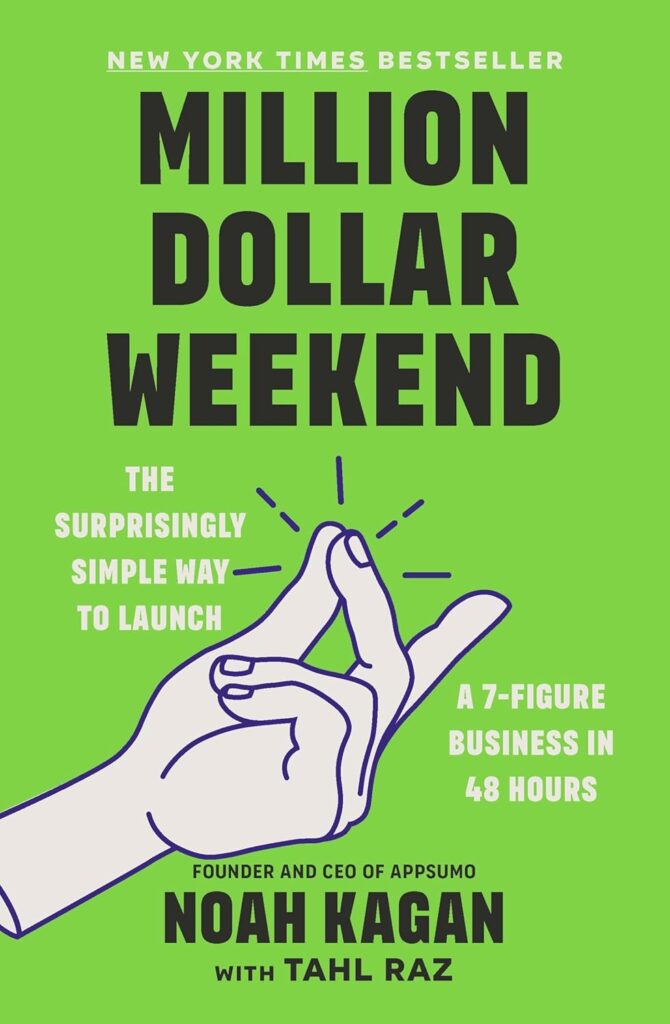
Million Dollar Weekend by Noah Kagan
Summary
Noah Kagan’s Million Dollar Weekend is a motivational book designed to help readers launch a business idea within 48 hours. Its message is simple: don’t wait, don’t overthink, and don’t waste money: start small, validate quickly, and learn by doing. “Now, not how” is his refrain. Kagan emphasises that a business must solve a real problem, that excuses are endless but rarely valid, and that fear of rejection is the greatest barrier to getting started.
Key Insights
Excuses: The most common barriers (“I don’t have ideas,” “I need more research,” “I’m broke,” “I lack skills”) are just avoidance mechanisms.
Problem Seeking: Business ideas come from problems. Always be on the lookout, in your own life, in your conversations, in the news, or online.
Validation: Never build a business without verifying demand. Pre-sell, run small experiments, and get at least three paying customers before committing.
Fear of Asking: Rejection is unavoidable, but it is also necessary. Kagan suggests aiming for 25 or even 100 rejections as practice. Asking is at the core of busines
Now, Not How: Take action before worrying about the perfect method. Focus on momentum, not perfection.
Selling as Helping: Sales isn’t manipulation. It’s advocating for a solution that genuinely improves a customer’s life.
Concrete Challenges: Try the “coffee challenge” (ask for a discount), set time-boxed goals (e.g., 48 hours), and test ideas cheaply through landing pages or marketplaces.
Marketing: Build an email list, offer a lead magnet, experiment with multiple channels, and aim to delight customers.
Failure as a Feature: Almost all great businesses grow from failed ideas. Failure is not the opposite of success but its foundation.
Strengths
Practical orientation: The focus on validating ideas cheaply and quickly is excellent.
Problem-first mindset: Training yourself to be a “problem seeker” is a valuable takeaway.
Memorable challenges: The book’s simple exercises (like the coffee discount) break down fear and get you moving.
Energetic tone: The writing pushes readers toward action and discourages procrastination.
Weaknesses
Over-reliance on anecdote: The “I did it, so you can too” tone feels thin as evidence. Success stories are motivating but not universally replicable.
Repetition: Many ideas are restated in slightly different forms, making the book feel longer than its content warrants.
Surface-level marketing advice: Tactics like SEO, email lists, and social ads are mentioned but not explored in depth.
Tails off: The later chapters lack the punch of the opening, sliding into more generic entrepreneurial advice.
Reflections
I thought this book was okay. Kagan’s emphasis on solving real problems is excellent; it sharpened my awareness that every business must begin with a genuine frustration or need. I particularly liked the idea of being a “problem seeker,” constantly scanning conversations and the media for things that don’t work and could be improved.
The focus on validation was another strong point. It struck me because I have made the mistake of developing an idea without confirming that anyone would pay for it. Kagan’s repeated refrain, never build a business without verifying paying customers, is excellent advice that deserves to be remembered.
Kagan occasionally relied on examples to prove his point. The problem with this is that these often were trivial. For example, he says (and sensibly) that we should validate a business idea before starting it, but the example he gave was of a dog-walking or dog-sitting business. These are pretty basic businesses and are easy to validate. Most bsuiness are more complex.
Where the book fell short, for me, was in its reliance on motivational energy rather than deep argument. Too often, the message boiled down to “I did this, therefore you can too,” which is ultimately unprovable. The practical suggestions were useful, but the book didn’t always deliver the depth or structure to make them stick.
Conclusion
Million Dollar Weekend is a useful kickstart for anyone paralysed by excuses or fear of failure. Its insistence on solving real problems and validating quickly is worth learning for would-be entrepreneurs. But beyond the energy and a few practical exercises, it doesn’t quite live up to the promise of its title. For readers new to entrepreneurship, it can be encouraging. For more experienced readers, there is little of substance. I do fear that some of the claims made about this book are exaggerated.
Book Details
Title: Million Dollar Weekend: The Surprisingly Simple Way to Launch a 7-Figure Business in 48 Hours
Author: Noah Kagan
Publication Year: 2024
Genre: Business, Startups
Reference: APA-07, p. 1
← Previous: Mindset by Carol Dweck