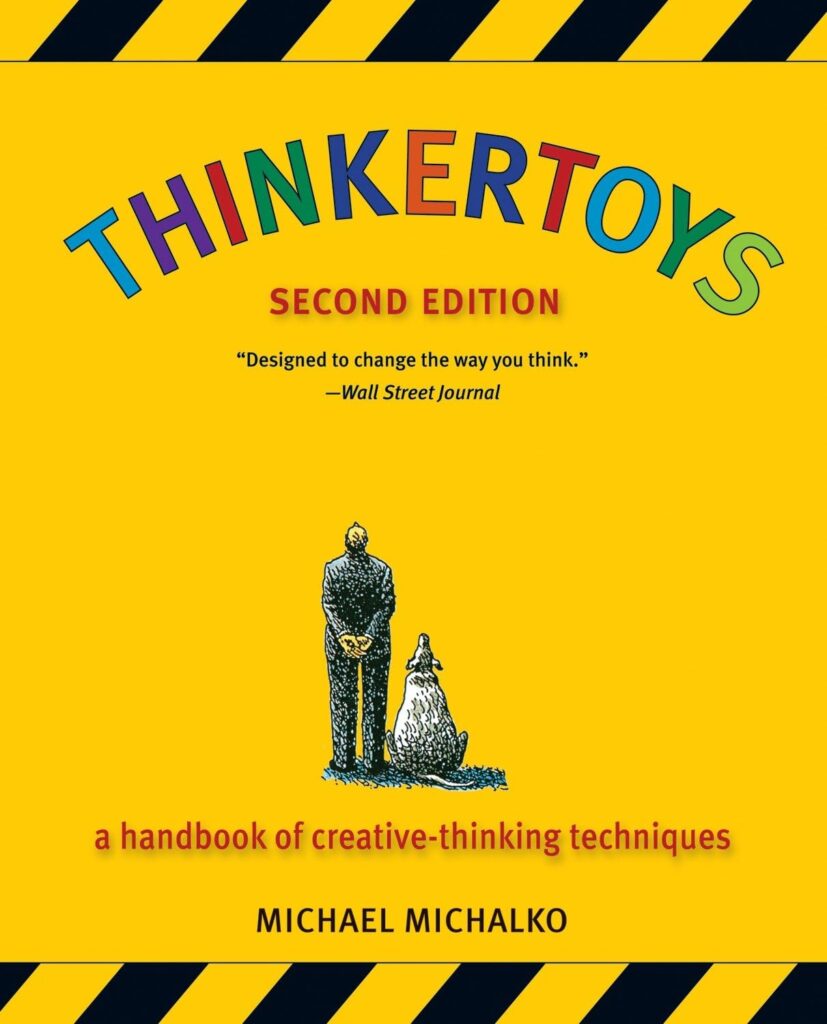
Thinkertoys by Michael Michalko
Summary
Michalko treats creativity as a skill that can be trained. The book is a toolbox of “thinkertoys”; these are prompts and frameworks that help create ideas. He uses the acronym SCAMPER: substitute something, combine with something, adapt something, modify, magnify, minimise, put to some different use, eliminate something, reverse or rearrange.
Other tools include assumption reversal, attribute listing, forced connections, the morphological “Idea Box,” and the Circle of Opportunity, among others. Two meta-rules run through it: pay attention (collect raw material) and think in writing (externalise, then iterate). Quantity begets quality: five ideas a day, relentlessly.
Key Insights
Agency of mind: I can’t control events, but I can control attention, framing, and feelings. Choose interpretations consciously.
Think on paper: Define the problem clearly, rewrite it multiple ways, and list pros/cons. Writing exposes hidden assumptions.
Assumptions are the cage: Use False Faces (state and reverse assumptions) and problem rewording (“In what ways might I…?”) to open new paths.
SCAMPER: Substitute, Combine, Adapt, Modify/Magnify/Minify, Put to other use, Eliminate, Reverse/Rearrange—systematic lenses for variation (e.g., paperclips, wheelbarrows).
Attribute Listing: Break an object into attributes (material, form, parts), then improve each attribute—specificity breeds ideas.
Forced Connections: Randomly pair quotes/images/clippings; meaning emerges from juxtaposition.
Morphological “Idea Box”: Pick key parameters, list variations for each, then mix-and-match combinations to spark concepts.
Attention is fuel: Build a stimulus library (quotes, clippings, photos); spend deliberate time looking (10-minute picture drills). Novel input → novel output.
Beware hidden traps: Sunk cost, prestige bias, framing, “decisiveness theatre.” Wait before deciding; let emotion settle.
Strengths
Highly actionable: Step-by-step exercises you can run today.
Repeatable systems: Moves creativity from mystique to method.
Attention training: Concrete habits for collecting and recombining stimuli.
Weaknesses
Anecdotal scatter: Some examples are dated or apocryphal; treat them as prompts, not proofs.
Legal/ethical edges: Idea prompts (e.g., scraping emails) need guardrails; creativity ≠ carte blanche.
Volume over vetting: Quantity-first can encourage magpie ideas; schedule selection time.
Reflections
For Michalko, creativity comes down to deliberate practice and discipline. set a goal of five ideas a day; it doesn;t matter if they’re useless, it is the process of thinking that matters. Many of the techniques are familiar; random word associations, random pairs of images or newspaper clippings. But there’s enought good in this book to make it worth reading.
I particularly like his prompts: How can I help…; in what way can I …? Michalko also emphasises the importance of attention, looking closely at an object or practice. Listing all the attributes of an object and then for each attribute, asking how I can improve it.
Conclusion
Thinkertoys earns a spot on the shelf as a working manual: collect inputs, challenge assumptions, and use structured combinatorics to generate options—then cool off, evaluate, and act.
Book Details
Title: Thinkertoys: A Handbook of Creative Thinking Techniques
Author: Michael Michalko
Publication Year: 2006
Genre: Creativity
Reference: Skylar 6. p. 31
← Previous: Irrationality by Stuart Sutherland