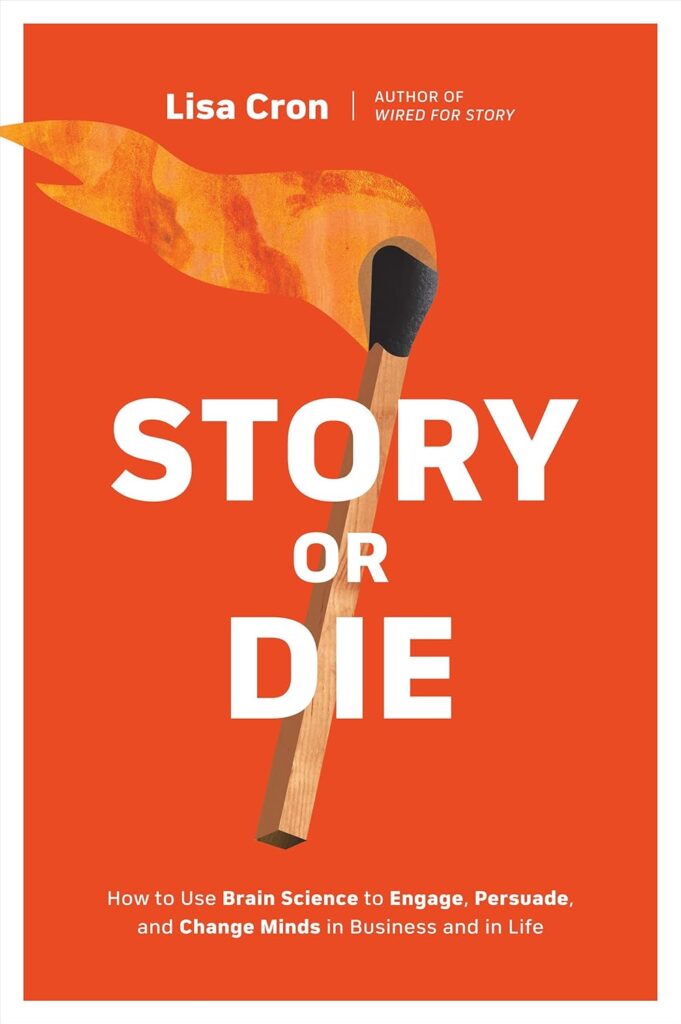
Story or Die by Lisa Cron
Summary
Lisa Cron’s Story or Die argues that story is not just entertainment. It is the most powerful survival tool humans have. Facts alone don’t persuade, but facts embedded in a story can change minds and inspire action. To change people, writers must connect with their audience’s beliefs and self-narratives. A story works because it makes us feel before it makes us think, and because it allows us to simulate life without actually living it. Cron shows how to harness story to persuade and inspire, not by telling readers what to do, but by putting them inside a character’s head so that change feels like their own discovery.
Key Insights
Facts Don’t Persuade—Stories Do: We defend beliefs like our bodies; conflicting facts trigger resistance or even the boomerang effect. But when facts are personified within a story, they are 22x more memorable.
Audience First: To be heard, we must first make the audience feel heard. Focus on what matters to them, not what matters to us. Understand their tribe, desires, fears, and misbeliefs.
Misbelief & Transformation:
- Misbelief formed in youth shapes behaviour.
- Truth is the opposite of the misbelief.
- Realisation discards the misbelief.
- Transformation follows.
Internal Change Matters Most: Story is the internal effect on someone we care about. External events force internal change, and that inner struggle is the real drama.
Elements of Story: Surprise (expect X, get Y), conflict (hard choices), and vulnerability (empathy flows from it).
Application: Craft story with precision:
- Who is my audience (A)?
- Who do I not want as A?
- What do I want A to do—not feel or think, but do?
- What belief prevents A from acting, and why does A hold it?
- What benefits, framed in A’s values, will move them to act?
Persuasion Through Emotion: We use reason to justify emotion. Memory exists to help us predict the future; emotions cement memory. Change how someone feels, and you change what they do.
Survival Lens: Story predates language, maintains social order (gossip), and helps us navigate reality. Social standing, not intelligence, has been vital to survival.
Strengths
Deeply rooted in psychology and evolutionary biology—story as survival, not escape.
Offers a practical, repeatable framework for persuasion: identify audience, pinpoint misbelief, build conflict, deliver transformation.
Strong emphasis on vulnerability, self-narrative, and emotional resonance—why stories move people.
Rich real-world examples: Brazil’s organ donor campaign, General Mills cake mix, Motel 6 rebrand.
Weaknesses
Strong prescriptive bent: every story must hinge on misbelief and transformation, which may not fit all storytelling forms.
Focus on persuasion and change can feel more tailored to marketing or activism than to literary fiction.
Occasionally overstates claims (e.g., story as the only effective tool of persuasion).
Lisa Cron’s Misbelief-to-Transformation Template
1. Misbelief
- What false belief shapes C’s (or A’s) worldview?
- Where did it come from (often rooted in childhood, early experience, or cultural influence)?
- How does this misbelief limit choices or create problems?
2. Truth
- What is the deeper truth that directly opposes the misbelief?
- Why has C (or A) resisted this truth until now?
3. Realisation
- What external event or unavoidable conflict forces C (or A) to confront the misbelief?
- How does C begin to see the misbelief for what it is?
- What is the emotional turning point?
4. Transformation
- How does discarding the misbelief change C internally?
- What external action now becomes possible because of this inner shift?
- How is C (or A) different at the end from the start?
Fiction Example:
- Misbelief: “I’m unworthy of love.”
- Truth: “I am loveable as I am.”
- Realisation: A friend risks everything to protect C, proving their worth.
- Transformation: C embraces vulnerability and commits to a relationship.
Persuasion Example:
- Misbelief: “Buying the cheapest option makes me smart.”
- Truth: “Being frugal means investing in quality that lasts.”
- Realisation: Data/story shows the long-term cost of “cheap.”
- Transformation: A reframes buying as saving face and protecting reputation by choosing wisely.
Reflections
What struck me most is Cron’s insistence that facts never persuade—stories do. Why? Because stories engage our emotions, create context, and allow us to simulate experiences, whereas facts in isolation are inert. A bare fact may be true, but without meaning attached, it slips away. Cron isn’t the first to recognise this. Forty-five years ago, my law professor explained the negligence principle res ipsa loquitur (“the thing speaks for itself”). He said, “If you’re walking along a pavement and a piano falls on your head, you don’t need to prove negligence, you just say, a piano fell on my head.” That story has stayed with me for decades, not because of the legal doctrine, but because I can feel it, the shock, the absurdity, the danger.
Cron’s focus on misbeliefs is equally useful: identifying a protagonist’s misbelief, forcing them into conflict, and showing their transformation mirrors the craft of fiction and the craft of persuasion. I also value her reminder that to be heard, I must first make the audience feel heard. That means focusing not on what I want to say, but on what matters to them. For me, the challenge is to avoid generalities and always drill down into the precise emotional stakes.
Conclusion
Story or Die reframes storytelling as humanity’s oldest and most effective survival tool. For anyone seeking to persuade, whether through fiction, nonfiction, or marketing, Cron’s framework of misbelief, conflict, and transformation offers an excellent guide. Stories work not because they convey facts, but because they make us feel those facts in a way that reshapes our beliefs, and consequently, our actions.
Book Details
Title: Story or Die: How to Use Brain Science to Engage, Persuade, and Change Minds in Business and in Life
Author: Lisa Cron
Publication Year: 2021
Genre: Creative writing
Reference:
← Previous: On Writing Well by William Zinsser