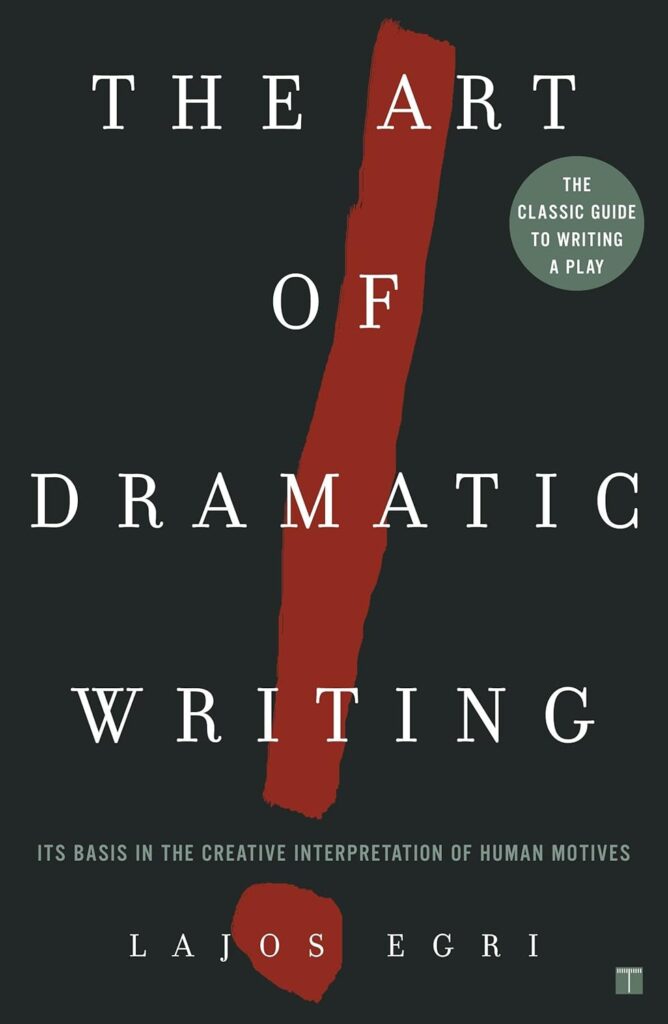
Art Of Dramatic Writing by Lajos Egri
Summary
Lajos Egri’s The Art of Dramatic Writing is a foundational text for anyone writing fiction or drama. His central claim is that every story must begin with a clear, unambiguous premise. This is a statement of what the story is about and what it seeks to prove. From this premise flows everything else: character, conflict, and conclusion. Characters must be three-dimensional, driven by their physiology, sociology, and psychology, and their choices must arise logically from who they are.
True drama emerges from the unity of opposites, when protagonist and antagonist are locked in a conflict that cannot be compromised. Step by step, characters are forced to reveal themselves, travelling from one pole of being to another.
Key Insights
Premise
- Every story must have one clear premise (e.g. Jealousy destroys the thing it loves).
- A premise = Character + Conflict + Conclusion.
- Vague premises (“Love conquers all”) lack force; precise ones (“Great love defies even death”) drive drama.
- The writer must believe the premise and set out to prove it.
haracterisation
- C must be tri-dimensional:
- Physiology: sex, age, health, appearance.
- Sociology: class, occupation, education, politics, religion.
- Psychology: moral standards, ambitions, complexes, temperament.
- Characters are shaped by environment, and must want something badly.
- Weak characters = no drama; strong characters with convictions create plots.
- Each C may have their own premise, but all serve the story’s main premise.
Conflict
- Drama comes from the unity of opposites: Protagonist and Antagonist want irreconcilable things.
- Compromise must be impossible; the conflict must be a fight to the death.
- P never chooses to be the hero; circumstances force them into conflict.
- Tension arises when characters with something at stake collide (e.g. a daughter in love with a man her father abhors but needing his money).
Plot & Development
- Characters create plots: story grows logically out of who they are and what they want.
- C must transition gradually from one pole to another (cowardice → courage, timidity → brazenness). Change must be logical and incremental.
- Scenes should show characters in conflict, not explaining themselves.
- Drama requires stakes: without risk of loss, there is no tension.
Goals of the Protagonist
- Characters create plots: story grows logically out of who they are and what they want.
- C must transition gradually from one pole to another (cowardice → courage, timidity → brazenness). Change must be logical and incremental.
- Scenes should show characters in conflict, not explaining themselves.
- Drama requires stakes: without risk of loss, there is no tension.
Strengths
Laser focus on premise as the foundation of dramatic writing.
Detailed and practical approach to building three-dimensional characters.
Excellent framework for thinking about conflict as unavoidable, uncompromising, and essential.
Emphasis on logical, incremental change keeps stories credible and powerful.
Weaknesses
Egri’s absolutism (one premise only, no compromise, all or nothing) can feel rigid.
His examples, often drawn from mid-20th-century theatre, may feel dated.
The insistence on a moral “conclusion” may not align with more open-ended or experimental fiction.
Lajos Egri’s Premise Template
A strong premise has three parts:
Character Trait → Conflict → Conclusion (Outcome).
Step 1 – Identify the Dominant Trait of the Protagonist (C)
- What single driving quality defines C?
- Is it a virtue or a flaw (love, jealousy, ambition, honesty, arrogance, frugality, intolerance)?
- Why does this trait matter?
Step 2 – Define the Conflict
- What external situation or antagonist forces this trait into action?
- Why is compromise impossible (unity of opposites)?
- What is at stake for C?
Step 3 – State the Conclusion
- What is the inevitable outcome if C follows this path?
- Does the trait lead to triumph, destruction, isolation, humiliation, or transformation?
Formula
[Trait / Drive] leads to [Conflict / Struggle], which results in [Conclusion / Outcome].
Examples (Egri-style)
- Jealousy destroys the thing it loves. (Othello)
- Ruthless ambition leads to death. (Macbeth)
- Great love defies even death. (Romeo and Juliet)
- Blind trust leads to destruction. (King Lear)
- Poverty encourages crime.
- Bragging leads to humiliation.
Fill-in Template
- Character Trait: ___________
- Conflict: ___________
- Conclusion: ___________
Final Premise:
“__________________ leads to __________________, which results in __________________.”
Reflections
Egri’s insistence that drama begins with premise is persuasive. A vague idea (“love conquers all”) produces vague drama; a precise one (“great love defies even death”) produces compelling conflict. I find his tri-dimensional characterisation especially useful: physiology, sociology, psychology force me to ask not just what a character does, but why.
His concept of the “unity of opposites” sharpens my understanding of conflict: unless both sides have something vital at stake, the story lacks tension. I also take to heart his warning that characters must change gradually, by tiny steps, rather than by sudden, implausible leaps.
For me, the power of Egri’s book is in its demand for precision: in premise, in characterisation, and in conflict. It challenges me not to begin writing until I can state exactly what my story sets out to prove.
Conclusion
The Art of Dramatic Writing is a demanding but invaluable guide. Egri compels writers to think rigorously: What is my premise? Who are my characters? What do they want, and why can’t they have it? By rooting plot in character and conflict, he ensures that drama emerges naturally and powerfully. Writers willing to engage with his uncompromising approach will find their stories strengthened at the core.
Book Details
Title: Art Of Dramatic Writing: Its Basis in the Creative Interpretation of Human Motives
Author: Lajos Egri
Publication Year: 1972
Genre: Creatibe writing
Reference:
← Previous: Story or Die by Lisa Cron