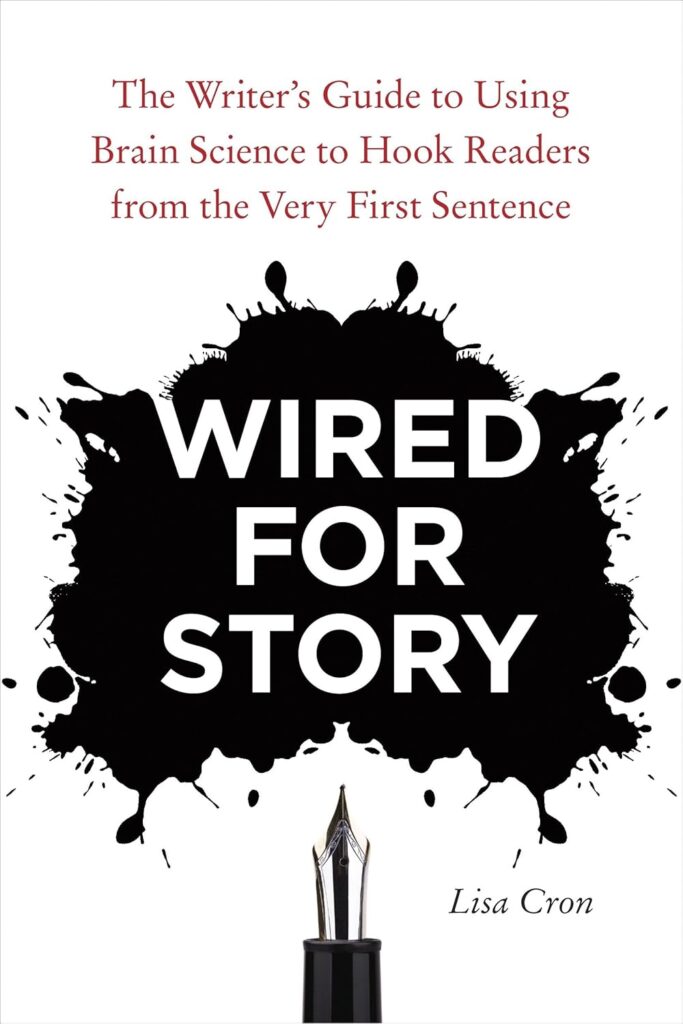
Wired for Story by Lisa Cron
Summary
Lisa Cron’s Wired for Story argues that our brains are hardwired to crave stories because they serve a survival function. Stories are not just entertainment, but simulations of life: they teach us how to navigate danger, test our beliefs, and predict outcomes. For Cron, a true story is not the external plot but the internal journey of the protagonist, how external events force the character to confront inner misbeliefs and change. The reader must be drawn in from the first sentence with curiosity, stakes, and conflict. Every detail must serve the story question; nothing extraneous is allowed.
Key Insights
Why Story Matters
- Stories are brain-training tools; they help us learn survival strategies.
- We read to ask: Will this help me or hurt me?
- Story = how events affect C as they pursue a difficult goal, and how they change.
- Plot is surface; story is the internal shift.
Openings & Stakes
- From page one: who’s story is it, what’s happening, and what’s at stake?
- The first sentence should intrigue (unusual, shocking, portents).
- John Irving: the whole story question is contained in the opening.
- Conflict must start immediately, tied to C’s quest.
Character & Misbeliefs
- The character must have internal and external goals, often in conflict.
- Each character is shaped by a core misbelief (e.g. Hal believes he is cursed).
- The story is about the battle between this misbelief and a deeper desire.
- The character’s reactions must be specific, personal, credible, and always tied to their goal.
- Theme emerges from how characters treat each other — what it means to be human.
Conflict & Escalation
- Plot forces the character to confront internal issues.
- Each scene must escalate problems: whatever C does to solve it makes things worse.
- Conflict must expose the Character’s deepest fears and secrets.
- Villains must have redeeming qualities; no cardboard evil.
- Subplots must tie back to the main plot.
Scenes
- Every scene should be caused by the previous one and make the next inevitable.
- A scene must:
- Be driven by a decision or event.
- Progress the story through the Character’s reaction.
- Provide insight into character.
- Raise new expectations of conflict.
- Always ask: If I cut this scene, would anything later change?
Details & Clarity
- Every detail must be relevant — cause and effect, insight into character, or metaphor.
- Avoid scenery for its own sake; it must reflect the Character’s perception.
- Precision beats generality (“Vince coughed from the ground floor up”).
- R abhors randomness; they want patterns.
Craft Principles
- “Show, don’t tell” means: show why the character does what they do, not just what an observer sees.
- Never editorialise; let R decide how to feel.
- Dialogue, action, and images must always be credible, relevant, and visualisable.
- Writing should avoid generalities, coincidences, and needless information.
Lisa Cron’s Scene Checklist Template
Purpose & Stakes
- What does the character want in this scene?
- What’s at stake if they don’t get it?
- How does this connect to the character’s internal misbelief and overall goal?
Cause & Effect
- Is this scene directly caused by something in the previous scene?
- Does it make what happens next feel inevitable?
- If I removed this scene, would the story still hold? (If yes, cut it.)
Conflict & Escalation
- Does the scene create a specific conflict tied to the character’s quest?
- Does solving one problem create a bigger, worse problem?
- Is tension escalated, exposing the character’s fears or weaknesses?
Character & Change
- How does the character react internally to what happens?
- Is the reaction specific, credible, and personal?
- Has C changed (even slightly) by the end of this scene?
- Does the scene provide insight into the character’s character, misbelief, or desire?
Reader’s Experience
- Does the scene provoke the reader’s curiosity (“what happens next?”)?
- Are details concrete, visualisable, and emotionally relevant?
- Does it avoid unnecessary info, generalities, and coincidences?
- Does it make the reader feel what the character feels?
Pass Test: The scene advances story through cause-and-effect, escalates conflict, deepens character, and makes R care.
Fail Test: The scene is static, general, disconnected, or could be cut without affecting the story.
Strengths
Cron reframes story as a biological survival tool—an insight both inspiring and practical.
Deep focus on misbeliefs and internal change gives stories emotional weight.
Excellent discipline: every detail must serve the story question.
Her scene-by-scene checklists provide a rigorous editing framework.
Weaknesses
Her strict ban on extraneous detail may feel constraining for more lyrical writers.
Heavy emphasis on internal misbeliefs risks undervaluing stories of external adventure.
The “everything must escalate” rule, while energising, can crowd out quieter, reflective beats.
Reflections
What resonates most for me is Cron’s assertion that plot is never the point; it exists only to force C to confront an inner misbelief. I find her precision refreshing: if a scene doesn’t change C or raise stakes, it doesn’t belong.
Her view of stories as survival simulations explains why readers crave them. We read to practice life, to test strategies, to answer “what would I do?” Her demand that every reaction must be specific and credible keeps the story grounded in character, not spectacle.
I also value her treatment of detail: avoid the travelogue, the weather report, the generalities. Instead, use concrete, visualised images tied to what matters emotionally.
For me, Wired for Story is a call to discipline: filter every word through the story question.
Conclusion
Lisa Cron’s Wired for Story is both a philosophy and a manual. It insists that story is hardwired into human survival and that writers must honour this by focusing on misbelief, conflict, and internal change. It is not about pretty sentences but about precision, credibility, and relevance. Writers who adopt Cron’s framework will not only craft more compelling stories but also understand why stories matter so deeply to us.
Book Details
Title: Wired for Story: The Writer’s Guide to Using Brain Science to Hook Readers from the Very First Sentence
Author: Lisa Cron
Publication Year: 2012
Genre: Creative writing
Reference:
← Previous: Solutions for Writers by Sol Stein
Next → Story Genius by Lisa Cron