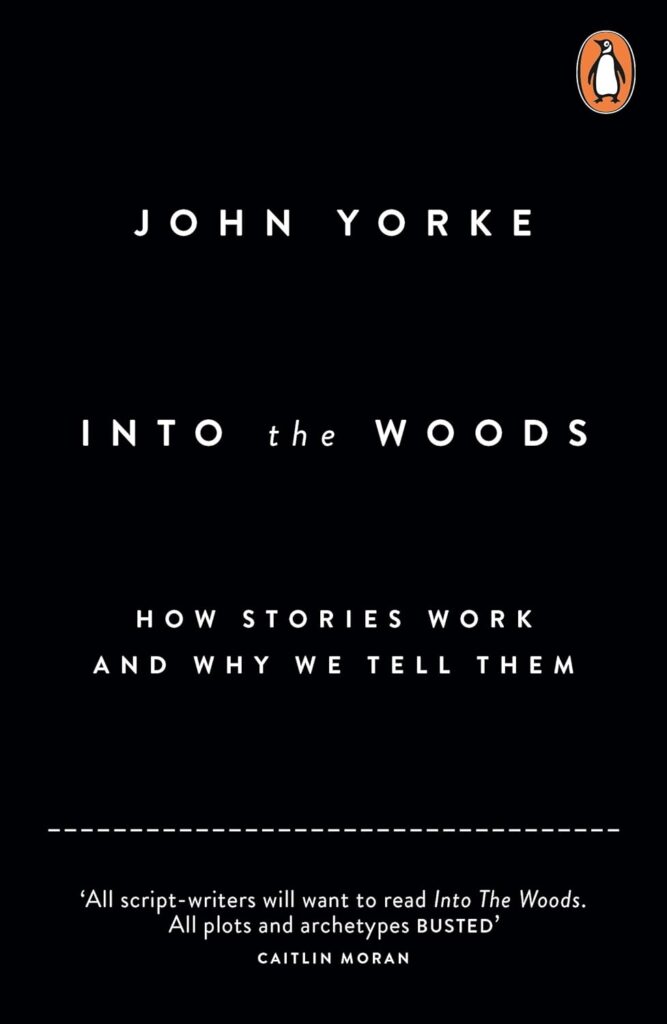
Into The Woods: by John Yorke
Summary
John Yorke’s Into the Woods is both a practical handbook and a philosophical exploration of why stories matter. At its core, it shows that stories are not arbitrary inventions but structured reflections of how humans make sense of life. Drawing from archetypes like the Monster story, the Brave New World, and the Quest, Yorke argues that stories are survival maps: they help us anticipate danger, navigate society, and rehearse our desires and fears.
Key Insights
Three fundamental story models:
- Monster: a threat endangers the community, and a hero sets out to restore order.
- Brave New World: a hero enters a dazzling new environment that proves deceptive.
- Quest: the community needs an elixir, and the hero undertakes a journey to retrieve it.
Craft before genius: Yorke stresses that mastering the mechanics of story structure does not kill creativity — it enables it.
Characters: Niceness alone kills drama; characters must have clear goals, with antagonists (internal or external) standing in the way. The antagonist, Yorke notes (echoing Hitchcock), often defines the story’s power.
Goals: A protagonist’s goal must be specific and active (“Juliet” not “love,” “revenge on X” not “justice in general”). Wants and needs often diverge; the story’s heart lies in reconciling them.
Structure: Each act, and each scene, turns on change: inciting incident, desire, crisis, climax, resolution. “Come in late, get out early” keeps scenes tight, and each should end with uncertainty or surprise.
Conflict: At the heart of story is the clash between two incompatible goals. The midpoint is key — the moment of no return where stakes are irrevocably raised.
Show, don’t tell: Emotions are revealed through behaviour, not exposition. Dialogue must manifest action and subtext, not memory dumps.
Universality: Storytelling is not about saints or devils but recognisable, flawed human beings.
John Yorke’s Scene Change Checklist Template
Purpose: Every scene is a unit of change. Something must shift — in stakes, knowledge, relationship, or character.
1. Scene Basics
- Whose scene is it? (Protagonist, antagonist, or another C)
- Goal: What does C want in this moment?
- Obstacle: Who/what stands in the way?
- Conflict: How does this clash escalate tension?
2. Change
- Before: What does C believe/expect at the start?
- After: What has shifted by the end?
- Nature of change:
- Stakes raised/lowered
- Relationship altered
- Knowledge revealed/withheld
- Emotional state shifted
- Is this change irreversible, or at least significant?
3. Craft
- Inciting spark: Does the scene begin late (in motion)?
- Exit: Does it leave early, with uncertainty or a cliff-hanger?
- Worst consequence: Did I consider the most dramatic possible outcome for C?
- Dialogue: Does it manifest behaviour, subtext, or conflict — not exposition?
- Show vs Tell: Are emotions revealed through action and consequence, not explained?
4. Integration
- Cause: Is this scene triggered by a decision or consequence of the previous one?
- Effect: Does it logically set up the next scene?
- Clarity: Can I answer “what changed?” in one sentence?
Final check: If I removed this scene, would the story still work? If yes, cut it.
Strengths
Provides a clear, structural framework that applies across genres and traditions.
Bridges practical craft advice with deeper reflections on why humans tell stories at all.
Examples from classic films and literature make abstract principles concrete.
Useful maxims — “every scene is a unit of change,” “come in late, get out early” — are easy to apply.
Weaknesses
Writers seeking detailed “how-to” exercises may find Yorke’s book more philosophical than prescriptive.
The scope of examples can feel selective, leaning heavily on familiar Western canon.
Reflections
What I find most useful in Yorke is his ability to connect ancient archetypes with modern storytelling practice. His three basic story models show that whether we’re writing Shakespeare or science fiction, we’re circling the same human concerns: survival, truth, belonging. I especially like his reminder that niceness kills character. Drama thrives on flaws, goals, and obstacles, not on well-behaved people.
Equally valuable is his insistence that every scene must change something. A static scene is wasted space. As a writer, I’m challenged to ask of every moment: what shifts here? What is revealed about my character under pressure?
Conclusion
Yorke’s Into the Woods distils centuries of storytelling practice into a framework that feels both timeless and practical. It reminds us that story structure is not an artificial imposition but the way our minds naturally process change and conflict. For writers, the lesson is liberating: if we honour these patterns, our stories will not just entertain but resonate with the deepest survival instincts of our readers.
Book Details
Title: Into The Woods: How Stories Work and Why We Tell Them
Author: John Yorke
Publication Year: 2014
Genre: Creative writing
Reference: