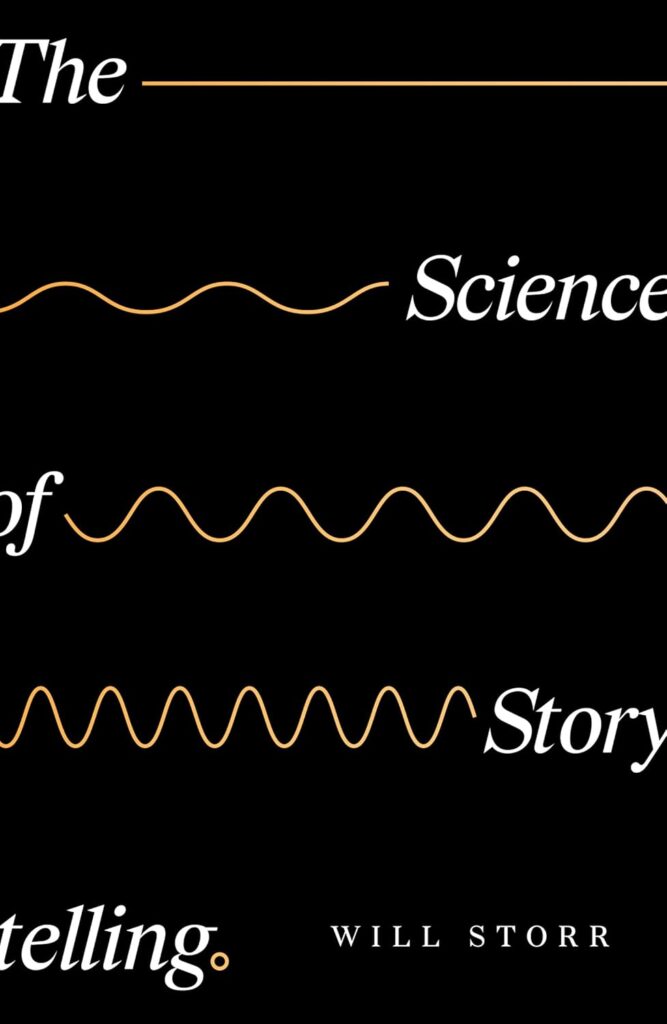
The Science of Storytelling by Will Storr
Summary
William Storr argues that the story is not about events or plots, but about people. The reader is drawn to stories because we want to see the character change, to watch beliefs tested and flaws exposed. Stories are not escapism; they are tools of survival. From childhood fairy tales to modern novels, we use them to learn how to live, how to avoid danger, and how to navigate the social world. At its core, a story begins with change; this could be a death, a birth, a betrayal, or a humiliation. That change provokes curiosity, which is hard-wired into the brain.
Key Insights
Curiosity as fuel: Stories work by creating information gaps — unanswered questions, withheld knowledge, or unexpected events that make R lean in and ask, “what happens next?”
Cause and effect: Scenes must connect through because, not “and then.” Random events mean nothing; we crave pattern.
Character over plot: C must have flaws, beliefs, and a theory of control — an inner logic about how the world works (“you must be strong to survive,” “life is a lottery”). The plot exists to test, break, and retest this flaw.
Status and survival: Our obsession with social standing explains why humiliation, rejection, or ridicule is such a powerful engine of story.
The sacred flaw plot: Storr shows how narrative arcs can be structured around C’s deepest flaw. Across five acts, C moves from denial to change, asking: Who am I? Who am I going to be?
Details and metaphor: Specific details (a cough day off, a fingernail grown while waiting) and fresh metaphors make the brain build vivid hallucinations. Familiar phrases dull impact.
William Storr’s Sacred Flaw Template
Sacred Flaw Template
1. Character’s Core Belief (Theory of Control)
- What is C’s guiding principle about how the world works?
- e.g., “Life is a lottery and the weak go to the wall.”
- Why does C believe this? What specific event caused the damage?
- Humiliation, rejection, ridicule, injustice, poverty, scorn, mockery, devaluation.
2. Sacred Flaw
- What is C irrational about?
- What does C hold sacred — something they cling to as truth?
- How does this belief distort their actions or relationships?
3. External Goal
- What does C want to achieve?
- Why is it urgent, necessary, and personal?
4. Internal Desire
- What does C really want beneath the surface (eudaemonic happiness: love, acceptance, belonging, purpose)?
- How does the sacred flaw prevent C from achieving it?
5. Plot as Test
- How does the plot challenge C’s sacred flaw?
- In what ways do external events force C to question their belief?
- What is at stake if C refuses to change?
6. Five Acts of the Sacred Flaw Plot
- Act 1: “This is not me and it’s not working.”
- Act 2: “Is there another way?”
- Act 3: “I find a new way.”
- Act 4: “Can I cope with the new me?”
- Act 5: “Who am I going to be?”
7. Transformation
- From what to what?
- Old belief → New belief
- Old identity → New identity
8. Dramatic Question
- What single, overarching question captures the inner battle?
- e.g., “Am I cursed, or can I make my life meaningful?”
- “Am I an honest citizen, or am I a gangster?” (The Godfather)
Strengths
Storr’s strength is marrying psychology and neuroscience with practical storytelling craft. His concept of the sacred flawgives writers a lens for building characters whose struggles feel inevitable and profound. He also grounds abstract principles with memorable examples — from The Godfather to the way we litter our rooms with personal clues. His emphasis on curiosity and cause-and-effect creates a toolkit that is both scientific and creative.
Weaknesses
The book is less of a how-to manual than, say, Stein or Cron. Writers looking for step-by-step methods may find it too conceptual at times. Storr sometimes favours psychological theory over page-ready craft advice.
Reflections
For me, Storr clarifies why stories grip us so fiercely: they are not about entertainment but about survival. We experience the character’s struggles as if they were our own, learning how to handle rejection, humiliation, or change without suffering the consequences ourselves. The idea of the sacred flaw is particularly powerful. A character may, for example, believe life is a lottery where the weak go to the wall. That belief shapes his behaviour until events force him to test it, question it, and ultimately discard it.
In the end, The Science of Storytelling reminds me that story is about more than drama or prose. It is about belief, identity, and transformation. R comes to story to ask: What would I do in this situation? Who would I become? The writer’s task is to make that question unavoidable.
Conclusion
Storr reframes the story as a case of psychology in action. What matters is not the spectacle or plot gymnastics, but the flawed ways in which C tries to control the world, and how those flaws are tested to the breaking point. His idea of the sacred flaw is a deep-seated belief formed in response to humiliation, rejection, or injustice, which gives writers a precise tool for shaping characters who feel both inevitable and surprising.
For me, the book’s strength lies in how it marries neuroscience, psychology, and craft. It shows why the reader craves change, why we are drawn to watch a character suffer and adapt, and why the stories that stay with us are the ones that force the character to confront who they really are. If we can unearth that sacred flaw and build the plot as a test of it, we can create stories that are not just entertaining but transformative.
Book Details
Title: The Science of Storytelling: Why Stories Make Us Human, and How To Tell Them Better
Author: Will Storr
Publication Year: 2019
Genre: Creative writing
Reference: