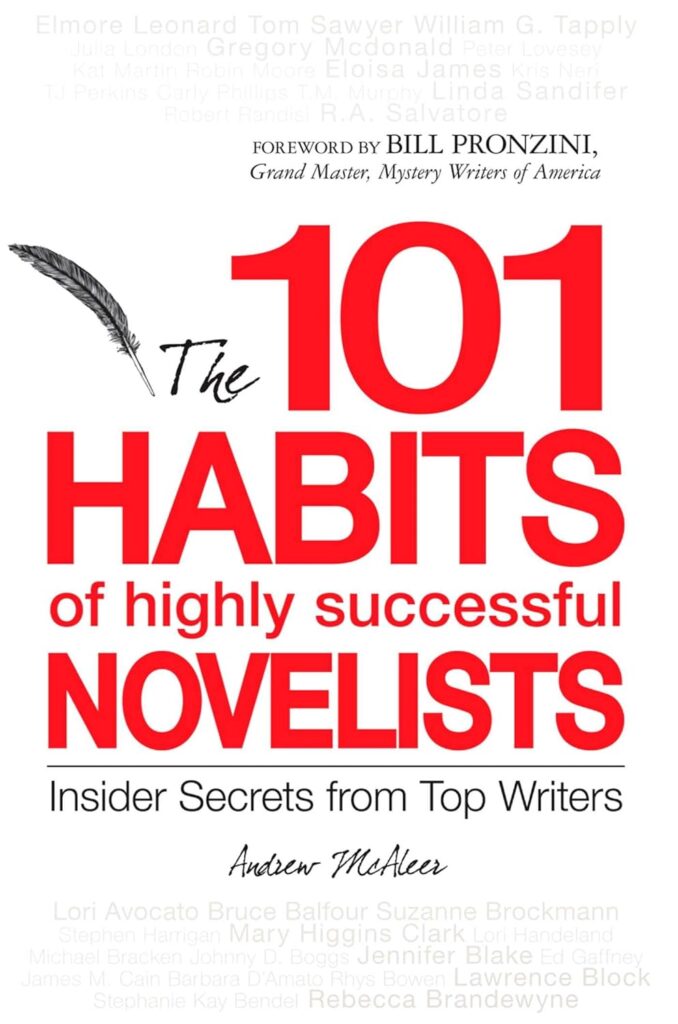
The 101 Habits of Highly Successful Novelists by Andrew McAleer
Summary
Andrew McAleer’s book distils the mindset and practices that separate the professional from the amateur. His central message is simple but uncompromising: writing success is built not on inspiration, but on discipline, persistence, and professionalism.
Key Insights
Passion and perspective: A novelist needs zeal for the craft, and the ability to imagine through the eyes of others — to write not only as oneself but as an engineer, a feminist, a soldier.
Discipline: Writing must be treated like a job. Set aside time, show up, and produce words whether you feel like it or not. Tom Sawyer’s losers wait for inspiration; professionals write daily.
Goals: Set precise, realistic, and controllable goals. “Write 500 words a day” is achievable. “Be published by Christmas” is not.
Excellence: Everything written must be of professional quality. Dialogue must always contain conflict; every scene is an argument.
Research: Get facts right. An incorrect detail pulls R out of the story. Separate research from drafting — if I don’t know something, leave a marker and keep writing.
Persistence: Success belongs to the amateur who never quits. The first draft is always rubbish, but revision transforms it. Let the manuscript rest before editing. Resist the urge to submit too early.
Professionalism: Writers are judged constantly. Courtesy matters in a small world; discourtesy can close doors.
Strengths
The advice is practical, tough-minded, and experience-driven.
It balances craft (dialogue, conflict, accuracy) with attitude (discipline, professionalism, persistence).
The emphasis on achievable goals provides both structure and motivation.
Weaknesses
The “habit” format can feel repetitive — many points circle back to the same mantra: discipline.
Less about the art of writing, more about the attitude of the writer. Some may crave more depth on narrative craft.
Reflections
For me, McAleer’s uncompromising tone is a helpful corrective. I confess I once flirted with the illusion that talent or inspiration alone could carry me (ha ha). McAleer insists otherwise: discipline, persistence, and professionalism are the actual bedrock. His advice to “write or do nothing” (in a detention-style manner) resonated; it strips away excuses and creates a stark choice.
The reminder that “luck is the residue of hard work” echoes what I’ve seen in other fields: consistent effort creates opportunities that appear to outsiders as luck.
Conclusion
McAleer’s 101 Habits is less a manual of technique and more a manual of mindset. It urges me to approach writing as a professional pursuit: to set realistic goals, to cultivate discipline, and to persist no matter what. If I adopt even half his habits, I’ll increase not only my output but my chances of success.
Book Details
Title: The 101 Habits of Highly Successful Novelists: Insider Secrets from Top Writers
Author: Andrew McAleer
Publication Year: 2008
Genre: Creative writing
Reference:
← Previous: Science of Storytelling by William Storr