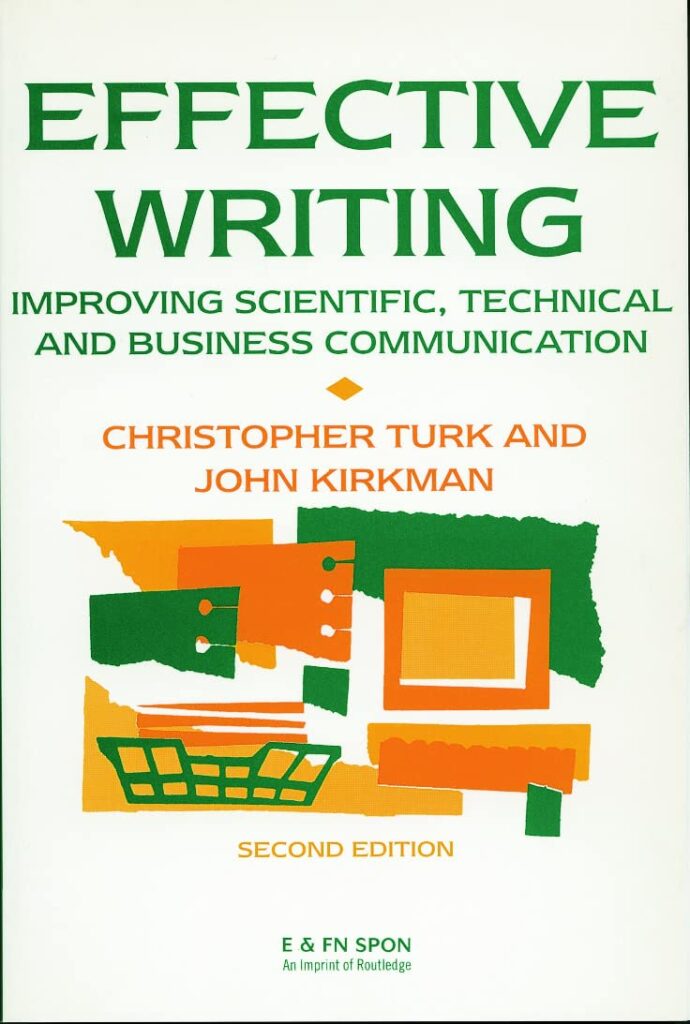
Effective Writing by Christopher Turk
Summary
Cristopher Turk and John Kirkham’s Effective Writing is a straightforward guide to the craft of clear, purposeful communication. Their central message is that writing is not an innate gift but a skill that can be learned through practice and reflection. The book insists that all writing must begin with clarity of purpose: why am I writing, and for whom? From there, every sentence should be tailored to the reader’s needs, not the writer’s vanity. Simplicity, brevity, and directness are their touchstones.
Key Insights
Writing is a skill to be learned; practice is essential.
Always ask: why am I writing, and who am I writing for?
Write for R’s benefit, not my own.
Keep sentences short, favour familiar words, prefer active over passive.
Distinguish between what is interesting and what is relevant.
Always pitch at the right level for the audience; avoid over-explaining or showing off.
Every piece of writing should have a “job specification” or target statement.
Important information should come first; order by significance, not chronology.
Avoid tautologies, footnotes, and nominalisations.
A report should have a clear title, succinct summary, and recommendations.
Test instructions to ensure they work.
Vary sentence length for rhythm; too many short ones become monotonous.
Prefer Anglo-Saxon words to Latin ones (start not commence; end not terminate).
All writing communicates something about the writer, whether intended or not.
Turn and Kirkman’s Wring Specification Template
1. Purpose of the document
☐ Describe
☐ Explain
☐ Instruct
☐ Specify
☐ Evaluate
☐ Recommend
☐ Persuade
☐ Provoke debate
☐ Concede
☐ Apologise
☐ Protest
☐ Reject
☐ Other: ______________________
2. Audience
- Who is R? (e.g. manager, colleague, client, general reader)
- What does R already know?
- What does R need to know?
- What are R’s likely attitudes to the subject?
- Are they similar to me, or very different?
3. Objectives
- What do I want R to do after reading? _____________________
- What objections might R raise? __________________________
- What is most important to R, and why? ____________________
4. Constraints
- Time available to write: ____________
- Word/page limit: ____________
- Format requirements: ____________
5. Structure
- Key point that must come first: ___________________________
- Order of importance (list main points in descending order):
6. Style & Tone
- Direct and active (avoid passive)
- Familiar words, not jargon
- Sentence length varied but mostly short
- Anglo-Saxon over Latin (start not commence)
7. Testing
- Leave draft for at least a day/week before editing.
- Can R easily find what they want?
- Are instructions (if any) testable and clear?
Strengths
The advice is relentlessly practical: everything is framed in terms of what will help R.
Their list of common tautologies and nominalisations is both amusing and memorable.
The focus on order of importance, rather than order of occurrence, is invaluable for reports.
The idea of a “job specification” for every piece of writing is an elegant way to impose discipline.
Weaknesses
The style is somewhat dry; it reads more like a manual than an inspiring craft book.
At times, the insistence on simplicity risks flattening prose into dullness, especially for creative contexts.
Some recommendations (e.g., decimal numbering) feel more bureaucratic than literary.
Reflections
When I first picked this book up as a young man, I remember thinking: What can they possibly teach me about writing? The answer turned out to be quite a lot. I had assumed that writing was about expressing myself, but Turk & Kirkham taught me that it is about clarity, brevity, and above all, respect for the reader. Their insistence that “don’t write – communicate” struck me then and has stayed with me.
The advice is as useful today as it was when I first read it. Whenever I draft a report or even an email, I still hear their voices reminding me: what does the reader need to know, and in what order? Keep it simple. Cut the flab. The lesson was humbling at the time, but invaluable.
Conclusion
Turk & Kirkham remind us that writing is not about showing off but about getting the job done. Effective Writing may not be glamorous, but it is a toolkit that every professional writer should have at their elbow. Its message endures: be clear, be brief, be kind, and above all, be respectful, to the reader
Book Details
Title: Effective Writing: Improving Scientific, Technical and Business Communication
Author: Christopher Turk, John Kirkman
Publication Year: 1988
Genre: Writing
Reference: