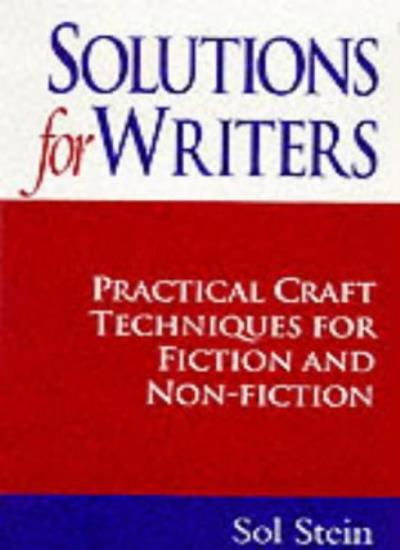
Solutions for Novelists by Sol Stein
Summary
Sol Stein’s Solutions for Novelists is a practical guide aimed at helping writers craft stories that grip the reader from the first page to the last. His central principle is that the novelist’s task is not to indulge in writing for its own sake, but to deliver an extraordinary experience to the reader. Characters are at the core. They must be vivid, distinct, and memorable. It is the characters that we remember long after the plot is forgotten. Stein emphasises adversarial conflict, precise detail, and dialogue that works as a battle of wits rather than an exchange of information. He also reminds us to keep every scene visual and filmable, and to escalate problems until the character has no choice but to risk everything.
Key Insights
Reader first: Writing is about creating an emotional experience for R, not satisfying the writer’s ego.
Extraordinary characters: C must stand out with one strong characteristic, candid vulnerability, and lifelike detail.
Conflict everywhere: All actors in a scene should have their own “script” (goals). Even a simple act, like buying coffee, can become adversarial.
Consequences matter: What does C want? Does he take risks to get it? Are the consequences serious? Who opposes him, and why?
Antagonist: The best opposition is usually a single, clearly defined person.
Avoid melodrama: Surprise is better than spectacle; entrances should intrigue, not explode.
Dialogue: Should reveal character, advance story, and work obliquely. It is a battle of wits, not an information dump.
Visual storytelling: Ask “can this scene be filmed?” If not, make it more immediate.
Particularity: Specific details (a small black Fiat, not just a small black car) create believability.
Escalation: Problems must grow progressively worse. End chapters with a question that makes R want to continue.
Precision: Every word must earn its place—cut what is unnecessary, vague, or imprecise.
Checklist for scenes:
- What does C want desperately?
- Why does R care?
- Who/what prevents C from succeeding?
- Are C and A sharply distinguished?
- What’s the hook?
- Is the hero active and concrete, not a passive observer?
- Are all senses engaged?
Strengths
Exceptionally practical advice—always focused on what will engage R.
Insists on precise detail, which makes characters and scenes believable.
Provides clear checklists that writers can apply immediately.
Strong emphasis on conflict ensures tension and momentum throughout.
Weaknesses
At times overly rigid (e.g. preference for one protagonist, avoidance of commas or “or”). Some rules may feel dated or overstated.
Heavy focus on adversarial conflict may neglect quieter forms of drama.
The advice on dialogue, while excellent, risks making all exchanges combative if applied without nuance.
Reflections
What I found most valuable in Stein is his focus on the reader’s experience. He reminds us that fiction is not merely self-expression, but rather a form of communication. The reader must be made to care about the protagonist. Thus, Stein’s insistence on extraordinary characters. The plot alone cannot carry a novel; we must have a compelling character. (Homo Fictus again.) I particularly liked his advice to test each scene by asking if it can be filmed; this forces me to make my writing immediate and visual.
Stein also underlines a personal truth for me: that precision and particularity matter more than flourish. A small black Fiat says infinitely more than a “small black car.” And his checklist questions: What does the character want desperately? Why should the reader care? Who opposes him? Answer these questions, and there is a chance the reader will stick with the book until the end.
Stein is not lacking in self-confidence. He preaches with vigour and certainty, as though his way is the only way. Broadly, I agree with him, but there is an unmistakable element of “my way is right.” At times this risks sounding dogmatic, yet I found his confidence oddly reassuring; it gives his advice force, even when I might temper it with my own judgement. Much of this material overlaps with Stein on Writing. That’s not a bad thing if you come to this book first, but if you’ve read the other, you’ll find most of the same principles restated here.
Conclusion
Solutions for Novelists is a pragmatic guide that strips writing down to its essentials: memorable characters, escalating conflict, precise detail, and conflict expressed through dialogue. Stein’s approach is uncompromising; his focus is on the reader’s experience. This is not a book about inspiration or style; it is about craft, discipline, and delivering a story that the reader enjoys.
Book Details
Title: Solutions for Novelists: Secrets of a Master Editor: Secrets of a Master Editor
Author: Solutions for Novelists by Sol Stein
Publication Year: 2000
Genre: Creative writing
Reference: