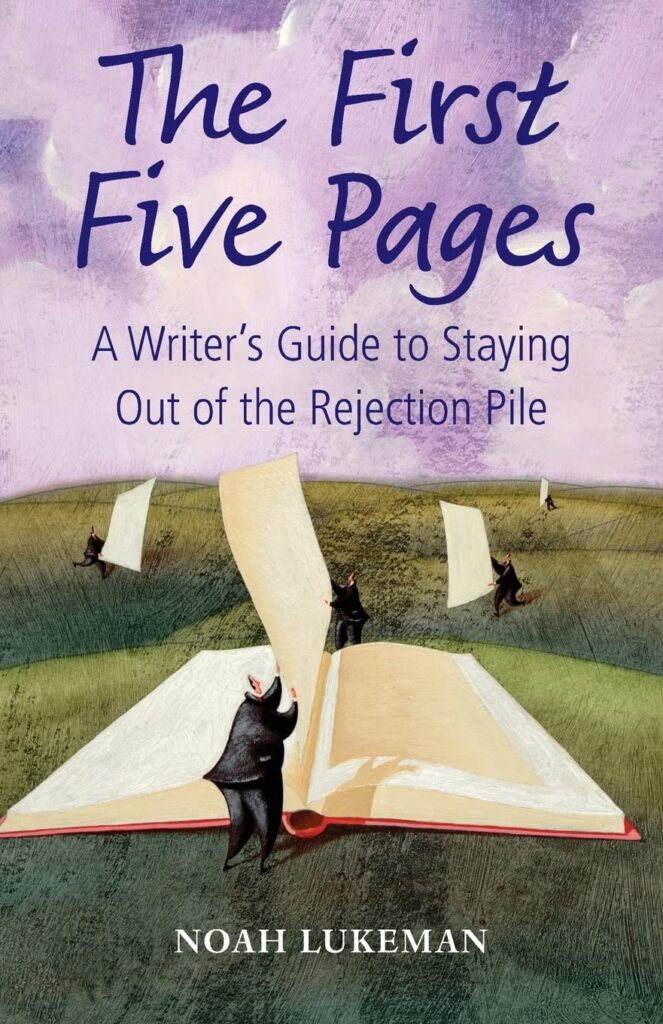
The First Five Pages by Noah Lukeman
Summary
Lukeman argues that excellence in writing is judged from the very first page, often the first five. Readers (and publishers) will stop immediately if those pages fail to engage. His advice is emphatic: every sentence must carry its weight, every word must earn its place. Style, clarity, precision, and above all, respect for the reader’s time are the governing principles.
Key Insights
Excellence matters: Small errors suggest laziness or sloppiness; they tell R the writer is not professional.
Conciseness is power: Adverbs and adjectives should be minimised or replaced by stronger nouns and verbs (“he sprinted” instead of “he ran quickly”).
Metaphor beats modifiers: “He was an ox of a man” is more vivid than “He was tall and strongly built.”
Pay yourself to cut words: Deletion sharpens prose.
Respect R’s time: Always keep the story moving—no flab, no wasted paragraphs.
Avoid “echoes”: Repeated words or phrases quickly dull the effect.
Read aloud: Essential for spotting rhythm, redundancy, and awkwardness.
Show with facts, not conclusions: “It hadn’t stopped raining for a week” conveys more than “the weather was bad.”
Mood comes from description: A dead rat in the corner creates unease more powerfully than “he had a creepy feeling.”
Hooks: The first sentence must grip. Camus’ The Stranger—“Maman died today; or yesterday maybe. I don’t remember.”—is a model.
Names and characters: Be consistent with names, introduce C’s slowly, and never give temporary characters full names.
Descriptions: Avoid clichés (hair/eye colour), describe from POV, and focus on what makes a C unique or engrossing.
Openings: Avoid gimmicks and cheap tricks; readers see through them. Dialogue as an opening rarely works.
Purpose in every unit: Each paragraph, section, and chapter should have a clear purpose and resolve it.
Detail as authenticity: Tiny, telling details (a chipped cup, a frayed carpet) make settings real.
Strengths
Lukeman writes with clarity and urgency—his rules are easy to grasp and practical.
His focus on conciseness helps any writer avoid amateur mistakes.
The emphasis on reader experience is powerful: he never lets the writer forget that the story exists for the reader, not the author.
His examples—both good and bad—are concrete and memorable.
Weaknesses
The book can feel uncompromisingly strict, leaving little room for stylistic experimentation.
Some advice (avoid opening dialogue, avoid adjectives) might be too rigid; great writers occasionally break these rules effectively.
Much of the guidance is focused on what not to do, which can feel negative rather than inspirational.
Reflections
What struck me most is Lukeman’s insistence that the first five pages must be polished to perfection, not just in plot, but in every detail of style, rhythm, and diction. His metaphor of paying oneself for every word written is worth noting. For Lukeman, writing is not about adding; it’s about refining.
Yet I also recalled an experience where I read a novel that opened with “Today was the day he decided to commit murder.” Far from hooking me, it repelled me. It was too obviously a “trick,” and Lukeman is right: gimmicks insult the reader’s intelligence. His approach may be austere, but he is right to demand excellence from the first sentence onward.
Conclusion
Lukeman’s central message is simple but vital: just as in life, first impressions matter. A weak opening can doom a manuscript before it has a chance to find its footing. Readers, like dates, rarely offer second chances. The first five pages set the tone, reveal the writer’s professionalism, and determine whether the reader will keep reading or quietly slip away. Whether in writing or in dating, it is wise to remember: you may never get another opportunity to make that crucial first impression.
Book Details
Title: The First Five Pages: A Writer’s Guide to Staying Out of the Rejection Pile
Author: Noah Lukeman
Publication Year: 2010
Genre: Creative writing
Reference:
← Previous: Solutions for Novelists by SOl Stein