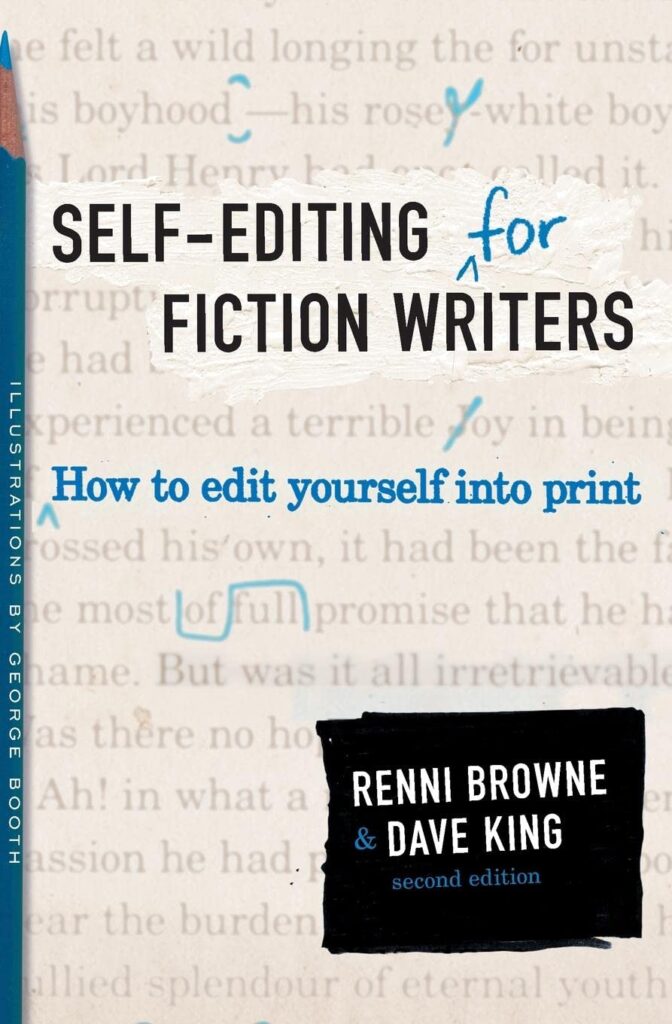
Self-Editing for Fiction Writers by Renni Browne and Dave King
Summary
Renni Browne and Dave King’s Self-Editing for Fiction Writers is a practical handbook for polishing a manuscript before it reaches an editor’s desk. Their focus is not on grammar or spelling, but on craft: showing rather than telling, sharpening dialogue, cutting waste, and trusting the reader. The book’s aim is simple: it is to teach writers to see their work with an editor’s eye, and to strengthen every page by dumping the dead weight.
Key Insights
Show, don’t tell: Reveal character and emotion through dialogue, action, and description, not through labels (he was furious vs. “How dare you lie to me?”).
Resist the Urge to Explain (R.U.E.): Let the reader draw conclusions without author intrusion.
Exposition in scenes: Deliver information through character action and reaction, not author lectures.
Dialogue discipline:
- Tags should be plain (she said, he asked).
- Avoid adverbs, especially “-ly” forms, which signal telling.
- Don’t attribute dialogue to actions (“Come closer,” she smiled).
Cut the flab: Every paragraph and every detail must serve the story.
Precision over vagueness: Replace weak nouns/adjectives with strong, specific ones (drink → Bloody Mary; car → 1932 Bentley).
Avoid clichés and stereotypes: Either cut them or twist them into something fresh.
Rhythm and immediacy: Keep sentence order natural and direct (She pulled off her gloves and turned to him).
Trust the reader: Eliminate obvious filler and explanations; readers are sharper than we think.
Consistency of perspective: Use line breaks for POV shifts, and describe only what a character would notice.
Browne and King’s Self-editing Checklist
Purpose & Focus
- Does every paragraph/scene have a clear purpose?
- Am I showing rather than telling wherever possible?
- Have I cut any flab, leaving only what serves the story?
Showing vs. Telling
- Are emotions revealed through action, dialogue, or description rather than stated directly?
- Have I resisted the urge to explain (“R.U.E.”)?
- Are objects, settings, and people described with precise detail rather than vague adjectives/adverbs?
Dialogue
- Does each line of dialogue reveal character, move the story forward, or create conflict?
- Have I avoided adverb-laden tags (“…he said angrily”)?
- Are tags simple (“said” / “asked”) and placed after the speaker, not before?
- Have I avoided using actions as tags (“she smiled”)?
- Have I read dialogue aloud for rhythm and believability?
- Do I break dialogue with purposeful beats (small actions), not filler (coffee-sipping clichés)?
Point of View & Exposition
- Is POV consistent (no head-hopping within a scene)?
- Have I delivered exposition through scenes, not narrative lectures?
- Are line breaks used when shifting POV?
Precision & Style
- Have I eliminated clichés, or transformed them into something fresh?
- Do verbs carry the weight of the sentence, with adjectives/adverbs pared down?
- Is every description concrete and precise (“1932 Bentley” not “old car”)?
- Are sentences immediate, without dangling participles or awkward constructions?
- Have I avoided exclamation marks and italics for emphasis?
Consistency & Repetition
- Are character names consistent (no unnecessary variations)?
- Have I avoided repeating the same information in different ways?
- If a detail or skill is introduced, is it relevant later (seeding, not clutter)?
Final Pass
- Could this scene be filmed—does it play visually?
- Does every sentence pull its weight, or am I dumping the dead weight?
- Have I trusted the reader to infer, rather than forcing conclusions?
Strengths
Practical focus: Every principle is grounded in examples that contrast weak and strong writing.
Concise lessons: Rules like R.U.E. are easy to remember and apply.
Hands-on tone: The book trains writers to think like editors, a valuable shift in perspective
Weaknesses
Occasional rigidity: Rules like “never use exclamation marks” can feel overly absolute.
Less emphasis on higher-level story: The advice is primarily at the sentence and scene level, not structural.
Overlap with other craft books: Some points (show, don’t tell) are repeated familiar advice, though well illustrated.
Reflections
I remember laughing at Stein’s line “1 + 1 = ½”. Browne and King echo the same warning: don’t overload the reader with double signals. If you want to show someone drunk, slurred speech is enough; stumbling as well diminishes the effect. I also appreciate their discipline about precision—ordering a “drink” is nothing; ordering a “Bloody Mary” is a story. Where I hesitate slightly is their absolutism. Not every cliché must be banished—some can be twisted to good effect, as they themselves admit. But as an editing checklist, their rigour is invaluable.
Conclusion
Self-Editing for Fiction Writers is a useful guide for writers who are past the first-draft stage. Its lessons, for example, show, don’t tell; cut the flab; trust the reader, are neither new nor glamorous, but they are what elevate writing from amateur to publishable. Browne and King’s advice is sometimes uncompromising, but in a marketplace crowded with manuscripts, their standards are precisely what a writer needs.
Book Details
Title: Self-Editing for Fiction Writers, Second Edition: How to Edit Yourself Into Print
Author: Renni Browne, Dave King
Publication Year: 2004
Genre: Creative writing
Reference: