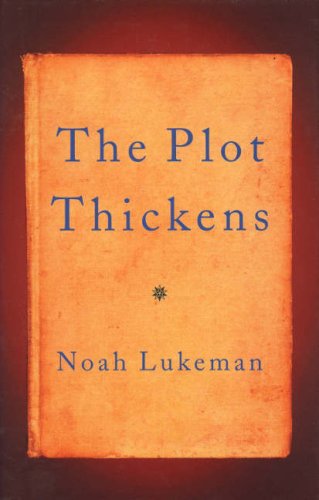
The Plot Thickens by Noah Lukeman
Summary
Noah Lukeman’s The Plot Thickens is a guide to deepening fiction through character, conflict, and suspense. At its heart, the book argues that plot is inseparable from character: our characters come alive only through the details we know about them, including their appearance, age, fears, flaws, and paradoxes, as well as through how others perceive and treat them. Lukeman stresses that a character must be flawed yet still command the reader’s empathy, while the antagonist and the lead character are embroiled in a crucible they cannot escape.
Lukeman offers a wide-ranging catalogue of techniques for creating tension: suspense through anticipation and delay, raising the stakes, the ticking clock, secrets, dramatic irony, sexual tension, and, importantly, the character’s flaws. Conflict is the lifeblood of story, whether between individuals (priest/woman, Jew/Nazi), groups (mods/rockers, Turks/Greeks), or even within the character himself (pacifist forced to fight). Each story, Lukeman reminds us, is a journey of realisation, whether the character discovers the truth about others (her husband is unfaithful) or about himself (remorse, regret).
Key Insights
Character depth matters: Define C’s best and worst traits, and show incongruities (a man in a smart suit wearing trainers). Paradoxical behaviour makes C unpredictable and interesting.
Conflict is essential: Every objective must be met with an obstacle, whether external or internal. C’s destiny—prince or pauper—is only compelling if he must struggle to escape it.
Suspense is engineered: Use danger, inability to act, secrets, dramatic irony, or future dreams cut short to keep R asking, what happens next?
The crucible intensifies drama: Confining characters in tight circumstances (lifeboat, prison, spacecraft) forces confrontation and raises the stakes.
Avoid pretension: No politics, no preaching, no moralising. Don’t strain for profundity; depth emerges naturally from character and conflict.
Strengths
Offers a comprehensive toolkit of techniques for building tension and conflict.
Emphasises character as the driver of story, not mere plot mechanics.
Provides practical, vivid examples (sexual tension, ironic deaths, family rivalries) that a writer can immediately apply.
Reinforces that suspense is an active process of delaying resolution, not just a by-product of action.
Weaknesses
The book leans heavily on lists, which can feel prescriptive rather than organic.
Its prohibition of politics, moralising, or profundity may feel limiting, given that great novels often tackle these very things.
Writers seeking deep theory may find the advice more checklist-like than analytical.
Reflections
In The Plot Thickens, Lukeman concentrates on conflict and suspense as the driving forces of the story. His practical strategies include secrets, ticking clocks, and crucibles. These are excellent reminders that drama arises not from clever writing but from situations that force the character into hard choices. At times, his ban on politics or profundity feels overstated, but the underlying point is sound: the story should never become a vehicle for lecturing or self-indulgence. Basically, you may be a clever and knowledgeable cove, but the reader doesn’t need to know that, so don’t show off. The strongest stories compel the reader to ask: What would I do in that situation?
Conclusion
The Plot Thickens is less about “plot” in the conventional sense and more about how to create characters and conflicts that generate a story organically. By emphasising a character’s flaws, Lukeman provides a set of tools to keep the stew bubbling. While his tone can verge on the prescriptive, his message is invaluable: without conflict and suspense, there is no story.
Book Details
Title: The Plot Thickens
Author: Noah Lukeman
Publication Year: 2003
Genre: Creative writing
Reference: