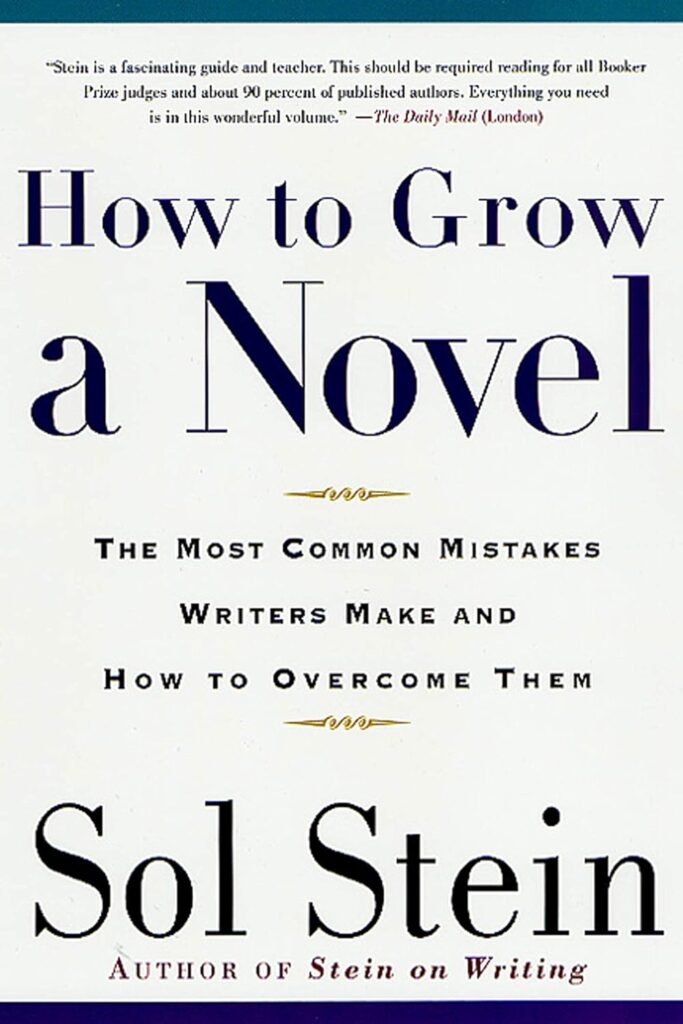
How to Grow a Novel by Sol Stein
Summary
In How to Grow a Novel, Sol Stein builds on his earlier work (Solutions for Novelists, Stein on Writing) with a single overriding aim: to help writers give R (the reader) an experience better than his own. A good novel should keep R tense, nervous, concerned, and emotionally engaged. To achieve this, Stein insists on immediacy: avoid narrative summary, show rather than tell, and keep everything grounded in action and dialogue.
Conflict is central. Whether between friends, lovers, or enemies, C’s (characters) should constantly be at odds, even when working toward the same goal. A disaster involving strangers will quickly be forgotten, but one involving people we care about will stay with us. Particularity is also essential: R responds not to vague generalisations but to the concrete—“a small black Mini” rather than “a small black car,” “7.42 on a March morning in Paris” rather than “an early spring day.”
Key Insights
The reader’s emotions matter most: Everything in the novel must aim to involve, disturb, or move R.
Conflict drives story: Every relationship should have adversarial tension; even disasters are remembered only when filtered through characters R cares about.
Immediacy over summary: Avoid abstract narrative; show the character’s actions, dialogue, and choices in the moment.
Characterisation through detail: What’s in the character’s pocket? Why does he keep it? Small, telling details create lifelikeness.
Structure and clarity: Begin with a premise, break it into scenes, decide what emotion each scene should evoke in R, and end chapters with questions that keep the reader turning pages.
Style choices: Use “and” instead of “or,” keep commas to a minimum, and above all maintain clarity. The reader must never stop to puzzle out what is happening.
Strengths
Intensely practical, with a focus on what actually grips the reader.
Emphasises concrete detail and adversarial relationships, two cornerstones of compelling fiction.
Provides a clear step-by-step approach to building a novel from premise to scene structure.
Rich in memorable, actionable advice, from “what’s in the character’s pocket?” to “end each chapter with a question.”
Weaknesses
Stein’s absolutism (“avoid narrative summary,” “don’t use commas”) may feel overstated; moderation can sometimes be more effective.
Some repetition of ideas from his earlier works (Stein on Writing, Solutions for Novelists).
His prescriptive style can feel rigid to more experimental writers.
Reflections
Stein writes with enormous self-confidence, preaching his sermon with vigour and certainty. There’s an unmistakable “my way is right” tone, but it comes from long experience as an editor and teacher. Much of what he advocates, for example, clarity, conflict, and particularity, rings true. There is overlap with his other books, but for readers encountering him here, the lessons remain powerful: fiction must not drift, but grab and hold the reader’s attention.
I once read an author who admitted that he included anachronisms simply because “they amused him.” I was unimpressed. That attitude, of writing for one’s own amusement rather than for the readers’ experience, fails the Sol Stein test. For Stein, every word must serve the reader, not the writer’s ego. A novel is not a private playground; it is a crafted experience designed to hold the reader’s attention and emotions.
Conclusion
How to Grow a Novel is a down-to-earth manual that strips writing down to its essentials: conflict, character, immediacy, and detail. While Stein’s dogmatism may not suit every writer, his insistence that readers’ emotions come first is an important reminder. A novel, he says, should give the reader not just a story, but an experience, and one so vivid that it lingers long after the last page.
Book Details
Title: How to Grow a Novel: The Most Common Mistakes Writers Make and How to Overcome Them
Author: Sol Stein
Publication Year: 2002
Genre: Creative writing
Reference:
← Previous: The Plot Thickens by Noah Lukeman