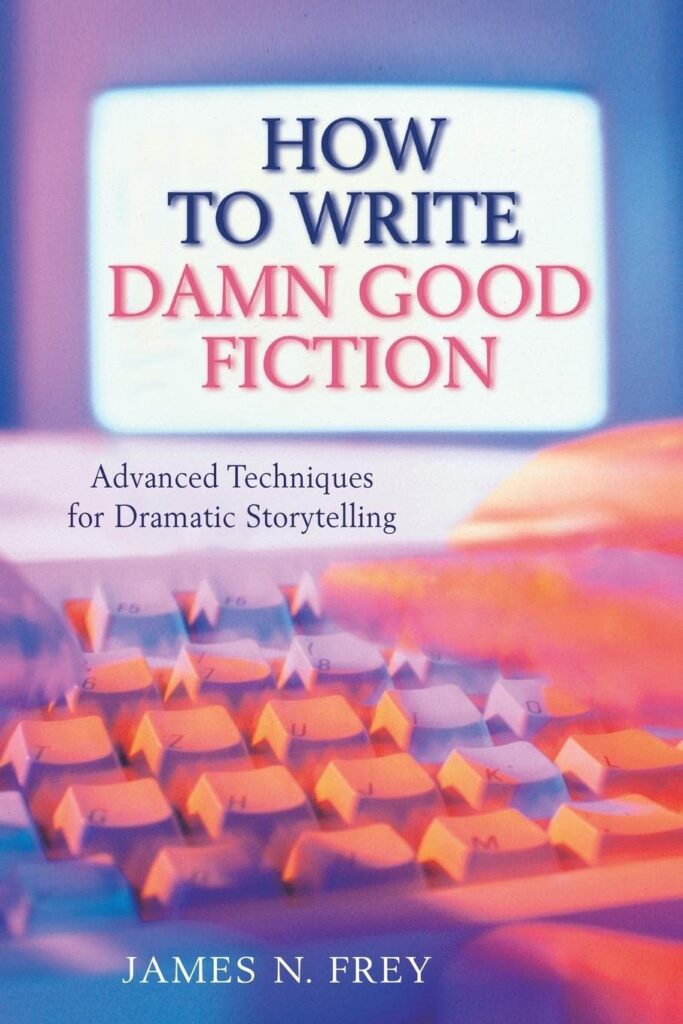
How to Write Damn Good Fiction by James Frey
Summary
James Frey’s How to Write a Damn Good Novel is both a craft manual and a passionate plea for dramatic, character-driven fiction. At its heart lies the conviction that stories are about conflict, transformation, and emotional truth. Frey insists on vivid, exaggerated characters who face crises that force them to change. He provides practical tools for constructing characters, shaping premises, and sustaining conflict through to climax. Above all, Frey argues that the writer’s job is not to lecture or impress, but to elicit empathy, hold the reader’s attention, and deliver a story that feels inevitable and just.
Key Insights
Core Structure: Every story rests on a pattern: Status quo → Dilemma → Crisis → Resolution.
Homo Fictus: Characters are larger than life. They must be dynamic, never passive, and defined through action.
Character Construction:
- Physiological traits (height, weight, appearance)
- Sociological traits (class, religion, politics, background, prejudices)
- Psychological traits (lust, envy, fear, ambition, superstition)
Conflict as Revelation: Conflict reveals character. Give each Character contrasting traits, weaknesses, and obstacles, plus goals that clash with others.
Crucibles: Keep the Characters in conflict by trapping them in situations they cannot escape (marriage, duty, family, army, prison).
Inner Conflict: Religion, culture, sexuality, race, obsession—internal battles deepen external ones.
Premise: A story must have one clear premise, stated succinctly, that defines how conflict transforms the Character. Example: Ruthless ambition brings glory and fame.
Empathy: The Reader must identify with and care about the Character as early as possible.
Dialogue: Always adversarial, indirect, and oblique. Dialogue is not about what is said, but what is meant—a struggle for ascendancy.
Process: Don’t edit while you draft. Use step-sheets to plan scenes. Avoid flashbacks unless indispensable. Use foreshadowing wisely.
Strengths
Provides a rigorous framework for building stories around character transformation through crisis.
The “Homo Fictus” model makes it easy to exaggerate traits and avoid flat, lifeless characters.
Clear on the centrality of conflict—both inner and outer—as the engine of drama.
The concept of the crucible is particularly useful for sustaining long-term tension.
Practical dialogue advice: make every exchange adversarial, indirect, and revealing.
Weaknesses
The insistence on exaggeration may feel overblown for writers drawn to subtle, understated realism.
His dismissal of flashbacks is sweeping; some stories require them.
The tone can verge on absolutist—his rules are useful but not universally binding.
James Frey’s Premise Template
Format:
Trait/quality/choice of Character → leads to Conflict → results in Transformation/Conclusion.
Steps:
- Identify the protagonist (C) and their ruling passion, flaw, or defining trait.
- State the central conflict (what drives the story forward).
- Show the outcome/lesson/transformation (how C changes, for better or worse).
Examples:
- Ruthless ambition brings glory and fame.
- Jealousy destroys both love and self.
- A hunger for revenge consumes the avenger more than the enemy.
Fill-in Template:
- [Trait/quality/flaw of C] → leads to [conflict/struggle] → results in [transformation/conclusion].
Reflections
I found Frey’s focus on conflict transformative. His idea that “conflict reveals character” pushes me to test my Characters relentlessly, giving them goals, weaknesses, and crucibles that prevent escape. I also value his emphasis on empathy; stories succeed only when Readers care about Characters.
The section on dialogue was eye-opening: adversarial, indirect exchanges are more potent than exposition-heavy chatter. I also value Frey’s concept of Homo Fictus, who is bigger, stronger, smarter; in short, everything the reader wishes they could be. At the same time, I may soften his principle of exaggeration. Not every character needs to be “larger than life”; sometimes quiet realism carries its own weight.
One golden nugget I took from this: always assume that I, the author, is the most stupid person in the room. Valuable advice.
Conclusion
How to Write a Damn Good Novel is a practical and passionate guide to crafting stories that transform characters through escalating conflict. Frey’s focus on premise, crucibles, and empathy makes the book an excellent resource for writers seeking clarity. Not every rule will suit every style, but Frey’s insistence on disciplined storytelling ensures that the reader is never forgotten and the novel never loses its drive.
Book Details
Title: How to Write Damn Good Fiction
Author: James Frey
Publication Year: 2018
Genre: Crearive writing
Reference: