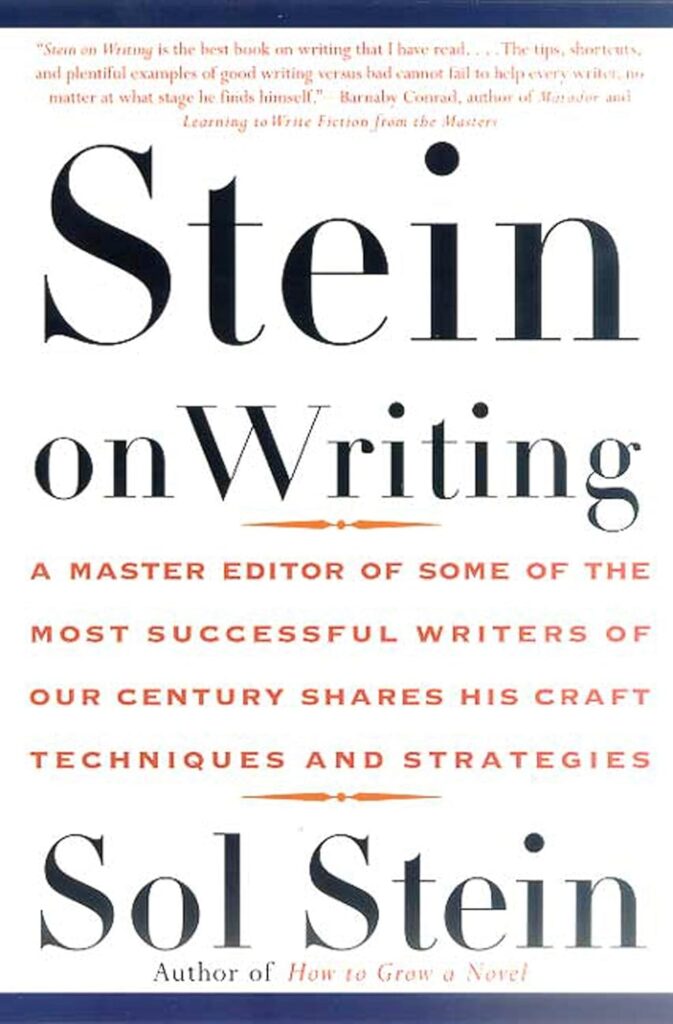
Stein on Writing by Sol Stein
Summary
Sol Stein’s On Writing is both a practical handbook and a call to arms for fiction writers. Unlike many guides that dwell on theory, Stein is relentlessly focused on craft—what actually keeps the reader turning pages. His central demand is that fiction must provoke emotion: it should not merely inform, but create in the reader an experience more intense than their own.
To achieve this, Stein insists on clarity, precision, and speed—every word must count, every scene must move. Characters must be extraordinary, flawed, and revealed through conflict. Above all, the writer’s task is to crack on, never slacken the pace, and always revise ruthlessly.
Key Insights
Goal of Fiction: Give the reader an experience superior to their own; provoke emotion, curiosity, and tension.
Clarity and Precision: Be clear, be precise, and test every word for necessity. No flab, no clichés, no verbosity.
Show, Don’t Tell: Don’t name emotions—show them through action (“her face flushed red,” “his hands shook on the cloth”).
First Impressions Matter: The opening sentence and paragraph must excite curiosity, establish character, and show action. Avoid neutral “laundry list” description.
Characterisation: Create extraordinary characters through action, contrast, mannerisms, eccentricity, and flaws. Every C must have immediate goals, strengths, weaknesses, and be revealed in conflict.
Conflict and Crucible: Protagonist and antagonist must want opposite things. Their clash must be life-changing, credible, and relentless. Keep them locked in a crucible so they cannot walk away.
Scenes: A scene is C in conflict, with a beginning and end. No action, no scene. Each scene should contain a surprise, clash, or strong emotion, and often end in suspense.
Dialogue: Must be adversarial, indirect, and oblique. Dialogue is never about information but about ascendancy. Every word must count; voices must be distinct.
Process: Plan → write → wait → review. First drafts are always weak; writing means rewriting. Leave the manuscript to “cool” before revision.
Style: Prefer strong nouns and verbs; adjectives and adverbs only if they change meaning. Short sentences and paragraphs for pace. Every page should contain a visual component.
Psychological Depth: Great fiction reveals secrets we’d rather hide. Probe private fears and shame; that’s what makes characters unforgettable.
Strengths
Laser-focused on the reader’s experience: emotion, curiosity, and tension.
Packed with practical, concrete techniques for scenes, dialogue, description, and characterisation.
Emphasises relentless revision and precision—no self-indulgence, no wasted words.
The idea of protagonist vs. antagonist scripts and crucibles are especially useful tools.
His emphasis on sensory detail (sight, sound, touch, smell) makes prose vivid and credible.
Weaknesses
Stein’s prescriptive style can feel severe; “always crack on” leaves little room for meditative or experimental fiction.
His hostility to adjectives/adverbs may be overstated—sometimes rhythm or style benefits from them.
The focus on speed and relentless tension may not suit all genres (e.g. literary fiction that thrives on stillness or reflection).
Reflections
What I value most in Stein is his insistence on clarity, precision, and emotional impact. He makes me test every word for necessity and strip away anything that slows the story. His checklist for opening paragraphs is especially useful, as is his discipline of showing emotions through action rather than naming them.
At the same time, his relentless drive for pace can feel almost militaristic. I appreciate the discipline, but I also see the value in moments of quiet realism. Still, I take his point: if a scene lacks conflict, it doesn’t belong.
Above all, Stein reminds me that the writer’s task is not to impress but to give the reader an unforgettable emotional experience—and that means being ruthless in revision.
Conclusion
On Writing is a masterclass in professional discipline and emotional precision. Stein’s advice is tough, uncompromising, and sometimes harsh, but it is also immensely practical. For any writer who wants to cut flab, sharpen prose, and hold the reader’s heart in their hands, this book is an invaluable guide.
Sol Stein’s Opening Paragraph Template
Excite Curiosity
- Does the first sentence raise a question in the reader’s mind?
- Is there something odd, startling, or unexpected?
Focus on Character
- Is the paragraph about an individual (not a landscape or weather report)?
- Does the protagonist want something badly, and is it shown immediately?
- Is the character threatened or under pressure?
Action & Sensory Detail
- What does the reader see?
- What does the reader hear?
- Is there action (not just motion)?
- Is there sound/noise/movement that brings the scene to life?
Avoid “Infiction” (info-dumping)
- Is background info withheld until it can be attached to emotion?
- Am I showing through character action rather than telling?
Tone & Resonance
Does the opening lend resonance to the larger story (hint at theme, conflict, or atmosphere)?
Example Fill-In (sketch):
- First line: [Insert something curious/startling]
- Character: [Name] wants [goal] but is [threatened by X].
- Sensory hooks: [Sound/visual/action included].
- Hint of theme/resonance: [Line that hints at the bigger story].
Book Details
Title: Stein on Writing: A Master Editor of Some of the Most Successful Writers of Our Century Shares His Craft Techniques and Strategies
Author: Sol Stein
Publication Year: 2000
Genre: Creative writing
Reference:
← Previous: Kiss that Frog by Brian Tracy