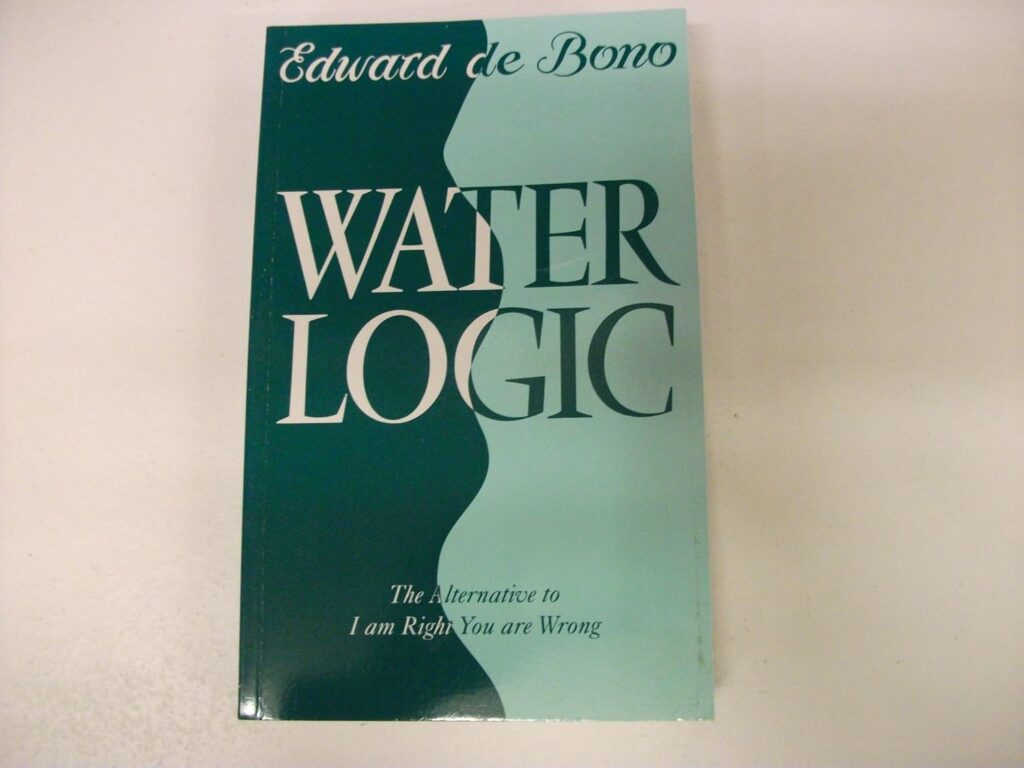
Water Logic by Edward de Bono
Summary
In Water Logic, Edward de Bono contrasts two modes of reasoning: rock logic and water logic. Rock logic is rigid, categorical, and focused on definitions (“what is”). Water logic, by contrast, is fluid, contextual, and focused on movement and consequences (“what does this lead to”). Instead of trying to force problems into fixed categories, de Bono encourages us to think in terms of flow, relationships, and outcomes — much like water finding its path to the sea.
Key Insights
Rock Logic vs Water Logic
- Rock logic: rooted in identity and definition. “A pen is an object with ink and a nib.”
- Water logic: rooted in outcomes and purposes. “A pen is something to write with.”
- Rock logic asks, “Is this true or false?”
- Water logic asks, “Where does this lead to?”
The Power of “Leto” Thinking
- De Bono coins the word “leto” (from “lead to”) to capture the habit of asking: “What does this thought, action, or policy lead to?”
- Repeatedly asking “what happens next?” helps uncover second-order and third-order consequences.
- Example: Instead of asking “Is this policy fair?”, water logic asks “If we adopt this policy, what flows from it over time?”
Perceptions and Myths
- A perception is real — even if wrong, it shapes behaviour.
- Example: one person sees a tank as national strength, another as oppression.
- When we lack answers, we often create myths to fill the gap. Water logic challenges us to track consequencesinstead of clinging to fixed myths or labels.
Application to Problems
- In business or personal crises, rather than asking “What is the problem?” (rock logic), water logic asks:
- “If sales are low, where does that lead?”
- “If money runs out, what happens next?”
- “If I change direction, what flows from that decision?”
- This creates a flowscape: mapping the ripple effects of choices, both good and bad.
Precision vs Flexibility
- Overly precise definitions can restrict creativity.
- “I need a match to light the fire” (too narrow).
- “I need a way to light the fire” (opens more possibilities).
- Water logic thrives on contextual adaptation rather than rigid categorisation.
Everyday Lessons
- We are better at recognising things than noticing them (as in Kim’s Game). Water logic sharpens our ability to notice relationships.
- Decision-making improves when we focus less on what things are and more on what they do and where they lead.
- Water logic is not about abandoning logic, but about making reasoning dynamic — allowing it to flow with reality instead of against it.
Strengths
Simple but powerful heuristic: the constant question “what happens next?” is both memorable and practical.
Contextual thinking: helps avoid rigid traps of binary reasoning.
Broad application: useful in business strategy, personal life, leadership, and problem-solving.
Weaknesses
Some repetition of ideas, typical of de Bono’s style.
The contrast with “rock logic” can feel oversimplified — categorical reasoning is not always unhelpful.
Practical exercises could have been expanded to help readers apply the concept more systematically.
Reflections
The most enduring lesson from Water Logic is the discipline of asking “what does this lead to?”. It turns problem-solving into a process of tracing flows rather than defending positions. I found this especially useful in thinking about policies, habits, or even conversations: instead of arguing whether something is “good” or “bad,” I can ask, “What will this choice set in motion tomorrow, next month, next year?”
Conclusion
Edward de Bono’s Water Logic reframes reasoning in a way that is at once simple and transformative. By shifting from rigid “is” thinking to fluid “to” thinking, we can better navigate complexity, anticipate consequences, and remain adaptable. While the book can meander at times, its central habit, asking “what happens next?”, is one of the most practical mental tools a thinker can carry.
Book Details
Title: Water Logic
Author: Edward de Bono
Publication Year: 1993
Genre: Psychology
Reference: Calandra 6
← Previous: The Psychology of Study by C. A. Mace