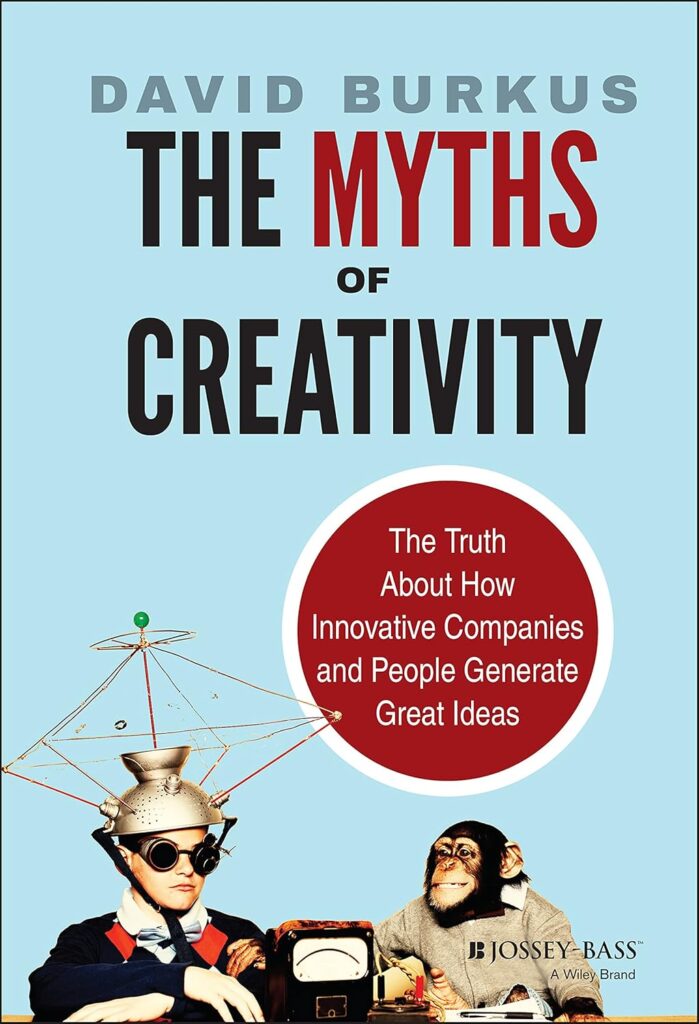
The Myths of Creativity by David Burkus
Summary
In The Myths of Creativity, David Burkus dismantles popular misconceptions about how creativity works. He argues that creativity is not a mystical gift bestowed on a chosen few, but the result of skills, motivation, and environment applied to problems over time. Through research, case studies, and historical examples, Burkus shows that breakthroughs emerge from preparation, collaboration, and persistence—not sudden flashes of inspiration or innate genius.
Key Insights
Debunking the Myths
- The Gift from the Gods Myth: Creativity is not divine inspiration but the ability to develop ideas that are both novel and useful.
- The Eureka Myth: Insights are rarely lightning bolts; they come from sustained effort, incubation, and switching perspectives. A walk or a break often unlocks “sudden” solutions.
- The Originality Myth: There is nothing entirely new—most inventions are adaptations or combinations of existing ideas.
- The Breed Myth: Creativity is not the preserve of special personality types. No gene determines it; anyone can develop creative capacity.
What Fuels Creativity
- Teresa Amabile’s four components: domain expertise, creative process, task motivation, and social environment.
- Deliberate practice: expertise matters, but can also constrain thinking—outsiders sometimes see solutions experts miss.
- The creative process: preparation, incubation, insight, evaluation, and elaboration.
- Personality: traits like openness and conscientiousness may help, but no profile guarantees creativity.
Conditions That Spark Innovation
- Combination evolution: new technologies often come from recombining existing ones.
- Constraints: limitations provoke ingenuity (e.g., “imagine I have no hands—how do I open the door?”).
- Diverse teams: the best results come from blending old colleagues with fresh voices. Over-familiarity stifles debate.
- Conflict done right: debate and criticism, framed constructively, generate stronger ideas than brainstorming alone.
Culture and Motivation
- Intrinsic motivation fosters creativity; extrinsic rewards often undermine it. Bonuses for “being creative” don’t work, though recognition and support do.
- Organisational practices: 3M’s 15% time, Twitter’s “hacker week,” or month-long independent projects create room for innovation.
- Edison and Mitchell: neither worked alone—innovation thrives in labs, teams, and collaborative settings.
Lessons from History
- Missed opportunities: Kodak invented the digital camera in 1975 but abandoned it; the US Navy ignored Percy Scott’s gunnery device until Roosevelt intervened.
- Bias against creativity: uncertainty makes us resistant to new ideas, even when evidence is clear.
- Incremental improvement: no idea is perfect—continuous refinement matters more than mythical breakthroughs.
Strengths
Demystifying creativity: Burkus replaces romantic myths with a practical, research-based framework.
Wide-ranging examples: from Edison’s lab to Twitter’s hack weeks, the book illustrates how creativity plays out in real organisations.
Team focus: emphasises collaboration and constructive conflict rather than lone genius.
Weaknesses
Some readers may find the book skims quickly across ideas without going deep into any single case.
The rejection of “big breakthroughs” can feel overstated; some inventions do hinge on singular moments, even if built on long preparation.
Reflections
I found the challenge to the “Eureka moment” myth particularly useful—creativity is less about waiting for inspiration than about working hard, switching gears, and letting the subconscious incubate. The reminder that constraints can provoke better solutions also stuck with me: rather than seeing limits as obstacles, I can frame them as opportunities.
The book also underlines the importance of resilience: Edison’s thousands of trials or Spitfire designer Mitchell’s team effort show that persistence and collaboration matter more than lone flashes of brilliance. Burkus leaves me convinced that creativity is not a talent bestowed on a few, but a discipline anyone can cultivate.
Conclusion
The Myths of Creativity reframes innovation as a systematic, collaborative, and disciplined process rather than a mysterious gift. By dismantling myths and highlighting practical drivers such as expertise, motivation, diverse teams, and constructive conflict, Burkus offers a hopeful message: creativity is not rare, but accessible to anyone willing to work, collaborate, and persist.
Book Details
Title: The Myths of Creativity
Author: David Burkus
Publication Year: 2013
Genre: Leadership
Reference: Calandra 6
← Previous: Fluent in Three Months by Benny Lewis