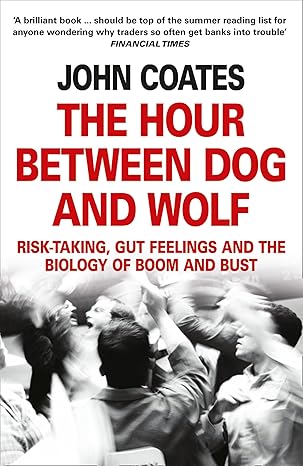
The Hour Between Dog and Wolf: Risk-Taking, Gut Feelings and the Biology of Boom and Bust by John Coates
Summary
A unique fusion of neuroscience, finance, and evolutionary biology, The Hour Between Dog and Wolf explores how the body and brain influence decision-making under stress, especially in high-risk environments like trading. J
ohn Coates, a former Wall Street trader turned neuroscientist, argues that financial markets are not just rational systems but intensely biological ones. Traders’ bodies, flooded with hormones like testosterone and cortisol, shape their confidence, risk appetite, and ultimately their performance.
Key Insights
Testosterone and Risk: High testosterone levels fuel risk-taking, confidence, and even recklessness—often tipping into what’s called Hubris Syndrome (overwhelming self-confidence, inattention to detail, contempt for others).
Gender and Risk: Women’s testosterone levels are only 15–20% of men’s, making them generally more risk-averse—a fact with profound implications for finance and leadership.
Hubris and Market Bubbles: Overconfident traders, inflated by rising markets and hormone surges, make reckless bets with poor risk-reward ratios (e.g., risking a house for £100). As Keynes said:
“Markets can remain irrational longer than investors can remain solvent.”
Biological Feedback Loops: The body influences the brain, not just the other way around. Movement, novelty, and environment all affect cognition and decision-making.
Stress Physiology:
- Cold water on the face can trigger natural painkillers.
- Controlled breathing stimulates the vagus nerve, calming the body.
- Exercise and exposure to cold improve mental health and immunity.
Mental Toughness: Begins with attitude—especially toward novelty. Those who welcome uncertainty are biologically better prepared to cope.
Neuroscience Nuggets:
- Otolith: organ that senses gravity—crucial for balance.
- Tunicate: a sea creature that eats its own brain once it stops moving (a metaphor for stagnation).
- Arborisation: growth of brain branches; a marker of learning and neural plasticity.
- Dopamine: released when learning something new.
Quirky but Fascinating:
- Ali threw 12 punches in 2 seconds—an example of instinctive reaction at its peak.
- Steroid use causes testicle shrinkage.
- The “Dumbbell defence” claims high testosterone as an excuse for aggression.
- Birth order matters—“second sons” are often more daring due to early-life competition.
- Even conception might be shaped by older siblings—my mother’s earlier pregnancies can leave hormonal traces.
The Illusion of Control: Feeling in control—even falsely—reduces stress and boosts performance.
Cognitive Fatigue: Rest isn’t always the cure—a change of task can be more effective.
Strengths
Blends hard science with human insight in a compelling, readable way.
Offers a rare biological lens on finance, decision-making, and leadership.
Encourages physical health, exercise, and autonomy as key to mental performance.
Weaknesses
Some claims, like birth order effects and hormonal memory, may require more empirical backing.
The neuroscience metaphors (e.g., tunicate brain-eating) may feel a bit stretched for some readers.
Reflections
This book reframes risk-taking not as purely rational but as deeply embodied. Hormones and stress shape every choice we make, and ignoring that fact, especially in high-stakes domains like trading or leadership, is perilous. The message is simple: to improve decision-making, take care of your body and understand your biology.
This idea echoes research showing that even judges, supposed arbiters of pure reason, are swayed by biology. One study found that the severity of sentences varied with the time of day: defendants appearing just after lunch fared better, while those unlucky enough to face a hungry judge before lunch received harsher punishments. Hunger and fatigue, not just legal principles, were shaping justice.
(See: “Extraneous factors in judicial decisions,” Proceedings of the National Academy of Sciences (2011))
Conclusion
The Hour Between Dog and Wolf is a rare book that bridges the gap between body and brain. Others have addressed this subject, but not in this detail. It’s valuable reading for those interested in the science behind decision-making under pressure, whether you’re on Wall Street or trying to make better choices in life.
And its title is fantastic.
Book Details
Title: The Hour Between Dog and Wolf: Risk-Taking, Gut Feelings and the Biology of Boom and Bust
Author: John Coates
Publication Year: 2012
Genre: Decision Making
← Previous: Making it All work by David Allen
Next → Motivation by Brian Tracy