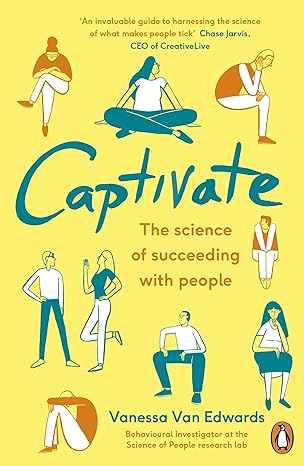
Captivate by Vanessa van Edwards
Summary
Why is it that some people can win trust and affection, whilst others struggle to connect or maintain relationships? Vanessa van Edwards addresses this question in Captivate. She aims to equip readers with the skills that they need to navigate social situations and to develop and maintain stronger relationships. Her central claim is that this skill, that of creating and maintaining friendships, is one that we can learn, and, using the techniques that Edwards describes, it can be mastered through practice
Key Insights
- First impressions matter
- We form judgments in two seconds: friend or foe, winner or loser, ally or enemy.
- Body language drives perception: posture, eye contact, and visible hands convey confidence and trustworthiness.
- A firm handshake releases oxytocin, fostering instant rapport.
- Positioning in social spaces
- Rooms divide into three zones: entrance, social zone, and side zones (bar, food, toilets).
- Connection thrives in the social zone, not on the sidelines.
- Stand at natural conversational “entry points” — such as the exit of a bar, where people look for someone to engage with.
- Conversation skills
- Avoid tired questions (“How are you?”); use “sparkers” that invite passion and novelty:
- What’s been the highlight of your day?
- Working on anything exciting?
- Got any good holidays planned?
- Unusual or specific requests (like asking for “37 pence”) are more memorable and effective than generic ones.
- Repeating someone’s name strengthens connection.
- Avoid tired questions (“How are you?”); use “sparkers” that invite passion and novelty:
- The psychology of influence
- The Pygmalion Effect: high expectations raise performance; low expectations (the Golem Effect) suppress it.
- Celebrate others’ successes; recognition is a powerful motivator in both personal and professional life.
- The “Franklin Effect”: people like us more when they’ve done us a small favour.
- Building rapport
- Authenticity beats faking enjoyment — people sense insincerity.
- To be interesting, be interested: active listening, curiosity, and shared interests foster closeness.
- Mirroring in dress, tone, and body language signals similarity and strengthens bonds.
- Stories, sensory detail (hot bread, coffee), and narratives make communication more engaging and memorable.
- Leadership and teamwork
- Frame tasks around skills, not duties: ask “Who is great at this?” rather than “Whose job is this?”
- Give autonomy and ownership to build emotional commitment.
- Use “because” to make requests more persuasive.
- Vulnerability and integrity
- Admitting mistakes humanises us and builds trust.
- Striving for perfection alienates others; authenticity draws them closer.
- Sharing secrets or asking advice deepens bonds.
- Toxic people drain energy; focus instead on those who make you feel valued.
- Underlying fears
- Much difficult behaviour stems from fear: of rejection, judgment, exclusion, or criticism.
- You can’t argue with feelings, but you can recognise and defuse the fear behind them.
Strengths
Clear, engaging writing style with practical, memorable techniques.
Rich mix of scientific studies, historical anecdotes, and everyday applications.
Particularly strong on conversation openers and non-verbal communication.
Encourages authenticity rather than manipulation.
Weaknesses
At times, the sheer number of tips can feel overwhelming.
Some strategies risk sounding formulaic if applied mechanically.
Focuses heavily on first impressions and networking, less on long-term relationships.
Reflections
Captivate balances science with humanity. Van Edwards insists that people skills can be learned, but also warns against faking connection. The consistent theme is that making others feel valued, appreciated, and understood is the surest way to succeed socially. Her emphasis on authenticity, curiosity, and celebration of others’ strengths echoes timeless wisdom: we reap what we sow in human connection.
However, if you are someone who doesn’t appreciate and value others, then, guess what – you will remain friendless.
Conclusion
Vanessa Van Edwards’ Captivate is a guide for those who want to thrive socially in whatever context. It demystifies charisma by showing that connection rests on small, learnable habits: posture, eye contact, listening, curiosity, and kindness. At its heart lies a simple truth: success with people is not about impressing them but about making them feel seen and valued.
Book Details
Title: Captivate: The Science of Succeeding with People
Author: Vanessa van Edwards
Publication Year: 2018
Genre: Communications
Reference: Calandra 6