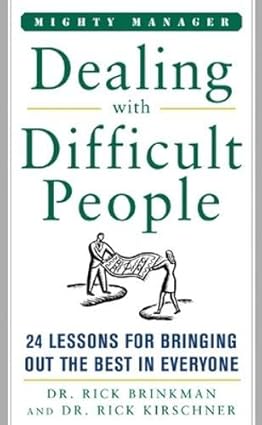
Difficult People by Rick Brinkman
Summary
Rick Brinkman’s Dealing With Difficult People offers a structured approach to understanding and managing disruptive behaviours in professional and personal settings. The goal is to bring out the best in others even when they are at their worst. Brinkman categorises difficult personalities into recognisable types, then provides practical strategies for responding without escalating conflict. The book balances “task focus” (getting things done) and “people focus” (building rapport), encouraging readers to adapt both attitude and behaviour to achieve better outcomes.
Key Insights
Core Goal: Aim to bring out the best in people, not “win” against them.
Difficult Personality Types:
- Tank: Believes ends justify means; forceful and controlling.
- Sniper: Undermines with covert jabs, sarcasm, or eye-rolling.
- Grenade: Sudden, disproportionate outbursts.
- Know-It-All: Genuinely competent but argumentative; exhausts others.
- Think-They-Know-It-All: Happy to bluff and mislead.
- Yes Person: Quick to agree, slow to deliver; avoids saying no.
- Maybe Person: Avoids decisions, blames others, shirks responsibility.
- Nothing Person: Withholds information; secretive.
- No Person: Pessimistic and discouraging.
- Whiner: Stuck in self-pity; drags others down.
Response Strategies:
- Say and do nothing (short-term only).
- Walk away when the cost of engagement is too high.
- Change your attitude — manage your emotional reaction.
- Change your behaviour to influence theirs.
Focus Types:
- Task Focus: “Get it done” (controlling) or “get it right” (perfectionism).
- People Focus: “Get along” (approval-seeking) or “get appreciation” (attention-seeking).
Communication Tools:
- Listen to understand.
- Backtrack: repeat the person’s words.
- Clarify: ask open-ended questions.
- Summarise and confirm.
- Seek to understand intent, not just words.
De-escalation Tactics:
- Repeat the person’s name calmly to slow them down.
- Set behavioural expectations (“Gentlemen, let’s…”).
- Postpone discussion until emotions are under control.
Handling Snipers:
- Bring their comments into the open.
- Use an amused, curious tone.
- Ask directly, “What do you mean by that?” or “Is there something you’d like to discuss with me?”
Strengths
- Provides a memorable classification system for difficult behaviours.
- Offers actionable scripts and tone guidelines for de-escalation.
- Balances behavioural change with self-awareness.
Weaknesses
Behaviour “types” are simplified and may overlap in real situations.
Some strategies require practice to execute without sounding confrontational.
Reflections
Brinkman’s framework is particularly useful for workplace conflicts, but it also applies in family, community, and customer service contexts. The emphasis on adapting your response, rather than trying to “fix” the other person, is both pragmatic and empowering.
Conclusion
A practical guide to recognising, understanding, and neutralising difficult behaviours. By combining awareness of personality patterns with disciplined communication, Brinkman equips readers to defuse conflict and maintain control of interactions without sacrificing respect or professionalism.
Book Details
Title: Difficult People
Author: Rick Brinkman
Publication Year: 2006
Genre: Training
Reference: Skylark vol. 3, p. 48
← Previous: Goals by Brian Tracy