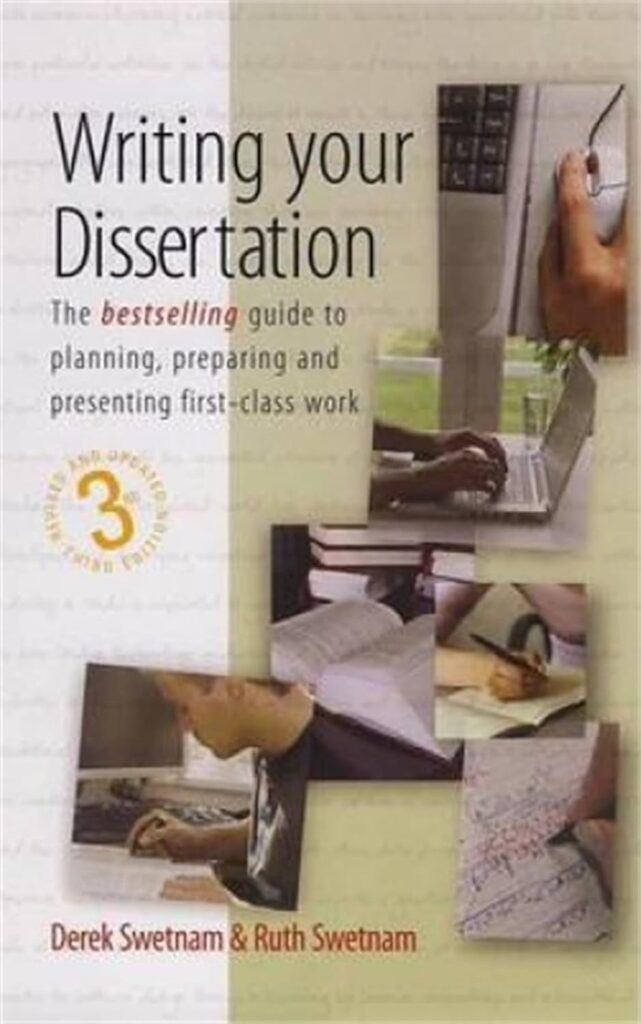
Dissertation by Derek Swetnam
Summary
Derek Swetnam’s Writing Your Dissertation is a practical guide for students facing the challenge of producing a dissertation. His approach is straightforward: ask a question, find the answer, and report it. The book outlines an ideal structure for dissertation writing, complete with percentage weightings for each section, from introduction to bibliography.
Swetnam provides step-by-step guidance on selecting a research topic, defining its scope, and avoiding vague aims. He emphasises clarity, relevance, and precision throughout, while also explaining the purpose of each section in academic writing. The book also addresses tone, advising writers to avoid humour or facetious remarks that may undermine professionalism.
Key Insights
Dissertation structure and weightings:
Introduction: 5%
Literature review: 35%
Research method: 10%
Data collection: 20%
Analysis: 15%
Conclusion & recommendations: 10%
Bibliography: 5%
Topic selection — Narrow from general to particular to precise; draft a working title early.
Clarity over vagueness — Use strong, active words such as *measure*, *evaluate*, *survey*, *assess*.
Purpose — Ask: What is the research for? What is its value? What will it add to the real world?
Literature review — Demonstrates reading, informs research, shows understanding of theory, and places the study in the historical debate.
Bibliography — Should be as complete as possible; correct referencing (e.g., *ibid.*, *op. cit.*) is essential.
Tone — Limit humour and casual remarks; maintain a professional style throughout.
Discipline — Plan, follow the structure, and ensure each section fulfils its purpose.
Strengths
Provides a clear structural blueprint with percentage allocations for each section.
Emphasises academic rigour, clarity, and relevance.
Explains the *why* behind each dissertation component, not just the *what*.
Offers practical guidance on narrowing a topic to a workable scope.
Weaknesses
Some sections are brief and could benefit from more real-world examples.
The referencing advice is traditional and may not fully reflect modern citation software practices.
The tone is very formal, which may feel rigid for readers looking for more creative approaches.
Reflections
Swetnam’s structured approach is invaluable for demystifying the dissertation process. The percentage allocations act as a built-in project plan, making it easier to balance time and effort across sections. His insistence on clarity of purpose, knowing exactly what the research is for and what it will add, helps keep the project relevant and focused.
The advice to avoid humour, while sounding severe, is well taken in the context of formal academic work. I also appreciate the emphasis on drafting a working title early, as it gives the project direction from the outset. Overall, the book balances strategic planning with practical execution tips.
Conclusion
Writing Your Dissertation is a concise yet comprehensive guide that gives students the confidence to approach their work systematically. Swetnam’s structure, clarity, and focus on purpose make it a valuable companion for anyone aiming to produce high-quality academic writing. By following his formula and maintaining discipline, writers can transform a daunting task into a manageable, well-organised project.
Book Details
Title: Writing Your Dissertation: The bestselling guide to planning, preparing and presenting first-class work
Author: Derek Swetnam
Publication Year: 2000
Genre: Communication and Presentation
Reference: Calandra Vol. 2, p. 66
← Previous: Drive By Daniel Pink
Next → Cringeworthy By Melissa Dahl