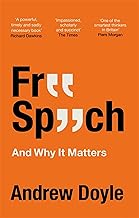
Free Speech by Andrew Doyle
Summary
Andrew Doyle is a learned cove, and that comes across in his book. Here, he delivers a concise and clear-headed defence of free speech. Doyle draws from history and philosophy to present a robust defence of the principles of free speech. He examines how freedom of expression is under threat from governments and cultural pressures. He describes the rise of self-censorship and the growing influence of tech platforms.
Doyle draws on the classics: John Stuart Mill and Thomas Paine. He quotes the US Constitution and the ACLU’s defence of unpopular speech. His central thesis is simple but uncompromising: free speech must protect all speech, including that which we personally find offensive, or it will protect nothing.
Key Insights
Historical grounding: From the 1789 French Declaration of the Rights of Man and the 1791 US First Amendment, through 20th-century totalitarian crackdowns, Doyle shows that restrictions on speech are an early warning of wider tyranny.
Principle over popularity: Thomas Paine’s 1795 warning still resonates — the precedents you set against your enemies will eventually be used against you.
Cultural vs. legal restraints: Choosing to be civil is different from being compelled to be civil under threat of punishment.
Status and conformity: We often self-censor not from principle but from fear of losing social status or acceptance.
Selective enforcement: “Hate incidents” are defined by perception rather than objective evidence, creating legal grey zones.
Moral cost of tolerance: In a truly free society, bad people will say bad things. We tolerate this not out of approval, but to preserve the principle that protects all voices.
Strengths
Compact and accessible — avoids jargon while engaging deeply with important issues.
Balances historical examples with modern-day controversies, keeping the argument grounded.
Shows how free speech is eroded culturally long before it is legislated away.
Willing to defend the rights of deeply unpopular voices, demonstrating intellectual consistency.
Weaknesses
Some readers may want a deeper dive into the legal frameworks surrounding speech in different countries.
The brevity, while a strength for accessibility, leaves some arguments less explored than they could be.
Reflections
Doyle’s work underlines a vital truth: you cannot have partial free speech. It either applies to everyone, particularly those whose views you find abhorrent, or it is no longer free. His examples of self-censorship driven by fear of social ostracism hit particularly hard in an era when online outrage can silence people as effectively as any law. The book is a brief but important reminder that the price of a free society is eternal vigilance, and that “guarding your enemies’ liberties” is often the surest way to safeguard your own.
“To guard your own liberties, guard your enemies’—because the precedents you set will be used against you.” — Thomas Paine
Conclusion
Free Speech: And Why It Matters is both a defence and a call to courage. It challenges us to resist the temptation to silence voices we dislike, because once the principle is breached, it will inevitably be used against us. As with Franklin’s maxim, an investment in knowledge pays the best interest, and in this case, that knowledge is an unflinching understanding of why the right to speak freely is the foundation of all other liberties. Crucially, free speech cannot be preserved by passive agreement alone; it must be actively and continually defended. If we do not take steps to uphold it, it will not simply remain; it will erode, quietly but inexorably.
Churchill said that courage was the greatest of virtues because without courage, none of the others could survive. He was right. It takes courage to resist those who try to silence dissent with outrage and indignation. And courage comes at a cost: people lose jobs, face complaints, even find themselves in court for trivial matters. For those with mortgages to pay and families to feed, the risk is all the greater. That is why it is so vital that others, less encumbered, find the courage to speak up in their place.
Book Details
Title: Free Speech And Why It Matters
Author: Andrew Doyle
Publication Year: 2022
Genre: Civil Rights
Reference: Calandra Lark 9, p. 51
← Previous: Super Thinking By Gabriel Weinberg