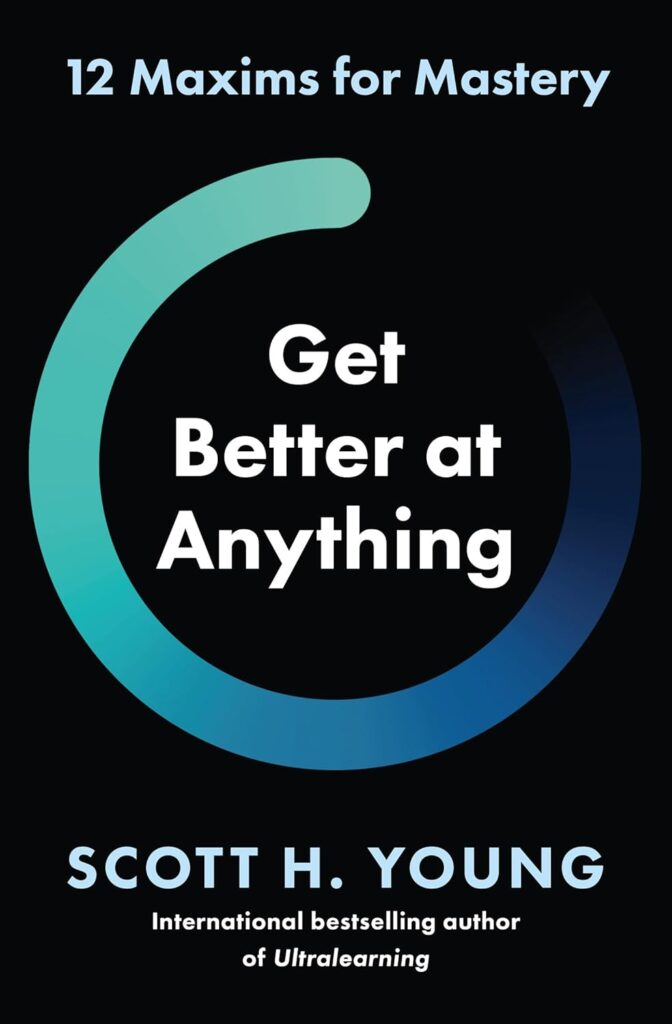
Get Better at Anything by Scott Young
Summary
There is a great deal in Scott Young’s Get Better at Anything: 12 Maxims for Mastery to get excited about. His book is a tour de force, ranging across imitation, deliberate practice, feedback, constraints, creativity, teamwork, and the psychology of motivation. Young writes with clarity and authority, avoiding the gimmicks and forced “success formulas” standard in the genre. Instead, he grounds his advice in research, case studies, and real-world examples from his own experience. His central message is clear: improvement is a process which comes from focused practice.
Key Insights
- Learning mechanisms: We learn by observation, imitation, doing, and receiving feedback. The larger the pool of examples, the faster we can improve.
- Retrieval over review: Active recall is more effective than passive re-reading.
- Deliberate practice: Don’t just repeat what you can already do — push beyond your current limits.
- Problem spaces: Define the initial state, goal state, constraints, and possible moves before solving a problem.
- Creativity through quantity: Good ideas emerge from producing many ideas; creativity is fuelled by expertise, environment, randomness, and experimentation.
- Avoid cognitive traps: Beware confirmation bias, functional fixedness, and the “curse of knowledge.”
- Constraints as tools: Deliberately limit resources or options to sharpen skills.
- Fear reduction: Gradual exposure is the best way to overcome anxiety and avoidance.
- Teamwork advantage: Diverse teams outperform lone geniuses; the “wisdom of crowds” is often more accurate than individual judgment.
- Self-efficacy: Confidence grows from small wins and targeted effort, and can vary across different skill areas.
Strengths
Credible and well-researched: The author clearly knows his subject and draws from both personal research and a wide base of scholarly work.
Practical and applicable: Each maxim is illustrated with examples, making it easy to connect to personal learning goals.
Avoids hype: No false promises or “shortcut” claims — Young is refreshingly honest about the hard work required.
Structured and clear: The principles build logically, with repetition used to reinforce core ideas without becoming tedious.
Weaknesses
Breadth over depth: While the maxims are well explained, some readers may wish for deeper exploration of individual concepts.
Less focus on emotional or motivational barriers: The book touches on fear and avoidance, but mostly from a behavioural standpoint, not exploring deeper psychological causes.
Reflections
This is not a contrived “life hack” manual but a grounded, thoughtful guide from someone who has done the work and understands the process of mastery. Young’s book is full of gems, details and stories that stick in the mind. For example, Francis Galton’s experiment where no individual guessed an ox’s weight correctly, but the crowd’s average was almost perfect; Major Robert Smith-Barry’s reorganisation of Royal Flying Corps pilot training, including the “Gosport tube” so instructors could speak to trainees mid-flight; and John Locke’s use of gradual exposure to treat animal phobias.
I found his emphasis on retrieval over review, constraints as tools, and the dangers of functional fixedness particularly relevant to my work as a writer and software developer. His discussion of self-efficacy also reminded me that confidence is domain-specific. I can be highly confident in one skill but hesitant in another. The call to combine different types of practices with quantity of output is a reminder that consistent experimentation beats perfectionism.
Conclusion
Get Better at Anything is a book worth reading. Scott Young distils the science and practice of skill development into actionable principles, without the fluff or contrivance found in many self-improvement titles. His own research and wide-ranging examples, from aviation training innovations to the wisdom of crowds, make the content engaging and credible. There are plenty of useful tips.
Book Details
Title: Get Better at Anything: 12 Maxims for Mastery
Author: Scott Young
Publication Year: 2024
Genre: Motivation
Reference: APA-04, 64
← Previous: Continuous Discovery Habits By Teresa Torres