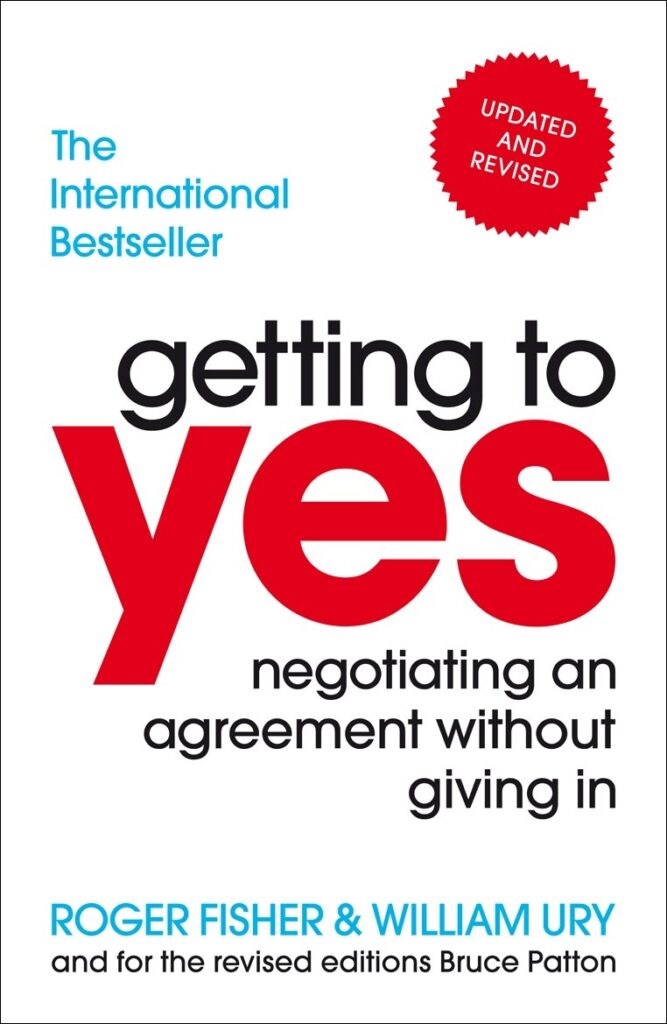
Getting to Yes by Roger Fisher
Summary
Getting to Yes is a landmark book on principled negotiation, advocating for agreements based not on entrenched positions but on underlying interests and objective criteria. Fisher and Ury argue that successful negotiation requires separating people from problems, focusing on mutual interests, generating creative options, and using fair standards to reach wise, efficient, and amicable outcomes. Rather than bargaining over fixed positions or yielding to pressure, principled negotiation seeks lasting solutions that preserve relationships and satisfy both sides.
Key Insights
Don’t bargain over positions: Positions entrench people and create needless conflict. Instead, dig beneath positions to identify the real interests at stake.
Separate people from problems: Negotiators are human beings first. Be tough on the problem but gentle on the people.
Focus on interests, not positions: Interests reveal motivations—e.g., wanting a window open (position) may reflect a deeper need for fresh air (interest).
Save face and preserve dignity: Allow the other party to back down gracefully; don’t humiliate or embarrass them.
Involve all parties: People accept decisions more readily when they help shape them.
Recognise emotions: Acknowledge and allow venting—only one person is allowed to be angry at a time.
Listen actively: Playback and clarify to show that the other party has been heard. Speak in terms of I (“I feel…”) rather than accusatory you statements.
Invent options for mutual gain: Avoid premature judgment, the search for one answer, or the assumption of a fixed pie. Keep idea generation and evaluation separate.
Use objective criteria: Agree on external standards—laws, market values, expert opinion—so outcomes are fair and principled rather than arbitrary.
Never yield to pressure: Yield only to reason. Bribes, threats, deadlines, and intransigence are pressure tactics, not principles.
BATNA (Best Alternative to a Negotiated Agreement): The cornerstone of negotiation strategy. Knowing your BATNA gives leverage and prevents bad agreements. Likewise, understand the other side’s BATNA.
Beware of tricks: Good cop/bad cop, low-ball offers, deliberate delays, psychological ploys, and anchoring tactics all undermine fair negotiation. The best defence is to call them out and reform the process.
Preparation is key: Most of the work happens before the meeting. Define your interests, know your BATNA, research objective criteria, and anticipate the other side’s motivations.
Review afterwards: Evaluate your own performance to improve for next time.
Strengths
Timeless framework: The four principles—separate people from problems, focus on interests, generate options, and use objective criteria—remain widely applicable across business, diplomacy, and daily life.
Clarity and practicality: The book provides memorable examples (the sisters dividing the orange, Malta vs. UK naval base negotiations) that illustrate principles vividly.
Balanced approach: It advocates toughness on substance without sacrificing relationships.
Weaknesses
Idealistic tone: While the framework is sound, it sometimes assumes both parties are rational and open to reason. In high-conflict or bad-faith contexts, this may not hold.
Light on cultural nuance: The guidance is rooted in Western negotiation styles and may not translate fully in all cultural settings.
Brief treatment of BATNA in practice: The book highlights the importance of BATNA but leaves readers to work out practical methods for developing and testing alternatives.
Reflections
I found the principle of focusing on interests, not positions, especially powerful. The orange story captures this perfectly: by uncovering interests, solutions multiply. The reminder not to humiliate the other side is equally important—saving face is often the difference between success and deadlock.
The idea that negotiations should be side by side, not face to face, struck me as profound. It reframes negotiation from an adversarial combat to a collaborative problem-solving approach. I also like the discipline of separating idea generation from evaluation, keeping the “black hat in its box” until after creativity has had room to flourish.
Perhaps the most enduring lesson is the BATNA concept. It sharpens clarity, prevents desperation, and gives strength to walk away when necessary. Combined with objective criteria, it ensures I do not agree to something I should reject.
Conclusion
Getting to Yes remains a classic because it distils negotiation into principles that are both humane and practical. By focusing on interests, respecting people, and grounding outcomes in fairness, negotiators can reach wise agreements without sacrificing relationships. While it may understate the challenges of dealing with bad faith, its core ideas, especially BATNA, are indispensable tools for anyone who negotiates, which is to say, everyone.
Book Details
Title: Getting to Yes: Negotiating an agreement without giving in
Author: Roger Fisher, William Ury
Publication Year: 2012
Genre: Negotiations
Reference: Skylark 6. p. 31
← Previous: Perfect Phrases by Susan Benjamin
Next → Hubris by David Owen