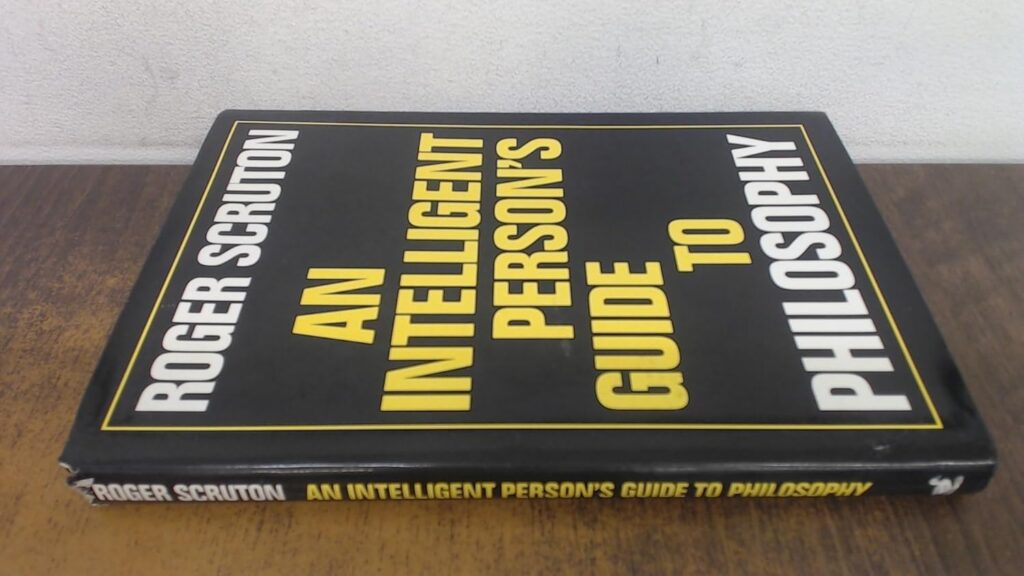
Guide to Philosophy by Roger Scruton
Summary
Roger Scruton’s An Intelligent Person’s Guide to Philosophy is a concise tour of the central questions and concepts of Western philosophy. Rather than offering a dry academic history, Scruton focuses on the live issues, truth, knowledge, freedom, justice, friendship, and the nature of reality, while showing how they relate to everyday human concerns. As one might expect, Scrutton quotes widely from Plato to Kant, Hume to Descartes. He distinguishes between explanation and justification, analytic and synthetic truth, and the limits of human reason.
Key Insights
Explanation vs. justification – An explanation can be true or false; a justification can be good or bad.
Ontological argument – St. Anselm’s claim that God must exist, for without Him, the universe would be inexplicable.
Epistemology – The study of how we know what we know, and what our statements mean.
Kant’s truths – Analytic truths (true by definition) vs. synthetic truths (true by virtue of reality).
A priori knowledge – Things known purely by reason, without appeal to experience.
Cartesian doubt – Descartes’ thought experiment that everything might be the work of a deceiving demon.
Freedom and responsibility – Hume’s idea that freedom requires the genuine possibility of acting otherwise; without freedom, responsibility collapses.
Justice and friendship – Justice demands retribution; friendship seeks reconciliation.
Moral sincerity – Proven not by words but by action.
Metaphysical distinctions – A sound is not a “thing” but an event—a change of state in a thing.
Strengths
Clarity without oversimplification – Scruton distils dense philosophical concepts into plain yet precise language.
Moral seriousness – The discussions link abstract reasoning with ethical and social life.
Wide-ranging but focused – Classical and modern thinkers are brought into conversation without losing the thread.
Weaknesses
Compressed treatment – Some topics are sketched so briefly that they may feel underdeveloped for readers new to philosophy.
Traditionalist bias – Scruton’s conservative leanings influence which thinkers and perspectives are emphasised.
Reflections
What I valued most was Scruton’s refusal to treat philosophy as a purely academic pursuit. His discussion of freedom, responsibility, and sincerity felt grounded in real moral life rather than abstract theorising. The distinction between explanation and justification is a useful mental tool, especially for clarifying arguments. I appreciated the way he linked metaphysical ideas, like the nature of sound, back to our lived experience. The brevity, however, left me wanting more depth.
Nevertheless, the book succeeds, at least partially, in sparking further curiosity. The problem for me is that, four weeks since I completed it, what memory stands out? There is no anecdote, no insight, not even a turn of phrase that I can recall.
Conclusion
An Intelligent Person’s Guide to Philosophy is a brief, engaging survey of philosophical thought aimed at readers who want substance without academic obscurity. Scruton’s clarity, moral focus, and respect for the tradition make it a reasonable starting point in the study of philosophy, even if his selective approach means some voices are left out. But there are better introductions available.
Scrutton’s work reminded me of Harry Sidebottom, the Oxford historian who turned to fiction with his Warrior of Rome series. The novels were, in my view, dreadful: the plots were staid, the characters lifeless, and I found myself unable to care what happened to them. It confirmed for me that being an accomplished historian does not necessarily make one a good communicator. The same applies to Scrutton. His book is no doubt academically sound, but it lacks flair. In one word: unmemorable.
Book Details
Title: An Intelligent Person’s Guide to Philosophy
Author: Roger Scruton
Publication Year: 1997
Genre: Philosophy
Reference: Calandra Lark 9, p. 61
← Previous: The Parasitic Mind By Gad Saed