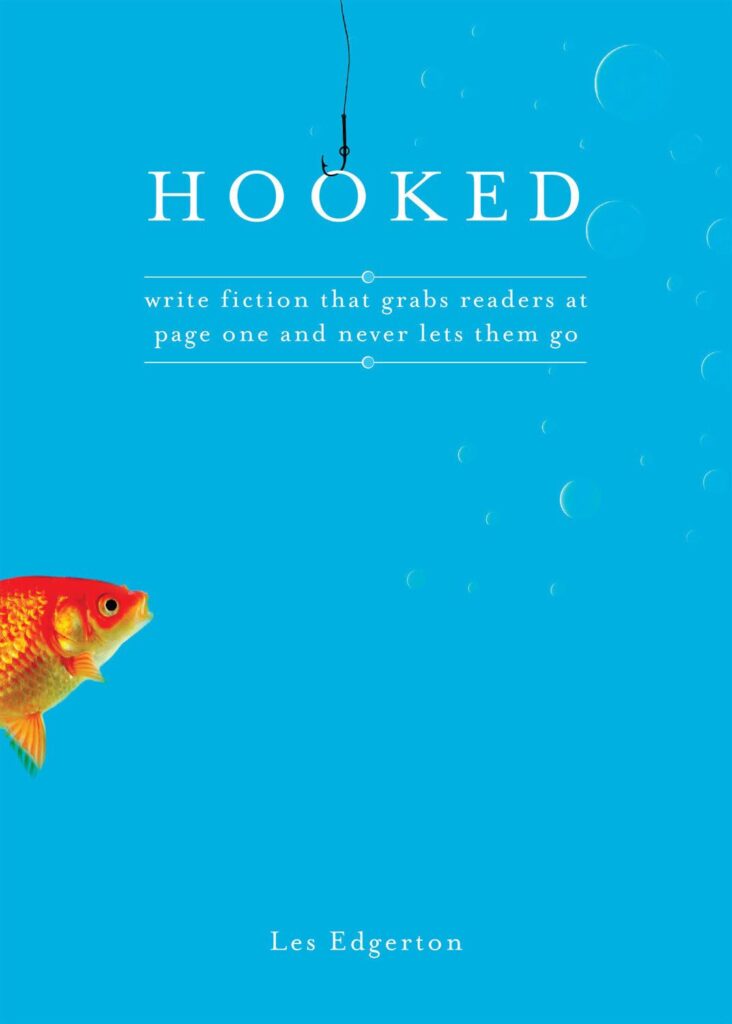
Hooked by Les Edgerton
Summary
Les Edgerton’s Hooked is a craft book with a laser focus: how to start your story so readers can’t put it down. It emphasises the importance of the inciting incident and the story-worthy problem , the deep, psychological issue that forces your character to change. Edgerton doesn’t want “window-pane” writing or trivial openings; he wants stories that grab us by the throat and refuse to let go.
Key Insights
Story cycle: stability → inciting event → struggle → new stability.
Inciting incident: must not be random or trivial. It should profoundly impact the protagonist psychologically and relate directly to the story.
Story-worthy problems: guilt, desire for reconciliation, need for approval, atonement, self-respect, belonging. These are personal, not abstract or global.
Conflict: Every scene is a struggle. Avoid melodrama; true drama is psychological.
Characters: Too many too soon confuses the reader. Establish the protagonist early and win the reader’s affection through action, not description.
Openings:
- Present a clear situation: who is who, what’s happening.
- Pose a question or promise trouble.
- End chapter one with the protagonist in worse trouble than at the start.
What to avoid:
- Dreams, alarm clocks, sunshine, birdsong.
- Overuse of adjectives/adverbs. Stick to strong verbs and concrete nouns.
- Bracketed asides and “window-pane” description.
Conflict of values: The most compelling stories pit two honourable goals against each other, not simply good vs. bad.
Emotion: The writer’s currency — without it, the story is dead.
Story-Worthy Problem Checklist Template
For every story I draft, I will test the protagonist’s core problem against the following:
1. Relevance & Depth
- Does the problem profoundly affect the protagonist psychologically (not just physically)?
- Does it force the protagonist to confront inner change?
- Is it rooted in personal stakes (family, guilt, belonging, approval, love, identity)?
2. Connection to the Story
- Does the problem directly relate to the inciting incident?
- Is it woven into the central theme of the story?
- Would the story fall apart without this problem at its core?
3. Conflict & Struggle
- Does the problem create continuous struggle for the protagonist?
- Does it escalate as the story progresses?
- Does it pit the protagonist against an equally strong force (antagonist or opposing goal)?
4. Unavoidability
- Is the protagonist unable to walk away from the problem?
- Is “doing nothing” impossible without dire consequences?
- Does the problem get worse if ignored?
5. Emotional Weight
- Does the problem provoke strong emotions (fear, guilt, longing, shame, love)?
- Will readers empathise with or relate to the struggle?
- Is the resolution meaningful — not neat success, but growth and change?
Strengths
Clear, uncompromising advice: cut flab, get to the point, don’t assume reader interest.
Deep focus on psychological stakes rather than surface action.
Practical lists of what to avoid in openings (dreams, alarm clocks, etc.) — instantly useful.
Weaknesses
Very focused on openings — less helpful on later stages of storytelling.
Can feel harshly prescriptive at times.
Reflections
What I take from Edgerton is that the true engine of story is the story-worthy problem—a profound disruption that forces the protagonist to change. Without it, no amount of craft will keep a reader engaged. I’m reminded of a novel I once picked up that opened with the line: “Today was the day he decided to commit murder.” The author clearly meant it as a hook, but it felt like a gimmick. Instead of drawing me in, it pushed me away. Edgerton’s warning resonates here: readers don’t want contrived drama, they want to be invited into a character’s genuine struggle. A story earns attention not with melodramatic tricks, but by showing us a problem that is psychologically urgent, deeply human, and impossible for the protagonist to avoid.
Conclusion
Hooked is a practical guide to beginnings that work. Edgerton reminds us that a novel lives or dies by its opening: the protagonist must face a story-worthy problem that resonates at the deepest psychological level. If I follow his principles, I’ll avoid the clichés of alarm clocks and sunshine, and instead craft openings that immediately promise struggle, conflict, and profound change.
Book Details
Title: Hooked: Write Fiction That Grabs Readers at Page One & Never Lets Them Go
Author: Les Edgerton
Publication Year: 2007
Genre: Creative writing
Reference: