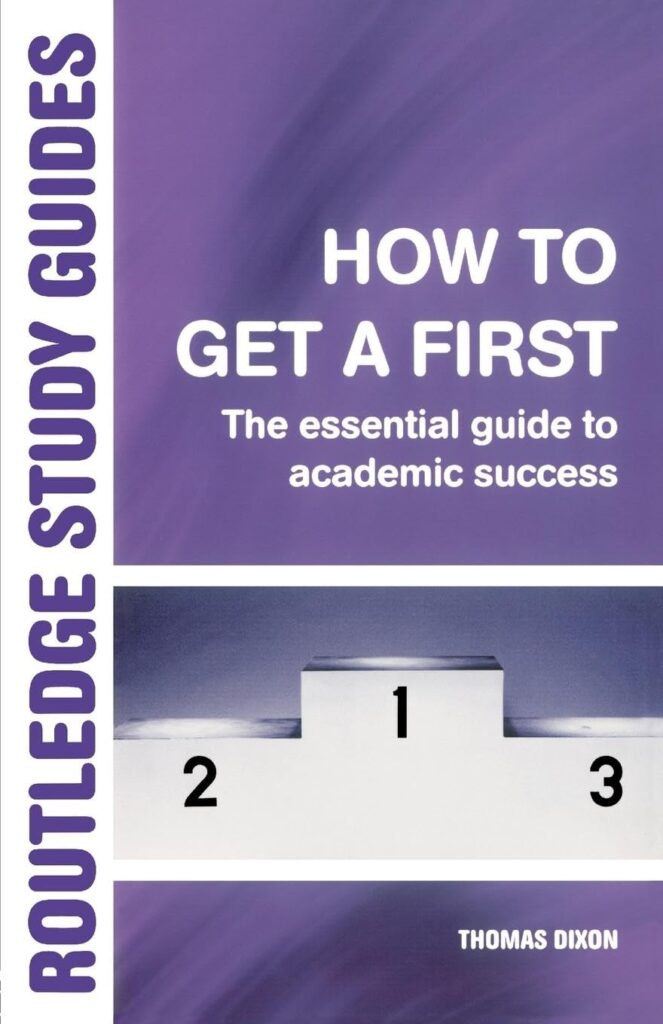
How To Get a First by Thomas Dixon
Summary
Thomas Dixon’s How to Get a First is a solid guide to getting a first. He believes that academic success depends on persuading through logical argument and relevant evidence. The student needs to prepare thoroughly, focus, and structure an argument that is both persuasive and well-informed. Dixon’s goal is to equip students with the tools and techniques to achieve this.
Key Insights
Persuade using logic and evidence — facts and examples matter more than opinions.
Preparation is key — plan your work, prepare for meetings, and break large tasks into smaller steps.
Focus entirely on the task at hand.
Characteristics of a good essay: correct grammar, elegance, conciseness, clear structure, thought-provoking content, well-informed analysis, persuasiveness, and logical flow.
Break down essay questions carefully, identifying scope, relationships, and assumptions.
Be selective when reading and taking notes — develop skim-reading skills (first/last paragraphs, first/last sentences).
Thinking is active — speak arguments aloud, explain them to an imaginary friend, and treat every essay as an argument.
Use language precisely — avoid “literally” unless literal, use “for example” instead of “e.g.”, avoid unnecessary commas before “however” and “nevertheless”.
Know key academic Latin terms: a priori, a posteriori, ibid., op. cit., ad hoc.
Strengths
Balances philosophical rigour with practical writing tips.
Covers both high-level academic strategy and detailed stylistic advice.
Clear and logically structured.
Weaknesses
Primarily aimed at humanities and essay-based disciplines; less directly applicable to technical subjects.
Some stylistic rules may feel overly prescriptive for experienced writers.
Reflections
Dixon’s emphasis on preparation and breaking down questions before writing matches my own experience. His points about selective reading and avoiding exhaustive note-taking on irrelevant material are notable. The essay checklist is an excellent pre-submission tool, and the language precision advice is a help to all writers who want to produce more disciplined prose.
Conclusion
How to Get a First highlights the skills and habits needed for top academic results in a clear, practical system. While Dixon’s intended audience is university students, its principles of preparation, critical thinking, and precision apply far beyond academia.
Book Details
Title: How to Get a First: The Essential Guide to Academic Success
Author: Thomas Dixon
Publication Year: 2004
Genre: Education
Reference: Skylark Vol. 5 p. 60