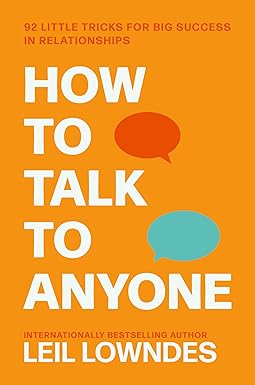
How to Talk to Anyone by Leil Lowndes
Summary
Leil Lowndes’ How to Talk to Anyone offers a practical collection of conversational and interpersonal techniques designed to improve our skills in conversation. Lowndes breaks down small, actionable changes that can make a big difference in how we talk to others.
Key Insights
Flooding smiles — greet others with a genuine, warm smile that reaches the eyes.
Good eye contact — maintain attention without staring, signalling interest and respect.
Pivoting — when speaking to someone, turn your whole body towards them to show full engagement.
Positivity is key — avoid complaining, rudeness, or unpleasantness.
Give more than bare answers — if asked “Where are you from?” don’t just reply “Birmingham,” but elaborate to encourage dialogue.
Encourage response — give the other person something to reply to and look for their interests.
Focus on the other person — actively listen and engage.
Parroting — repeat back a key phrase or word to show you’ve heard and understood.
On questions and answers:
Avoid asking “What do you do?”; instead, ask “How do you spend your time?”
Don’t give job titles as a bare reply — explain the benefit your work provides.
On compliments:
Vary compliments rather than repeating the same one.
Delay “me too” until the other person finishes speaking.
Compliment the person, not just the object (“You look good in that dress” rather than “I like your dress”).
On humour and gratitude:
Avoid jokes at another’s expense.
Express gratitude by specifying what you are thanking them for and why.
Strengths
Highly actionable — advice is specific and easy to implement immediately.
Covers both verbal and non-verbal communication.
Encourages a mindset of genuine curiosity and respect.
Weaknesses
Some tips feel a little formulaic if applied mechanically.
Readers looking for in-depth theory may find it overly focused on tactics.
Reflections
Many of these techniques overlap with good listening skills and the principle of making the other person feel valued. While not all suggestions will suit every cultural or social setting, the core emphasis on attentiveness, positivity, and personal warmth is universally beneficial. The idea of replacing job titles with benefit-focused responses is particularly useful in professional networking.
Conclusion
How to Talk to Anyone distils social success into practical, repeatable habits. While best applied with sincerity rather than as a checklist, its tips can quickly improve how we connect with others. A worthwhile read for those seeking to enhance both their personal and professional conversations.
Book Details
Title: How to Talk to Anyone: 92 Little Tricks For Big Success In Relationships
Author: Leil Lowndes
Publication Year: 2014
Genre: Business Life
Reference:
← Previous: Now Build A Great Business By Brian Tracy
Next → Drive By Daniel Pink