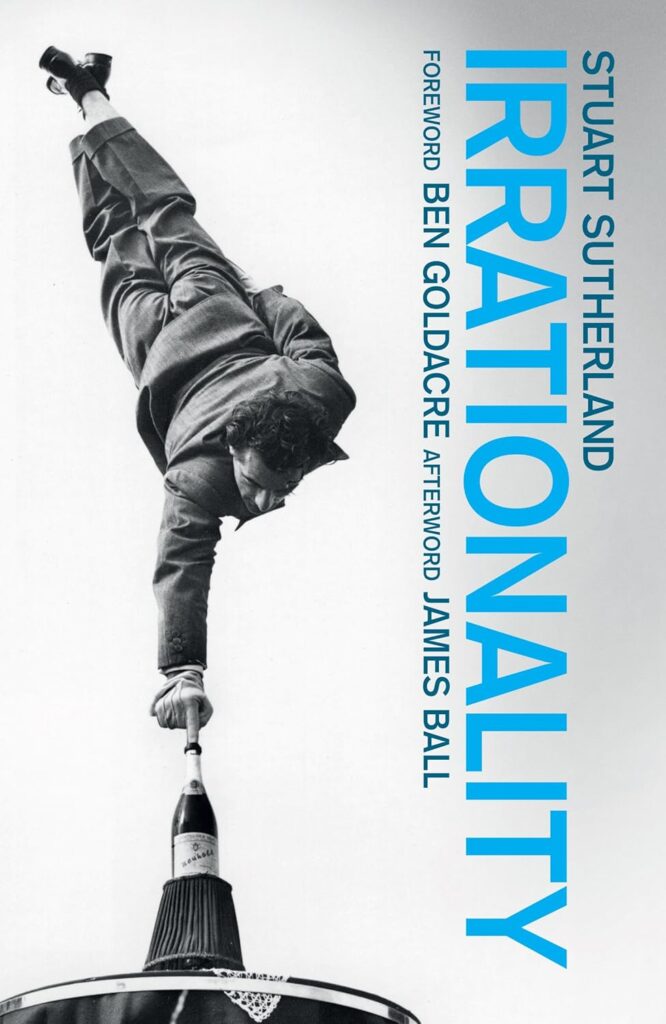
Irrationality: The Enemy Within by Stuart Sutherland
Summary
Sutherland argues that irrationality isn’t rare or exotic. It’s our default when we rush, rely on first impressions, or ignore base rates and statistics. He distinguishes rational thinking (choosing the most likely correct belief given the information) from rational action (choosing the action most likely to achieve the goal). Errors aren’t “irrational” by definition; honest mistakes happen, but patterns like availability, primacy, conformity, authority, sunk cost, attribution error, and bad probability intuition repeatedly derail us.
His prescription is practical: slow down, suspend judgment, seek missing information, separate issues, write pros/cons, and test disconfirming evidence. Motivation matters too: extrinsic carrots/sticks can backfire; autonomy and intrinsic pride in good work tend to win. Sutherland particularly advocates the Ben Franklin approach to problem-solving, and he is correct to do so.
Key Insights
What rationality is (and isn’t):
- Rational belief/action depend on the information available now; you must update as new facts arrive.
- A wrong outcome ≠ irrationality; the process can still be rational.
- If you lack crucial data, the rational move is to go get it.
Base rates & risk:
- Don’t answer “Which disease is likeliest?” without the baseline; relative risks (e.g., “10× cancer, 2× heart disease”) are meaningless without prevalence.
Availability & concreteness:
- We over-weight what is recent, emotional, dramatic, and concrete; the vivid case beats statistics.
- Story order and wording steer judgments (kidney-donor story boosts cooperation; “smashed” vs “hit” alters speed estimates).
Primacy & first impressions:
- Early cues anchor later interpretation; even adjective order reshapes perception.
- Invest in the first paragraph—people (and graders) over-reward early polish.
Bias in evaluation:
- Handwriting, names, prestige, and group labels skew judgments; never decide on a single case.
- Break complex assessments into separate questions to reduce halo effects.
Conformity, authority, diffusion:
- We obey and conform by habit, fear rejection, and commit more mayhem when anonymous.
- In groups, responsibility diffuses (bystander effect); more witnesses can mean less help.
Commitment, consistency, and sunk cost:
- Public commitments harden positions; foot-in-the-door works.
- Beware sunk cost—evaluate by current value, not past spend.
Motivation:
- For intrinsically enjoyable tasks, external rewards can undermine motivation; pride, autonomy, and persuasion outperform coercion.
- Offer choice; perceived control correlates with wellbeing.
Attribution error:
- We over-attribute actions to disposition (“what they’re like”) and under-weight situation.
Probability & statistics (our blind spot):
- People add probabilities that should be multiplied (conjunction fallacy: the “Linda” problem).
- Sample size matters; small samples mislead.
- Framing changes answers; write questions neutrally.
Decision hygiene:
- Suspend judgment; list pros/cons (Franklin).
- Seek disconfirming evidence (Bacon).
- Don’t decide in hot emotion; take time; think on paper.
Strengths
Breadth with concrete hooks: dozens of memorable biases and everyday examples you can test immediately.
Actionable guidance: repeatable tactics—seek base rates, separate dimensions, pros/cons, look for disconfirming evidence.
Clear definitions: helpful split between rational thought vs rational action.
Weaknesses
Dated cases & uneven claims: some examples (e.g., Kitty Genovese, older nutrition claims) are debated today; treat them as illustrative, not definitive.
Over-general prescriptions: lines like “never decide on intuition” are too absolute; informed intuition can be useful with expertise and feedback.
Group sections can blur moral/immoral with rational/irrational; keep those axes separate.
Reflections
There’s some good stuff here. The welcome reminder of Ben Franklin’s technique—write down the pros and cons, wait a few days, then decide—is always worth rereading. Sutherland distils the essence of Franklin’s method. First, think in writing. Don’t let thoughts swirl around in the brain; get them down in black and white. The act of writing clarifies thinking and exposes folly. Next, wait three days. This step is vital and too often overlooked. Oh, the folly of wanting to look “decisive.” Being decisive may signal strong leadership, perhaps, but not if you’re wrong. By waiting, we free ourselves from the emotions that so easily hinder judgment. Bravo to Sutherland for the timely reminder.
Conclusion
Sutherland’s Irrationality is a practical guide to common cognitive pitfalls and how to avoid them. A toolbox for noticing the traps we so often fall into. It’s long in the tooth, but so is Marcus Aurelius’ Meditations, and I’d still rather spend an hour with that than with much of the modern stuff.
Book Details
Title: Irrationality: the Enemy Within
Author: Stuart Sutherland
Publication Year: 1992
Genre: Psychology
Reference: Skylark 6. p 19