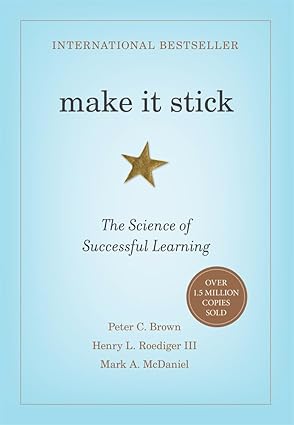
Make it Stick by Peter Brown
Summary
Peter Brown’s Make It Stick draws on decades of cognitive science to offer practical strategies for learning more effectively. The book challenges popular myths, such as the idea of fixed learning styles, and replaces them with evidence-based techniques like retrieval practice, spaced repetition, and interleaving.
Brown emphasises that learning is effortful: trying to solve problems before seeing the solution, making mistakes, and reflecting on experience all strengthen memory and understanding. The central message is that we learn best not through passive review, but by actively recalling, applying, and integrating knowledge over time.
Key Insights
Memory is the foundation of wisdom – Every act of recall strengthens the neural connections that support long-term learning.
Retrieval beats repetition – Rereading is far less effective than self-testing or quizzing.
Spaced practice – Revisiting material after intervals, especially with sleep in between, consolidates learning.
Interleaving – Mix study of different subjects or skills to improve adaptability and retention.
Generation effect – Attempting to solve a problem before learning the solution deepens understanding.
Reflection as retrieval – Writing about what went well, what went wrong, and what you learned cements lessons from experience.
Learning styles are a myth – Use multiple modes of engagement; variety strengthens understanding.
Mistakes are valuable – They are signs of effort and opportunities to improve, not evidence of failure.
Growth mindset – Intelligence is not fixed; grit and determination matter more than raw IQ.
Beware cognitive biases – False consensus, social contagion of memory, and the curse of knowledge distort both learning and recall.
Strengths
Evidence-based – Draws on solid cognitive psychology and neuroscience.
Practical application – Clear, actionable techniques like self-quizzing, interleaving, and generation.
Myth-busting – Challenges popular but unhelpful ideas about learning styles and passive review.
Weaknesses
Repetitive examples – Some key points (e.g., retrieval over rereading) are emphasised so often they risk redundancy
Light on deeper science – While accessible, the book sometimes glosses over the underlying research detail.
Reflections
I found Make It Stick to be one of the most practical and applicable books on learning I’ve read. The core idea that Brown argues is that in the field of learning, retrieval is king. This has shaped my study methods, especially through regular reflection in writing. I particularly liked the emphasis on “generation” and interleaving, both of which make learning harder in the short term but stronger in the long term. The reminder that mistakes are part of the process, and that hard work changes the brain, is a motivating counter to the now largely debunked concept of fixed intelligence.
For me, the core of Make It Stick is spaced retrieval—a principle I discovered for myself decades before reading Peter Brown. In the summer of 1978, after a poor first year in the sixth form, I decided to turn things around. For my History A-Level, I rewrote my notes from memory each morning on a blank sheet of paper. I repeated the process until I could reproduce each page perfectly. I even graded my recall as provisional, ready, or battle-worthy. By the end, I could summon the material at will and ended up doing well. That experience taught me, long before I knew the term, that retrieval strengthens memory far more effectively than rereading. Brown’s book confirmed what I had discovered myself so many years ago.
Conclusion
Make It Stick offers a clear, research-backed roadmap for more effective learning. By replacing passive review with active retrieval, spacing, and interleaving, readers can retain more and understand more deeply. Worth reading by anyone committed to lifelong learning.
Book Details
Title: Make It Stick: The Science of Successful Learning
Author: Peter Brown
Publication Year: 2014
Genre: Learning
Reference: APA-04, 20