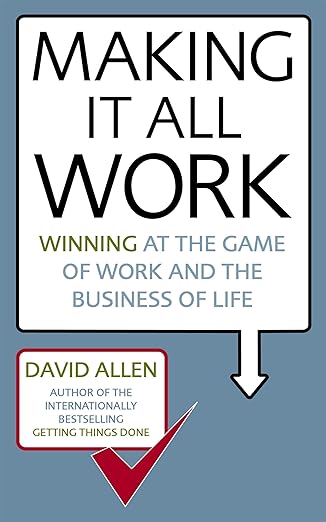
Making It All Work by David Allen
Summary
David Allen’s Making It All Work builds upon his foundational productivity method, Getting Things Done (GTD), but elevates it into a complete philosophy for personal and professional clarity. This isn’t just about getting organised, it’s about taking control of your commitments, goals, and focus, so you can create the life you want with purpose and direction.
Allen argues that our productivity and stress levels are determined less by time constraints and more by how clearly we define our commitments. Managing actions, not time, is the central discipline. The book blends practical workflow strategies with a mindset shift: clarity and definition give control, while vague commitments drain mental energy.
Key Insights
Clear Your Mind: Your brain is for having ideas, not holding them. Offload everything into a trusted system to reduce stress and free up mental space.
GTD Basics:
- Capture all obligations.
- Define the next concrete step for each.
- Organise by context (e.g., office, phone, errands).
- Regularly review and maintain your system.
Inventory of “Stuff”: Anything that grabs your attention—“stuff”—should be inventoried, clarified (“What is it?”), and evaluated (“Is it worth doing?”).
The Power of Action: Vague tasks like “deal with Dad’s situation” create stress. Instead, identify a tangible action like “call Aunty and ask about Dad.”
The Next Action Question: Ask: “What has to happen first?” or “What does doing it look like?” Being specific gives control.
Mind Sweep: A complete brain-dump of all concerns, commitments, and distractions. Identify and process each one.
Focus and Control: Focus isn’t about being organised—it’s about reducing internal noise. Most distractions come from mismanaged commitments.
Horizons of Focus:
- Purpose
- Vision
- Goals (reviewed quarterly)
- Areas of focus
- Projects
- Actions
Context Matters: Match your next action to your environment. At a desk? Write. In a car? Listen to a podcast.
Work–Life Myth: Work is part of life, not separate from it. You can’t dodge your responsibilities without facing the consequences.
The Future Is Built Now: Goals are only useful if they change your behaviour in the present. A goal without present action is wishful thinking.
Clarity Feels Good: Your brain relaxes when it knows what it’s doing. Getting clear on your commitments is a form of mental health.
Strengths
Translates productivity into purpose and identity.
Offers a deep philosophical grounding for GTD principles.
Extremely practical while still being reflective and life-oriented.
Weaknesses
Repeats material from Getting Things Done, so readers familiar with GTD may find parts redundant.
Some concepts (like “Horizons of Focus”) can feel abstract without real-world examples.
Reflections
This book is a bridge between task management and life design. It shows that stress isn’t caused by too much to do, but by unclear commitments. Allen reframes productivity as the art of clear thinking, not just list-making.
The quote from Winston Churchill captures the spirit:
“The first 25 years of my life, I wanted freedom. The next 25 years, I wanted order. Then I realised that order is freedom.”
Conclusion
Making It All Work is not just about getting things done—it’s about getting the right things done in a way that aligns with your deepest values and goals—a powerful read for anyone seeking clarity, focus, and meaningful progress.
Book Details
Title: Making It All Work
Author: David Allen
Publication Year: 2008
Genre: Business Life