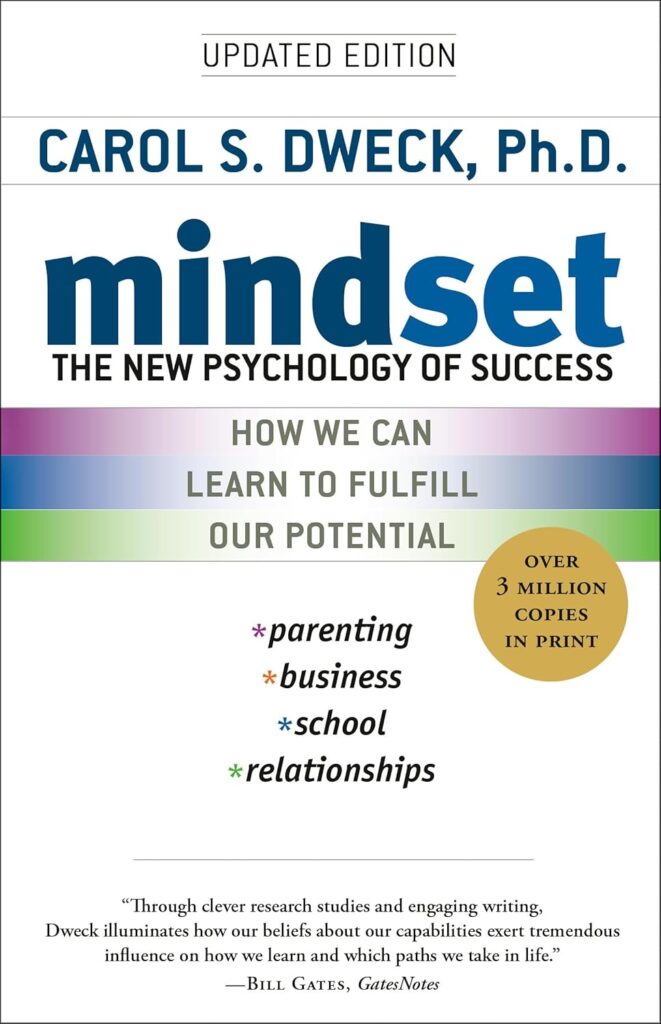
Mindset: The New Psychology of Success by Carol Dweck
Summary
Carol Dweck’s Mindset introduces the powerful distinction between a fixed mindset, the belief that ability and intelligence are static, and a growth mindset, the belief that skills and intelligence can be developed through conscious effort. Dweck argues that mindset shapes success in all areas of life.
The book illustrates how we can build growth-oriented environments by praising effort and persistence, and viewing failure as a learning opportunity, and, importantly, not a source of shame.
Now and then, an important book comes along. This is one of them.
Key Insights
Fixed vs. Growth: Fixed-mindset individuals see failure as a verdict on their identity (“I failed, therefore I am a failure”), while growth-mindset individuals see failure as feedback and an opportunity to improve.
Effort and Learning: Fixed-mindset people believe effort signals a lack of talent; growth-mindset people see effort as the path to mastery.
Praise Matters: Praising children for being “brilliant” fosters fragility. Praising effort, strategies, and persistence encourages resilience.
Identity vs. Action: Dangerous to let actions define identity. Spilling nails isn’t “I’m clumsy,” but “I spilled nails; I will pick them up.”
Leadership: Successful leaders admit mistakes, seek dissenting voices (as Churchill did), and value people smarter than themselves (Carnegie).
Relationships: Fixed mindsets expect perfection and are crushed by rejection. Growth mindsets accept challenges, work at relationships, and avoid humiliation from setbacks.
Practical Habits: Concrete plans work best (“I will do it tomorrow at 10 AM” vs. “I’ll do it tomorrow”). Success requires where/when/how tactics.
Self-Competition: True growth is measured against yourself—becoming the “best me,” not simply “the best.”
Trained, Not Innate: There is no innate “strong will” or “good memory.” Willpower and memory are trained, just like muscles.
Strengths
Clear, memorable core concept: fixed vs. growth mindset.
Wide-ranging application across school, business, sports, and relationships.
Practical strategies: praise effort, set concrete plans, learn tactics, embrace feedback.
Strong storytelling, with examples ranging from Andrew Carnegie to Winston Churchill.
Weaknesses
Sometimes oversimplifies complex human behaviour into fixed/growth categories.
Can feel repetitive, with many anecdotes reinforcing the same point.
Less detail on the limits of growth mindset (e.g., biological or structural constraints).
The concept has since been popularised to the point of cliché, reducing its impact.
Reflections
As a not-particularly-clever ten-year-old, I remember being told that IQ was fixed and that nothing could be done about it. That was it: I was destined to remain in the “slow boys” group forever. It took decades to shake off this dreadful misconception. What puzzled me even then was this: if I was so stupid, why was I so good at chess? The first real crack in the edifice came years later, when I read research on London taxi drivers. Their brains showed physical changes after mastering the Knowledge, the encyclopedic map of London’s streets. That was the revelation: our brains aren’t fixed. They can grow.
Then came Dweck’s marvellous book. IQ isn’t fixed. We can learn, and we can improve our thinking. Character outweighs talent. And character, in this sense, means persistence, the determination not to give up. It is resilience. It is humility: recognising that I do make mistakes, accepting them, and using every one as an opportunity to learn and improve.
For me, one of the great things about Dweck’s message is that there is nothing shameful about making a mistake. I grew up in a time when teachers seemed to believe humiliation was a form of discipline. Getting an answer wrong in class wasn’t just an error; it was an excuse for mockery. Small wonder that so many of us learned to fear mistakes rather than see them as opportunities to grow.
I use the word message deliberately. Mindset is not an abstract academic study, weighed down with jargon and footnotes. It is more like a sermon; it is a clear and urgent call to change the way we see ourselves and others. Dweck writes with the conviction of someone who knows that real harm is being done in classrooms and homes whenever children are shamed for their mistakes. Her urgency comes from wanting that harm to stop, and from showing us a better way forward.
For anyone who grew up under the tyranny of a fixed mindset, the belief that these are the cards you have been dealt, so get to the back of the queue, this book is a godsend. It offers freedom from that sentence. It says that we are not stuck in the “slow group,” or forever defined by a careless mistake. Dweck’s message is that character matters more than talent: persistence, resilience, and the humility to admit error and learn from it. For me, reading Mindset was like being released from the fetters of childhood into the possibility of growth. It is a message of hope, and one that I wish I had heard much earlier in life.
Conclusion
Mindset is a modern classic of psychology and self-improvement. It shatters the myth of genetic inevitability and shows that what we believe about our abilities shapes how far we go. At its heart is a simple but transformative conviction: we can always improve.
Book Details
Title: Mindset: The New Psychology of Success
Author: Carol Dweck
Publication Year: 2007
Genre: Psychology
Reference: Skylark 6, p. 1
← Previous: Learning how to learn By Joseph Navok